
Fast-growing vines for Arizona fences include queen’s wreath, cat’s claw vine and bougainvillea, each able to fill several feet of fence in one warm season. Match the vine to your fence type, plant in spring, and water deeply.
Key takeaways
- Queen’s wreath, cat’s claw vine and bougainvillea are among the fastest options, often adding many feet of growth in their first warm season.
- Chain-link and wire fences suit tendril and twining vines, while flat block walls need horizontal wire spaced about 12 inches apart.
- Plant after the last frost, from about March to May, or in October so roots settle before winter.
- Dig the planting hole 12 to 18 inches from the fence, break through any caliche, and mulch 2 to 3 inches deep.
- Cat’s claw vine and bougainvillea need the most pruning, so plan a cutback in late winter once frost risk has passed.
Which fast-growing vines cover an Arizona fence best?
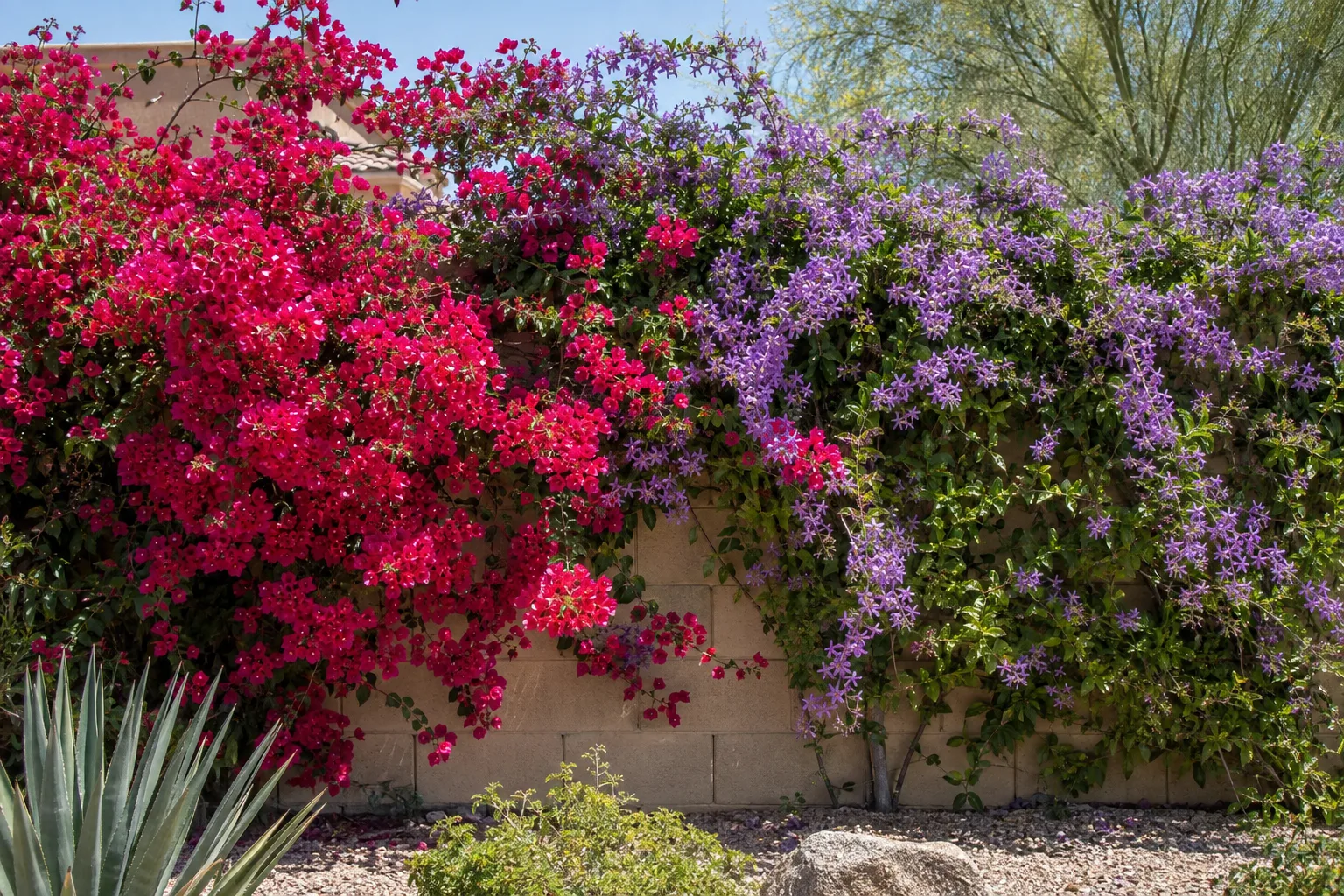
Queen’s wreath, cat’s claw vine and bougainvillea cover ground fastest, while Lady Banks’ rose, canyon grape and blue sky vine suit more specific spots. These are varieties we commonly carry, though availability changes from week to week and season to season, so browse our plant department to see what is ready to plant. Each has one drawback worth knowing. Sizes below are typical mature ranges for the low desert.
Queen’s wreath (Antigonon leptopus)
Mature size: stems commonly reach 15 to 20 feet once established. Sun: full sun. Water: drought tolerant after the first year, though regular deep watering in summer produces more of its pink flower sprays from late spring into fall. Drawback: it dies to the ground in frost, leaving the fence bare in winter, and it can seed itself into nearby beds.
Cat’s claw vine (Macfadyena unguis-cati)
Mature size: 20 feet or more in height, spreading wide if left alone. Sun: full sun to part shade. Water: moderate, and tolerant of dry spells once established. It grips flat masonry on its own with small hooked tendrils and carries yellow trumpet flowers in spring. Drawback: it is very aggressive, works into mortar joints and cracks, and is hard to remove, so it needs firm pruning every year.
Bougainvillea (Bougainvillea spp.)
Mature size: 10 to 20 feet when tied to a support, depending on the variety. Sun: full sun, with reflected heat from a wall suiting it well. Water: deep soaks with the soil allowed to dry between them. Colorful bracts appear in magenta, orange, red, white and yellow. Drawback: it has thorns, and a freezing night can burn leaves and tips, so cover it when frost is forecast.
Lady Banks’ rose (Rosa banksiae)
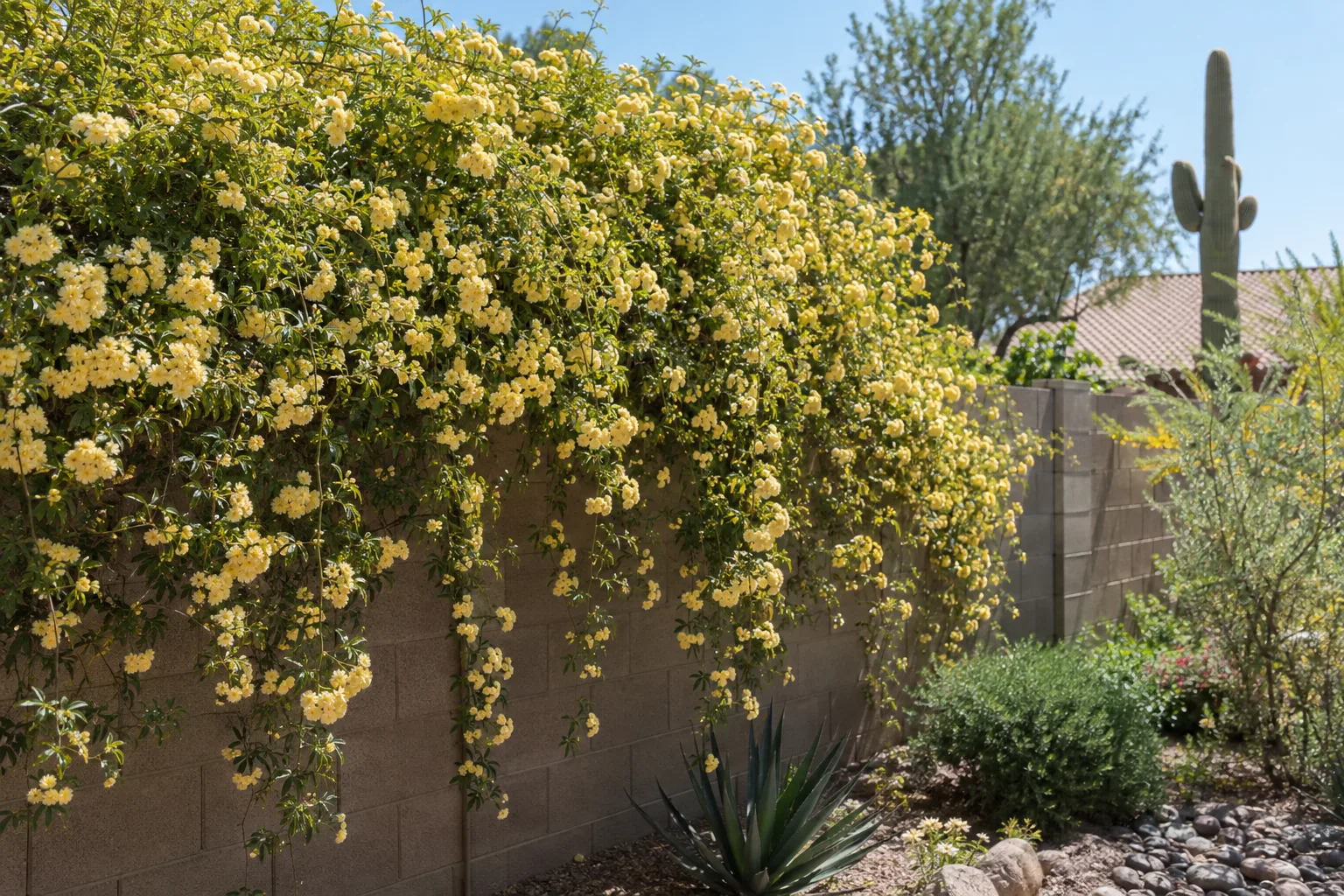
Mature size: long canes that reach 15 to 20 feet. Sun: morning sun with afternoon shade in the hottest exposures. Water: regular deep watering. It carries masses of small yellow or white blooms in early spring and is usually thornless or nearly so. Drawback: it blooms once, for a few weeks, and the canes need to be tied to a support because they do not cling.
Canyon grape (Vitis arizonica)
Mature size: 15 to 25 feet on a wire or chain-link support. Sun: full sun to part shade. Water: low once established, with growth often flushing during the monsoon. This Arizona native has small, tart grapes that birds eat and leaves that color in fall. Drawback: it drops its leaves in winter, and its tendrils need thin wire to grip.
Blue sky vine (Thunbergia grandiflora)
Mature size: 15 to 20 feet. Sun: afternoon shade suits it best here. Water: regular, since it is not a dry-garden vine. It twines through wire and bears large sky-blue flowers from summer into fall. Drawback: frost sends it back to the ground, and it can scorch on a bare west-facing wall.
How do I match a vine to my fence or block wall?
Match the way the vine climbs to what the fence offers. Chain-link and welded wire give tendril and twining vines plenty to grip, so queen’s wreath, canyon grape and blue sky vine need little help there. A flat block wall gives them nothing. Run horizontal galvanized or stainless wire about 12 inches apart on masonry anchors, and hold it 2 to 3 inches off the surface so stems can wrap behind it.
Cat’s claw vine is the one that clings directly to a wall. Its hooked tendrils leave marks and pull at mortar when removed, so choose it only for a wall you are willing to live with for years.
| Vine | How it climbs | In winter | Best exposure |
|---|---|---|---|
| Queen’s wreath | Tendrils on wire or mesh | Dies back in frost | Full sun |
| Cat’s claw vine | Hooked tendrils on masonry | Semi-evergreen | Full sun to part shade |
| Bougainvillea | Needs tying, thorns catch | Evergreen in mild winters, frost burns tips | Full sun |
| Lady Banks’ rose | Long canes, needs tying | Evergreen to semi-evergreen | Morning sun, afternoon shade |
| Canyon grape | Tendrils on thin wire | Bare until spring | Full sun to part shade |
| Blue sky vine | Twining stems | Dies back in frost | Afternoon shade |
When should I plant a fence vine in the low desert?
Plant after the last frost, from about March to May, or in October. Warm-season vines such as queen’s wreath and bougainvillea sit still in cold soil, so wait until nights have warmed before you set them out. Fall planting gives roots a few mild months to spread before winter, and the vine then starts spring with a head start. Summer planting is possible but risky. Highs above 110°F in June through August stress new roots faster than they can grow. Our gardening calendars show what to plant and do each month.
How do I plant a vine against a fence?
Install the support first, then plant 12 to 18 inches out from the fence so roots are not crowded against the footing. The steps are the same for every vine on this list.
- Fix wire to masonry anchors, or confirm the chain-link is tight and the posts are solid.
- Dig a hole two to three times as wide as the root ball and no deeper than it.
- Break through any caliche in the bottom so water can drain.
- Backfill with your native soil, mixed with a modest amount of compost if you like, and avoid filling the hole with pure potting mix.
- Water deeply to settle the soil, then build a low earthen basin around the plant.
- Spread 2 to 3 inches of mulch, keeping it a few inches from the stems.
- Tie the first shoots to the support with soft ties.

Caliche is the usual culprit when water pools in a new hole. If it drains slowly overnight, dig deeper or break the layer wider, because a vine sitting in a bowl of standing water will decline whatever its heat tolerance. New vines need frequent watering for the first few weeks, then you can stretch the interval as roots reach into the surrounding soil.
How much water does a fence vine need?
Established vines need deep, infrequent watering, with the schedule rising in summer and falling in winter. A drip line with emitters set 12 inches from the base wets the root zone without soaking the wall. Shallow daily sprinkling builds shallow roots. In the hottest months, many vines on this list want a deep soak every few days to once a week, while winter may need one every two to three weeks, depending on rain and soil.
Feed actively growing vines with a balanced slow-release fertilizer in spring and early summer. Bougainvillea is the exception, since extra nitrogen pushes leaves at the expense of color. Stop feeding by about October so tender new growth does not meet a frost.
How do I prune and train a vine for full coverage?
Pinch the growing tip of long shoots and tie new growth sideways to the support. Each pinched tip sends out two or three side shoots, which fill the lower part of the fence that fast vines tend to leave bare and woody. Do this weekly in the first season. It takes a few minutes.
Prune hard in late winter once frost risk has passed, usually late February to March, taking overgrown vines back by half or more. Prune Lady Banks’ rose right after its spring bloom, because it flowers on last year’s canes. Avoid heavy cuts in July and August, when exposed stems can sunburn. For hands-on pruning demonstrations, see our classes and events page.

Which vines should I skip on a sun-baked fence?
English ivy is the first to skip, since it struggles through low desert summers even with extra water. Wisteria can grow here but needs generous irrigation and often blooms sparsely in alkaline soil, so it is a risky choice for a hot wall. Anything that prefers a cool, humid climate will decline on a west-facing block wall in July. Ask us before you buy a vine you have not seen growing in the East Valley.
Frequently asked questions
How long does a vine take to cover a fence?
Most fast vines need one to two warm seasons to cover a typical fence section. Queen’s wreath and cat’s claw vine can fill several feet in the first season when planted in spring and watered deeply, while bougainvillea and Lady Banks’ rose often spend year one building roots and cover far more in year two. Wider fences take longer.
Can vines damage a block wall or stucco?
Some can. Cat’s claw vine is the likeliest, because its hooked tendrils grip masonry and can work into mortar joints and small cracks. Vines trained on wire held off the wall cause far less trouble. If the wall finish matters to you, use a freestanding trellis a few inches in front of it and tie the stems to the wire.
What is the best vine for a chain-link fence?
Queen’s wreath is a strong choice for chain-link, because its tendrils grab the wire mesh without added hardware. It blooms from late spring into fall in full sun. Canyon grape is a good native alternative if you want fall color and fruit for birds. Both lose their leaves in winter, so mixing in an evergreen like bougainvillea keeps some cover year round.
Can a vine grow on a west-facing fence?
Yes, if you choose heat-tolerant vines. Bougainvillea, queen’s wreath and cat’s claw vine handle full afternoon sun, and a leafy cover shades a wall that would otherwise hold heat into the evening. Blue sky vine and Lady Banks’ rose fare better with afternoon shade, so keep them for east or north exposures. Any vine may scorch a little in a spell above 110°F.
Can I grow a fast vine in a pot against a fence?
You can, with a large container and a sturdy trellis. Bougainvillea is the usual pick because it tolerates being a little root-bound. Pots dry out quickly in summer, so check the soil often and plan on more frequent watering than for a vine planted in the ground. Expect slower, smaller growth than in a planting bed.
Is a fast-growing vine the right fix for your fence?
Yes, if you have a sunny fence, a sturdy support and a willingness to prune once or twice a year. A vine softens a bare wall, adds privacy and shades masonry within one to two seasons. Skip it if the wall finish is delicate, the fence is already failing, or you want a plant that never needs trimming, because every vigorous vine does. Come see what is ready to plant at Desert Horizon Nursery in Queen Creek.