
The best drought-tolerant groundcovers for Arizona are trailing lantana, desert marigold, blackfoot daisy, damianita, prostrate rosemary and angelita daisy. All six handle full sun, alkaline soil and summer highs above 110°F once their roots are established, usually after the first year.
Key takeaways
- Plant from mid-September through November so roots settle in before the first 110°F summer. Late February to March is the second-best window.
- Expect to water new groundcovers regularly for 6 to 12 months, then shift to deep, infrequent soakings.
- Desert marigold, blackfoot daisy, damianita and angelita daisy prefer lean, gritty soil, so skip heavy compost in their planting holes.
- Trailing lantana and prostrate rosemary spread 3 to 8 feet. The daisies and damianita stay roughly 1 to 3 feet wide.
- Drip irrigation wastes less water than spray heads, and it should be shut off after a heavy monsoon storm.
What makes a good groundcover for the low desert?
A good low desert groundcover stays under about 2 feet tall, fills bare soil, and tolerates alkaline soil, reflected heat and infrequent watering once it is established. Shallow, wide-spreading roots also help in yards where caliche sits close to the surface. Turf, by comparison, needs frequent irrigation all summer.
Every plant below has a drawback. We list each one so you can match the plant to the spot. You can browse our plant department to see the shrubs, perennials and groundcovers we commonly carry.
Which drought-tolerant groundcovers work best in Arizona?
Six plants cover most situations, from hot wall strips to slopes to open beds. These are varieties we commonly carry, and availability changes week to week and season to season, so call or stop in before you plan a large planting around one species.
Trailing lantana (Lantana montevidensis)
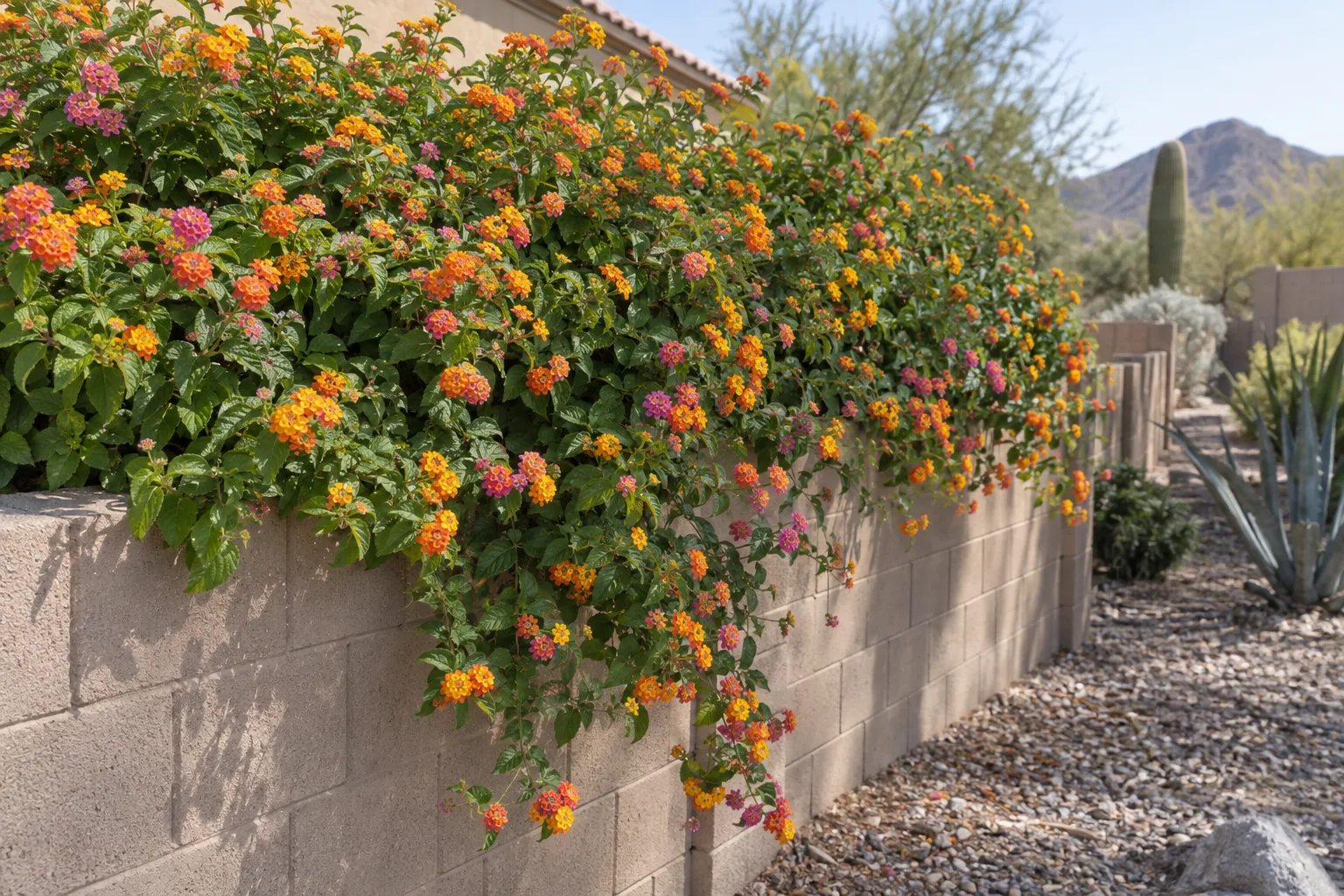
Trailing lantana grows 12 to 18 inches tall and spreads 3 to 6 feet, which makes it the fastest cover on this list. It wants full sun and low water once established, and it blooms from spring into fall in purple, white or yellow depending on the variety. Its drawback is frost. A hard freeze can cut it to the ground, and it looks ragged until spring regrowth fills in.
Desert marigold (Baileya multiradiata)
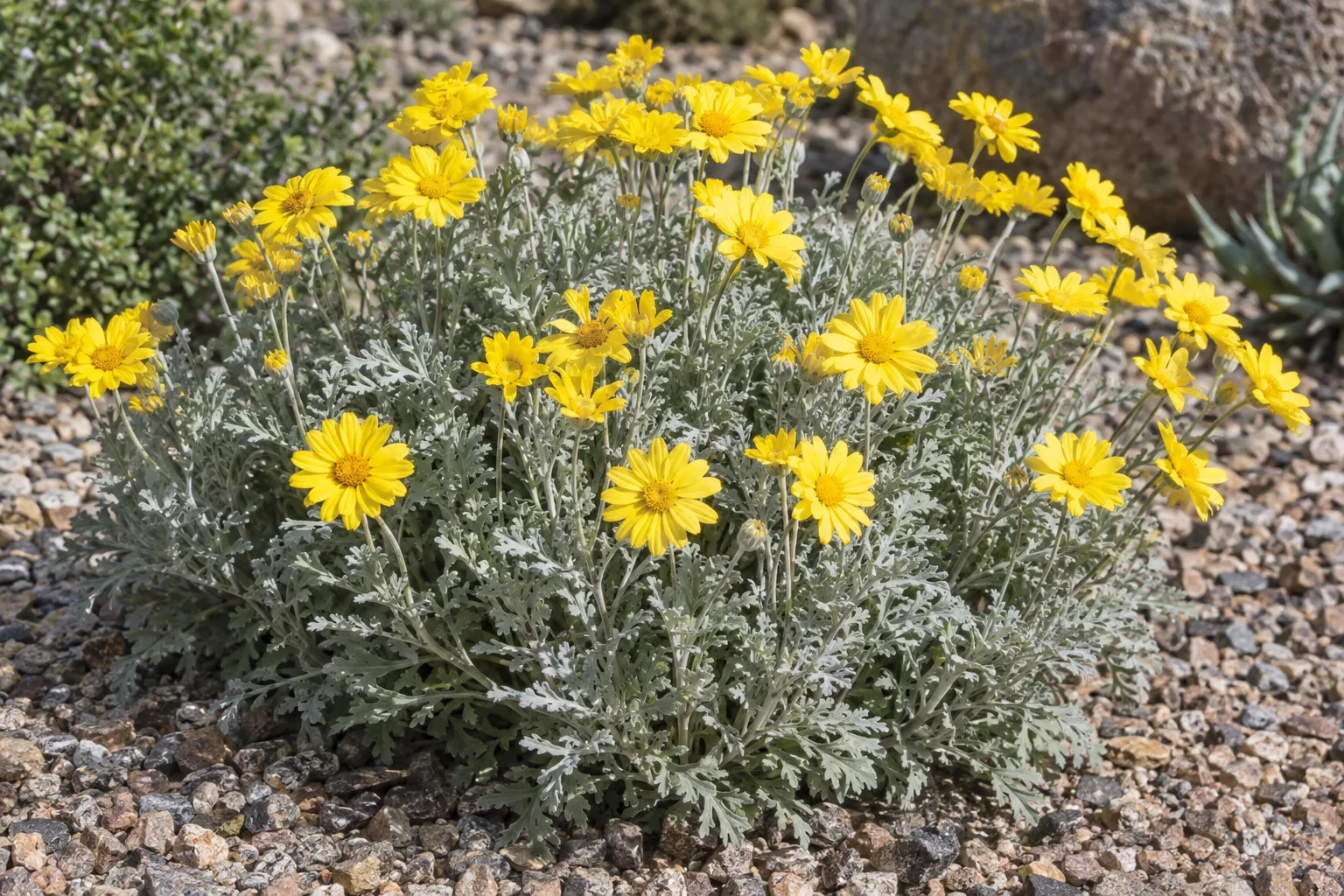
Desert marigold forms a silvery mound 12 to 18 inches tall and wide, topped with yellow, daisy-like flowers. It prefers full sun, fast drainage and very little water. Blooms peak in spring and can continue on and off through much of the year. The drawback is a short life. Plants decline after a few years and rely on reseeding to keep the bed full.
Blackfoot daisy (Melampodium leucanthum)
Blackfoot daisy makes a tidy mound about 8 to 12 inches tall and 12 to 18 inches wide, covered in small white flowers with yellow centers. It takes full sun and reflected heat and needs little water once established. It does not creep, so you have to plant it in drifts to cover ground. It also rots quickly in soil that stays wet.
Damianita (Chrysactinia mexicana)
Damianita is a fine-textured, aromatic shrub 12 to 24 inches tall and 2 to 3 feet wide, with small yellow flowers in spring. It handles poor, alkaline, rocky soil and full sun on very little water. The drawback is speed. It fills in slowly and gets woody if you never shear it lightly after flowering.
Prostrate rosemary (Salvia rosmarinus ‘Prostratus’)
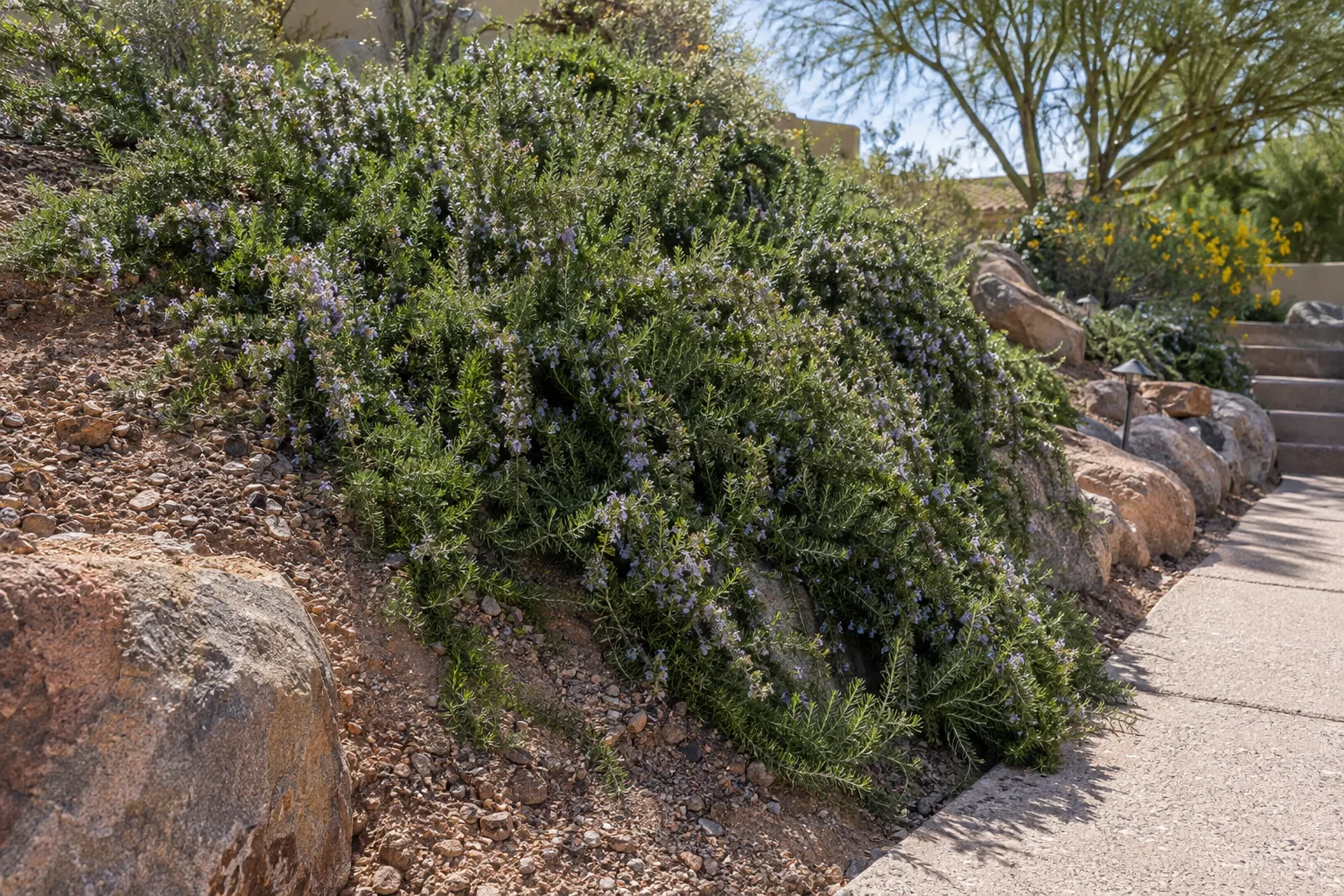
Prostrate rosemary stays 1 to 2 feet tall and spreads 4 to 8 feet, spilling over walls and down slopes with evergreen, fragrant foliage and pale blue flowers in winter and spring. It is also a culinary herb you can cut for the kitchen. It wants full sun and sharp drainage, and it declines in soil that stays soggy after monsoon storms.
Angelita daisy (Tetraneuris acaulis)
Angelita daisy forms tight, grass-like clumps 6 to 10 inches tall and about 1 foot wide, with yellow flowers that appear over a long season. It tolerates full sun, reflected heat and alkaline soil on low water. Because it clumps rather than runs, you need to space plants 12 to 18 inches apart and accept bare soil between them for a season or two.
How do these six groundcovers compare?
Lantana and prostrate rosemary cover the most ground, while the daisies and damianita suit smaller beds and edges. Use this table to match size and bloom to your space.
| Plant | Height | Spread | Main bloom | Sun |
|---|---|---|---|---|
| Trailing lantana | 12 to 18 in | 3 to 6 ft | Spring to fall | Full sun |
| Desert marigold | 12 to 18 in | 12 to 18 in | Spring, on and off after | Full sun |
| Blackfoot daisy | 8 to 12 in | 12 to 18 in | Spring to fall | Full sun |
| Damianita | 12 to 24 in | 2 to 3 ft | Spring | Full sun |
| Prostrate rosemary | 1 to 2 ft | 4 to 8 ft | Winter to spring | Full sun |
| Angelita daisy | 6 to 10 in | About 1 ft | Long season | Full sun |
When should I plant groundcovers in Arizona?
Plant from mid-September through November. Cooler air and warm soil let roots grow for months before the next summer arrives, and a fall planting is usually through its hardest stretch by the time 110°F days return.
Late February through March works as a second window, though spring plants get less time to root. July and August planting is a poor bet because the heat stresses newly disturbed roots. Our gardening calendars lay out what to plant each month in the East Valley.
Should I amend the soil before planting groundcovers?
Mostly no. Desert marigold, blackfoot daisy, damianita and angelita daisy evolved in lean, gritty, alkaline soil, and rich compost mixed deep can hold too much moisture around the crown. A light top-dressing of compost after planting is plenty.
Rosemary and lantana tolerate a little more organic matter, but drainage still matters most. Test it before you plant. Fill a hole 12 inches deep with water, and if water is still standing the next day, caliche or clay is blocking drainage. Break through the hard layer with a digging bar or choose a raised planting area.
How do I plant a groundcover bed in the low desert?
Dig each hole twice as wide as the root ball and no deeper, then set the plant so the top of the root ball sits level with or slightly above the soil. Follow these steps.
- Mark spacing. Set clumping plants 12 to 18 inches apart and spreading plants 3 to 4 feet apart, adjusting for the mature spread in the table.
- Check drainage and break through any caliche at each hole.
- Remove the plant from its pot and loosen circling roots with your fingers.
- Backfill with the native soil you dug out, firming it gently to remove air pockets.
- Water the whole planting area deeply to settle the soil.
- Spread 2 to 3 inches of decomposed granite or shredded bark, keeping it a couple of inches back from each stem.
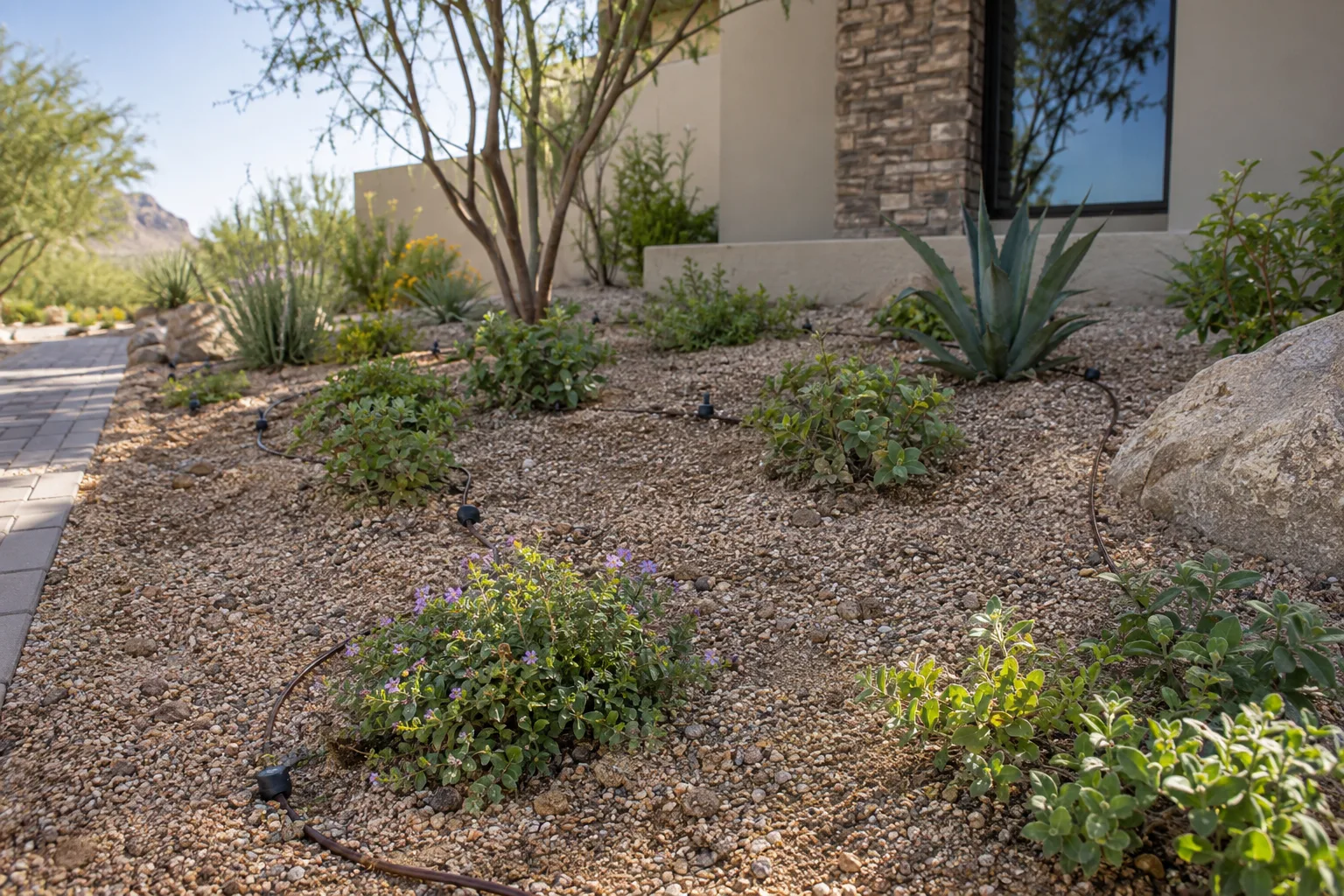
- Connect drip emitters, one or two per plant, rather than spray heads.
How much water do established groundcovers need?
Once established, most of these groundcovers need a deep soak every 2 to 3 weeks in summer and little supplemental water in winter. During the first summer, expect to water every 5 to 7 days by drip. Soil type, exposure and plant size all shift those intervals.
Drip is the better choice. Spray heads lose a good share of their water to evaporation and wind in summer, while emitters put water at the roots. Run the system early in the morning.
During monsoon season, from roughly July through September, turn the controller off after a heavy storm. Rosemary and blackfoot daisy in particular decline when roots sit in wet soil. A rain delay setting does this for you.
Which groundcover works on slopes and hot strips?
Trailing lantana and prostrate rosemary are the best slope choices from this list. Their long stems spread across the surface, anchor soil and slow runoff during monsoon downpours, and both take heat radiating off walls and pavement.
For a narrow strip between a stucco wall and a sidewalk, damianita and lantana handle the reflected heat well. Angelita daisy and blackfoot daisy suit smaller beds and edges where you want a neat, low look. West-facing exposures are the hottest, so choose full-sun plants there and water new ones more often during their first summer.
Frequently asked questions
Can I replace an entire lawn with groundcovers?
Yes, for areas people look at rather than walk across. None of the six plants above tolerates regular foot traffic, so keep a path of decomposed granite or pavers through the planting. Families with kids or dogs who play on the grass will usually want to keep a smaller patch of turf.
Do these groundcovers attract bees and butterflies?
Yes, the flowering ones do. Lantana, desert marigold, blackfoot daisy, damianita and angelita daisy all produce flowers that draw bees and butterflies while in bloom. If a bed sits beside a walkway or patio seating, place the flowering plants a few feet back from where people sit.
How long does a groundcover take to fill in?
Trailing lantana and prostrate rosemary often cover bare soil within one to two growing seasons, while damianita, blackfoot daisy and angelita daisy usually take longer. Spacing sets the pace, since closer planting fills faster but needs more plants. Fill gaps with 2 to 3 inches of mulch or decomposed granite in the meantime.
How do I keep weeds out of a new groundcover bed?
Mulch bare soil 2 to 3 inches deep and pull weeds while they are small. Roots that reach caliche become hard to extract, so a quick weekly walk through the bed during the first year pays off. Weeds fade as the groundcovers close their canopy and shade the soil.
Do these plants need fertilizer?
Rarely. Desert marigold, blackfoot daisy, damianita and angelita daisy prefer lean soil and can grow soft and floppy with rich feeding. Lantana and rosemary can take a light feeding in spring if growth looks pale. Skip fertilizer in July and August, when pushing new growth in 110°F heat stresses plants.
Is a drought-tolerant groundcover right for your yard?
It is a good fit if you have a hot strip, a slope that washes out in monsoon storms, or a bed of tired turf that nobody walks on. You will water regularly for the first year and then far less. It is a poor fit if you want a soft play lawn for kids and dogs, since none of these plants handles heavy foot traffic. If you are weighing options for a specific spot, come visit us at the nursery in Queen Creek.