
Eight drought-resistant flowers handle Arizona heat above 110°F: desert marigold, globe mallow, blackfoot daisy, Parry’s penstemon, angelita daisy, lantana, red bird of paradise and desert zinnia. Plant them in fall or early spring and water deeply but rarely.
Key takeaways
- Plant from late September through November or in February and March, so roots settle in well before summer highs pass 110°F.
- Water new plants every 2 to 3 days for the first 2 to 3 weeks, then taper to weekly, then to every 1 to 3 weeks once they are a year old.
- Set the root ball slightly above the surrounding soil and top it with 2 to 3 inches of decomposed granite, kept clear of the stem.
- Desert marigold, blackfoot daisy and desert zinnia prefer lean, fast-draining soil. Rich beds make them floppy.
- Lantana berries are toxic if eaten, and lantana and red bird of paradise can freeze back in a hard winter frost.
Why do drought-resistant flowers handle Arizona summers?
They carry built-in cooling and water-saving features. Deep taproots reach moisture below the hot top layer, silvery or waxy leaves reflect sunlight, small leaves lose less water, and many species slow down in July before blooming again once monsoon moisture arrives.
Many gardeners believe a drought-resistant plant needs no irrigation at all. That is wrong during the first year, when roots are still shallow. The East Valley averages under 10 inches of rain a year, and the soil surface in summer runs far hotter than the air. Roots come first. Once they reach deeper soil, these flowers ask for much less water than typical bedding plants.
Which drought-resistant flowers grow best in Queen Creek and the East Valley?
These eight handle low-desert sun, alkaline soil and long dry spells. They are varieties we commonly carry, though availability changes week to week and season to season, so browse our plant selection or ask a team member what is on hand.
Desert marigold (Baileya multiradiata)
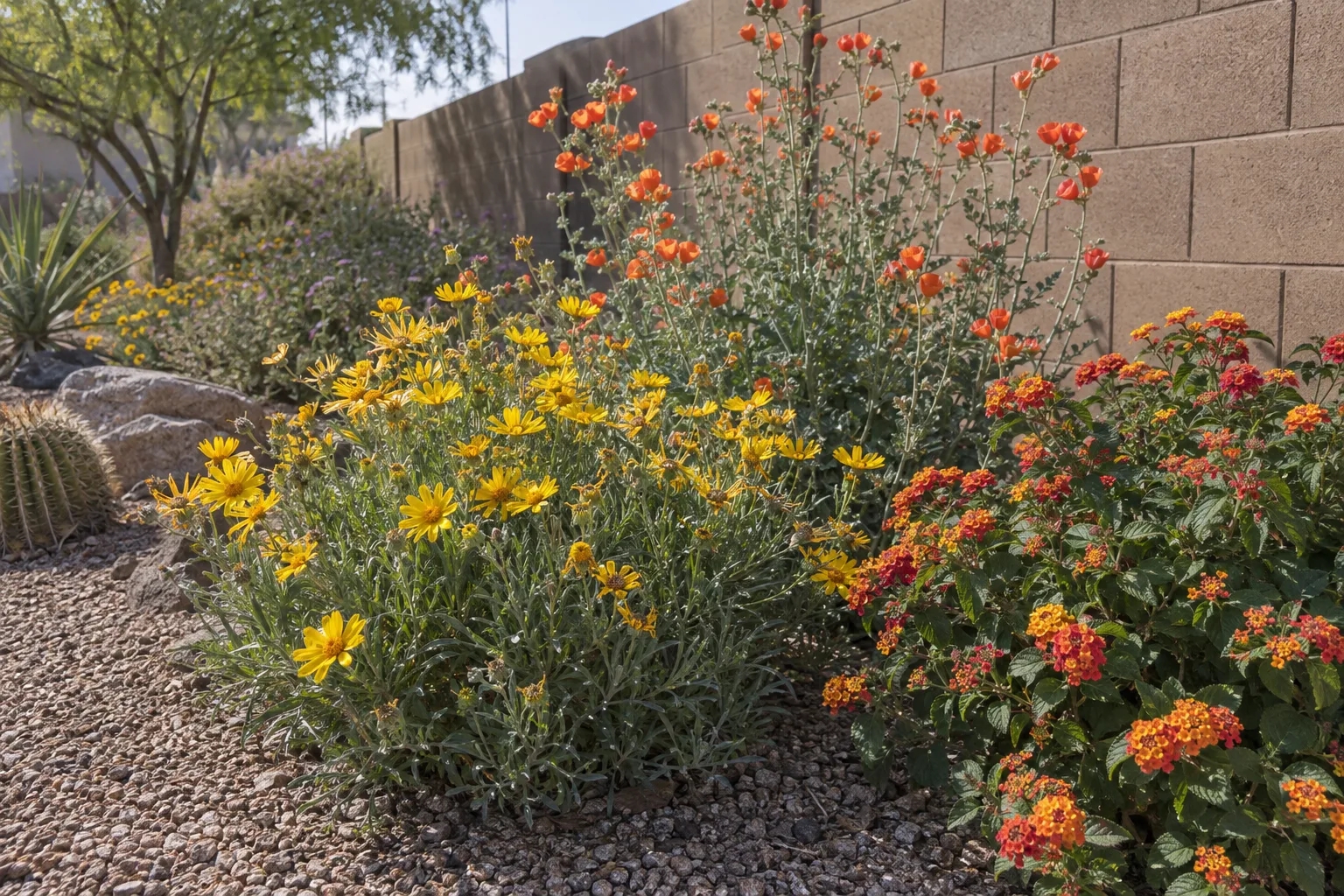
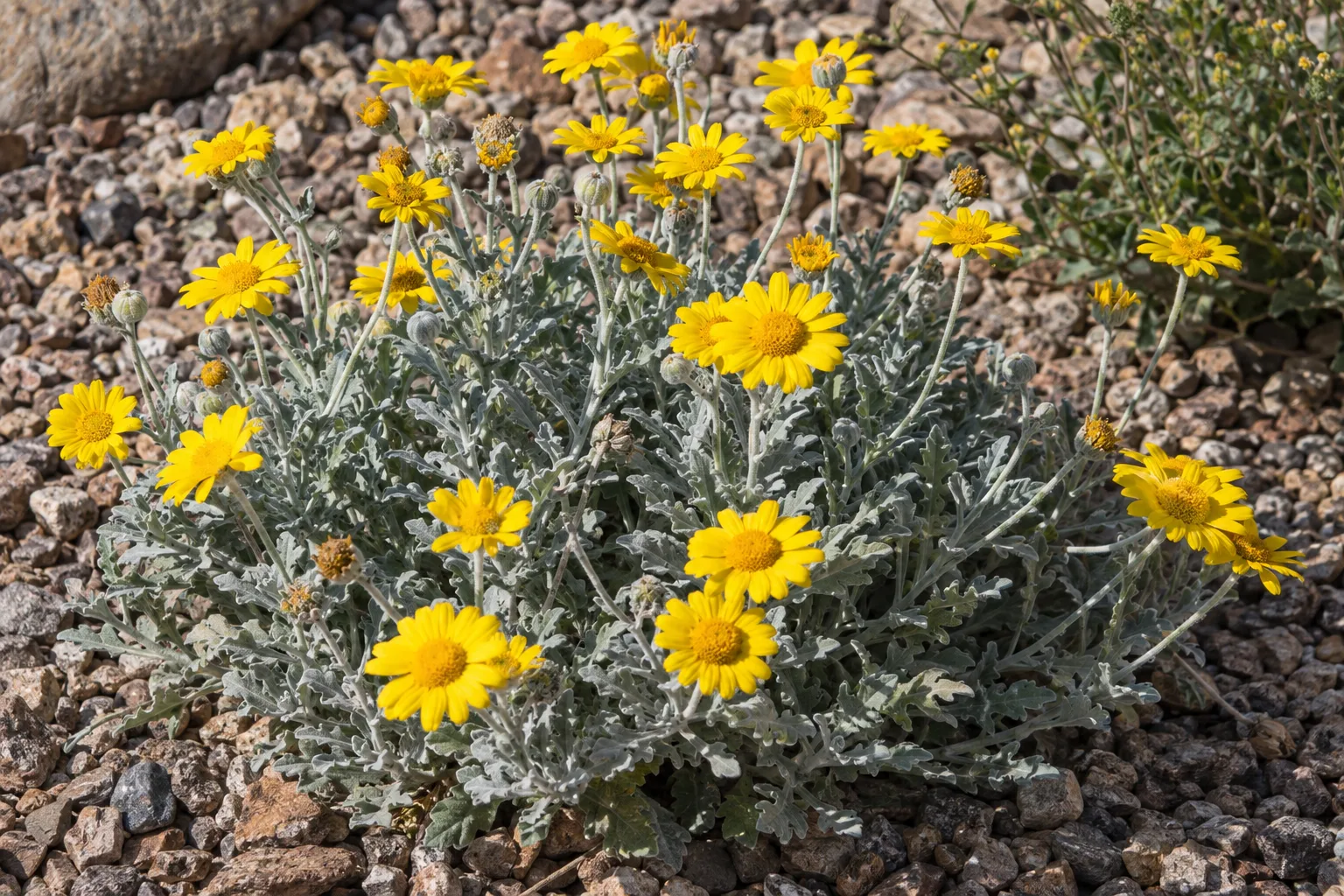
This native wildflower has golden yellow blooms above silvery gray foliage. It reaches 12 to 18 inches tall and about as wide, wants full sun, and needs a deep soak every 2 to 3 weeks once established. Bloom peaks in spring and returns after cooler weather, with scattered flowers in between. The drawback is a short life and a ragged look after a heavy bloom, so let it reseed.
Globe mallow (Sphaeralcea ambigua)
Globe mallow sends up orange, apricot or pink cup-shaped flowers in spring. It grows 2 to 4 feet tall and wide in full sun, tolerates caliche and decomposed granite, and needs a deep soak every 2 to 3 weeks after the first year. It can rebloom in fall. The drawback is a leggy, open shape, which a cutback after the main spring bloom corrects.
Blackfoot daisy (Melampodium leucanthum)
Small white daisies with a honey scent cover this mounding perennial in spring and fall. It stays 8 to 12 inches tall and 12 to 24 inches wide, wants full sun, and needs water only every 2 to 4 weeks once established. It rests in midsummer. The drawback is root rot in soggy or heavily amended soil, so give it sharp drainage.
Parry’s penstemon (Penstemon parryi)
Tall spikes of pink-magenta tubular flowers appear from late winter into spring, and hummingbirds visit them. Flower stalks reach 3 to 5 feet above a low clump 2 to 3 feet wide. Give it full sun and a deep soak every 2 to 3 weeks. The drawback is a short life, but leaving the seed stalks in place lets new plants fill in.
Angelita daisy (Tetraneuris acaulis)
Bright yellow daisies sit on a tidy clump 6 to 12 inches tall and 12 to 18 inches wide, with the heaviest bloom in spring and fall. It handles reflected heat from walls and paving in full sun and needs water every 1 to 3 weeks. The drawback is decline in shade or constantly damp soil, and clumps need dividing every few years.
Lantana (Lantana camara and L. montevidensis)
Lantana blooms in red, orange, yellow, pink and purple from spring until frost and draws butterflies. Upright types reach 3 to 4 feet, while trailing purple lantana stays 1 to 2 feet tall and spreads wider. It wants full sun and water every 1 to 2 weeks in summer. The drawbacks are toxic berries and frost damage, which can cut it back to the ground.

Red bird of paradise (Caesalpinia pulcherrima)
Clusters of orange and red flowers cover feathery foliage from late spring through fall, which is when many plants stall. It grows 5 to 8 feet tall and wide in full sun and needs a deep soak every 1 to 2 weeks in summer once established. Hummingbirds visit it. The drawback is size, plus a hard freeze that can take it to the ground.
Desert zinnia (Zinnia acerosa)
This native perennial forms low mounds of small white daisies over narrow leaves, blooming from spring into fall. It grows 6 to 10 inches tall and 12 to 18 inches wide in full sun and needs water every 2 to 4 weeks once established. The drawback is subtlety. It fills in slowly and looks quiet beside bolder neighbors.
When should I plant drought-resistant flowers in Arizona?
Fall is best, from late September through November, because roots grow all winter before summer heat arrives. February and March work as a second window. Warm-season plants like lantana and red bird of paradise do well planted from March through May.
| Plant | Best planting window | Main bloom | Note |
|---|---|---|---|
| Desert marigold | Late Sept to Nov, or Feb to Mar | Spring, scattered through fall | Reseeds freely |
| Globe mallow | Late Sept to Nov, or Feb to Mar | Spring, fall rebloom | Cut back after spring bloom |
| Blackfoot daisy | Late Sept to Nov, or Feb to Mar | Spring and fall | Needs sharp drainage |
| Parry’s penstemon | Oct to Nov | Late winter to spring | Leave seed stalks |
| Angelita daisy | Late Sept to Nov, or Feb to Mar | Spring and fall, some year-round | Divide every few years |
| Lantana | Mar to May | Spring until frost | May freeze back |
| Red bird of paradise | Mar to May | Late spring through fall | Cut back in late winter |
| Desert zinnia | Late Sept to Nov, or Feb to Mar | Spring through fall | Slow to fill in |
Our gardening calendars lay out the planting months for the rest of the yard. If you want fast color while these perennials settle in, look at annual flowers and foliage for the same season.
How do I plant them in caliche and alkaline soil?
Dig wide rather than deep, check drainage, and add very little to the native soil. Caliche, the hard calcium carbonate layer common in Queen Creek, holds water in the planting hole and rots roots if you ignore it.
- Dig a hole 2 to 3 times as wide as the container and only as deep as the root ball.
- If you hit caliche, break through it with a digging bar or move the plant to a new spot.
- Fill the hole with water. If it is still standing after an hour, break up more of the layer or plant on a low mound.
- Leave the soil unamended for natives like desert marigold and blackfoot daisy. For lantana and red bird of paradise, mix in no more than 20 to 25 percent compost.
- Set the top of the root ball about an inch above the surrounding grade, then water slowly to settle the soil.
- Add 2 to 3 inches of decomposed granite and keep it 2 to 3 inches back from the stem.
How often should I water drought-resistant flowers?
Water new plants often and established plants rarely, always deeply. Shallow sprinkling keeps roots near the hot surface, while a slow soak sends them down where soil stays cooler. Deep soaks also push salts from hard irrigation water below the root zone.
First year in the ground
- Weeks 1 to 3: every 2 to 3 days.
- Months 2 and 3: weekly.
- Spring: every 7 to 10 days.
- Summer before the monsoon: every 5 to 7 days.
Established plants
- Winter: about once a month, or skip it after a good rain.
- Spring: every 2 to 3 weeks.
- Summer: every 1 to 2 weeks, and less during steady monsoon storms.
Soil type changes these intervals, so check a few inches down before you water. Our classes and events page lists upcoming gardening sessions if you want to see irrigation setups in person.
What goes wrong with these flowers in the monsoon and in winter frost?
Standing water, reflected heat and hard frost cause most losses. The monsoon runs roughly from July through September, and a storm can drop an inch of rain in under an hour, so plants sitting in poorly draining soil develop crown and root rot.
Mound the planting area slightly and turn off drip irrigation when storms are delivering water. A west- or south-facing wall can add 20 to 30°F of radiant heat. Young plants in those spots benefit from 30 to 50 percent shade cloth through their first summer.
Frost matters at the other end of the year. Lantana and red bird of paradise can freeze to the ground, and both usually resprout in spring. Wait until frost danger has passed, often late February, before cutting back damaged growth, because the dead stems protect the base.
Frequently asked questions
Can I grow these flowers in containers?
Yes, angelita daisy, lantana and desert zinnia suit pots well. Containers dry out much faster than ground soil, so expect to water every 2 to 3 days in summer. Use a fast-draining mix and a pot with drainage holes. Browse pottery and planters for sizes with room for roots.
Are any of these flowers toxic to pets?
Lantana is the one to watch, because its berries are listed as toxic to pets and people if eaten. Check any plant against the ASPCA toxic plant list before you buy it. If a pet or child chews on any plant, call your veterinarian or poison control right away.
Do these flowers attract pollinators?
Yes, most of them do. Lantana draws butterflies, and Parry’s penstemon and red bird of paradise are visited by hummingbirds. Desert marigold, blackfoot daisy and desert zinnia attract small native bees, and globe mallow flowers are visited by bees as well. A mix with staggered bloom times keeps something in flower for months.
Can I plant them in summer if I need to?
You can, but June through August is the hardest time to establish any plant. Roots are small and soil surface temperatures are extreme. If you must plant, choose heat-lovers like lantana or red bird of paradise, shade them with cloth, and water more often. Waiting until fall gives much better results.
Do I need to fertilize them?
No, they need very little feeding. Too much fertilizer produces soft, floppy growth that struggles in summer, and natives like blackfoot daisy and desert marigold decline in rich soil. A light mix of compost at planting is plenty for lantana and red bird of paradise, and established plants rarely need more.
Are drought-resistant flowers right for your yard?
They suit sunny beds with well-drained soil where you want color on a modest water budget. They are a poor match if you want a lush, constantly blooming border, plan to water daily, or have a shady, soggy corner. In that case, annuals or shade plants will serve you better. If you are ready to plan a bed, visit us at the nursery in Queen Creek and we will help you match plants to your spot.