
The best DIY fountain ideas for Arizona backyards are a glazed container fountain, a stacked stone or millstone bubbler, a wall spill fountain and a pondless waterfall. Each recirculates its water, and each does best in afternoon shade with a pump sized for the job.
Key takeaways
- A glazed container fountain is the easiest first build and can be finished in one afternoon with a pump, tubing and a pot.
- Build from roughly October to April so the pump and algae routine are settled before summer highs pass 110°F.
- Afternoon shade cuts both evaporation and algae, so place the fountain 6 to 12 feet from where you sit and out of the west sun.
- Use a submersible pump with adjustable flow, keep it fully underwater at all times and plug it into a GFCI-protected outlet.
- Valley water is hard, so plan to wipe scale every few weeks and soak the pump in white vinegar about once a month.
Which DIY fountain style suits an Arizona backyard?
A glazed container fountain suits most first-time builders, and the other three styles suit yards with more room or a block wall to work with. Choose the style first, because it decides your basin, your pump and your budget. Our fountains department shows finished pieces if you want to compare designs before you build your own.
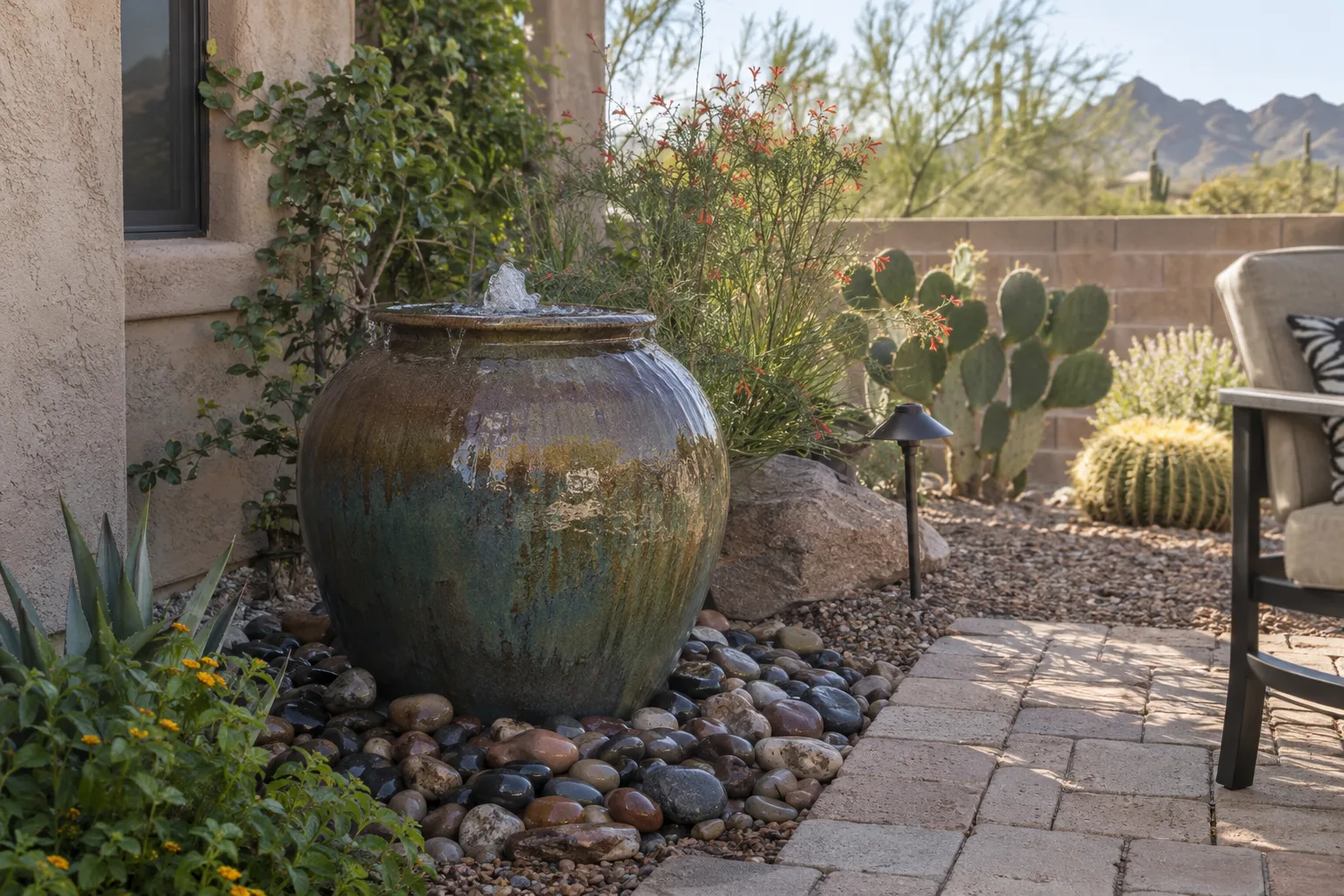
Container or pot fountain
A large glazed pot, a submersible pump and a length of tubing make a working fountain with no digging. The small reservoir loses water faster than a buried basin, so expect to top it off often in July or add a float valve. Browse our pottery and planters for glazed container ideas.
Stacked stone or millstone bubbler
Water rises through a pipe in the center of a drilled stone and drains into a buried basin topped with gravel. Very little open water is exposed to the sun. The build needs a hole, a basin sized for the pump and a level base, so plan on a full weekend.
Wall spill fountain
A spout set into a stucco or tile wall drops water into a trough below. It fits a block wall well and puts the sound right beside your seating. The wall has to carry a filled trough and its plumbing, which is why many people bring in a mason or electrician for this one.
Pondless waterfall
Water tumbles over boulders and disappears into a buried reservoir, so there is no visible pond to maintain. The pump has to match the height of the falls, and the basin needs a liner or rigid shell. It is the largest of the four projects.
When should you build a fountain in the low desert?
Build from about October to April. Daytime temperatures are mild then, and you can set up your algae and cleaning routine well before summer arrives.
Summer is when a new fountain gets tested, with highs above 110°F and water that can warm quickly in a small reservoir. The monsoon, roughly July through September, adds dust and wind that clog pump screens. Frost is occasional in winter, usually December through February, and water that freezes can crack a glazed pot. On nights forecast near freezing, cover a small fountain or drain it. Our gardening calendars list other seasonal jobs by month.
What materials hold up to desert sun and hard water?
Glazed ceramic, sealed concrete, natural stone, UV-rated fiberglass and copper all handle low desert conditions. Thin plastic is the one to avoid, because sun and heat fade and crack it within a few summers.
| Material | Sun and heat | Hard water | Best use |
|---|---|---|---|
| Glazed ceramic | Good, glaze resists fading | Scale wipes off the glaze | Container fountains |
| Cast concrete | Good when sealed | Needs a sealer, scale shows on dark colors | Custom basins, millstone bases |
| Natural stone (basalt, granite, sandstone) | Very good | Scale blends into rough surfaces | Stacked and drilled stone |
| UV-rated fiberglass | Good | Good | Buried basins |
| Copper | Good, darkens with age | Develops a patina | Spouts, wall features |
| Thin plastic or resin | Poor | Scale shows | Skip it |
For a buried basin, use a rigid fiberglass shell rated for outdoor UV, or a concrete basin sealed with a waterproof coating. A cheap black tub from a big-box store costs less on day one and more when you dig it up. Check that any glazed pot is rated for outdoor use and frost.
What do you need for a container fountain?
You need a glazed pot, a submersible pump, tubing, a spitter and a nearby GFCI outlet. A few extras make the build cleaner.
- A glazed pot at least 18 inches wide with no drainage hole, or one you can seal
- A submersible pump with an adjustable flow valve
- Clear flexible tubing and a decorative spitter or copper pipe
- River rock or smooth pebbles to hide the pump
- A float valve, if you want automatic refilling
- A level, stable surface
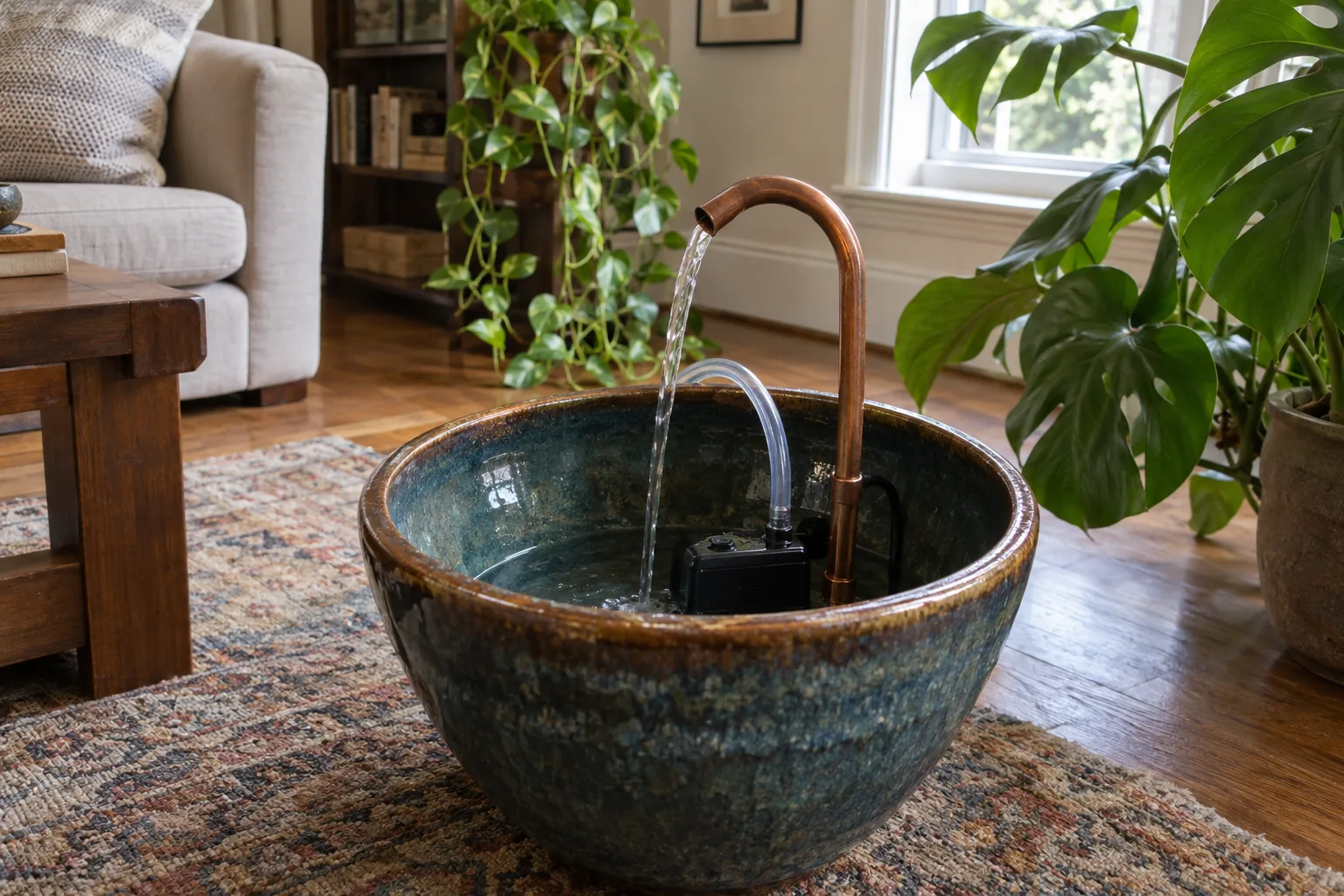
Buy the pump by what the fountain needs, not by the biggest number on the box. A small pot fountain needs modest flow, and the pump should state the maximum height it can lift water, so match that to your spitter. An adjustable valve lets you turn the stream down if water splashes out of the pot. Magnetic drive pumps tend to run cooler, which helps in hot reservoirs.
How do you build a container fountain?
You can build one in a single afternoon with ten steps. Test the pump before you start, and keep the water above it at all times.
- Choose a glazed pot at least 18 inches wide with no drainage hole. If it has one, plug it with waterproof silicone and a rubber stopper, and let the silicone cure as the label directs.
- Run the pump in a bucket of water first to confirm it works and the flow adjusts.
- Set the pump on the floor of the pot, raised slightly on a flat stone if the intake would sit tight against the bottom.
- Attach clear tubing to the outlet and fit the spitter, so the opening sits just above the planned water level.
- Route the cord over the rim toward a GFCI outlet, leaving a small downward loop so water cannot run along the cord into the outlet.
- Fill the pot to about 3 inches below the rim, covering the pump completely.
- Plug in the pump and adjust the flow until the water lands inside the pot.
- Cover the pump and tubing with river rock, which also hides the cord and cuts open water surface.
- If you add a float valve, connect it to a supply line with the right fittings, or ask an irrigation professional to do it.
- Run the fountain for an hour and check the level, the splash zone and the stability of the pot.
How much water does a fountain lose, and where should it sit?
A small container fountain in full summer sun can lose an inch or more of water a day in June, before monsoon humidity arrives. Shade, a larger reservoir and a low spray pattern all slow that loss.
Place the fountain where it gets shade after about 2 p.m., ideally 6 to 12 feet from your seating so you can hear it. A desert tree with filtered shade works well, though trees that drop pods and small leaves will clog the pump intake. Set the fountain on a level base, because a tilted pot spills one side and exposes the pump on the other.

A float valve on a supply line keeps the level steady while you are away. Covering the basin with river rock leaves only a small gap for the return flow, and it cuts the open water surface. Keep the spray low and wide, since high spray vaporizes quickly in dry wind.
How do you control scale and algae?
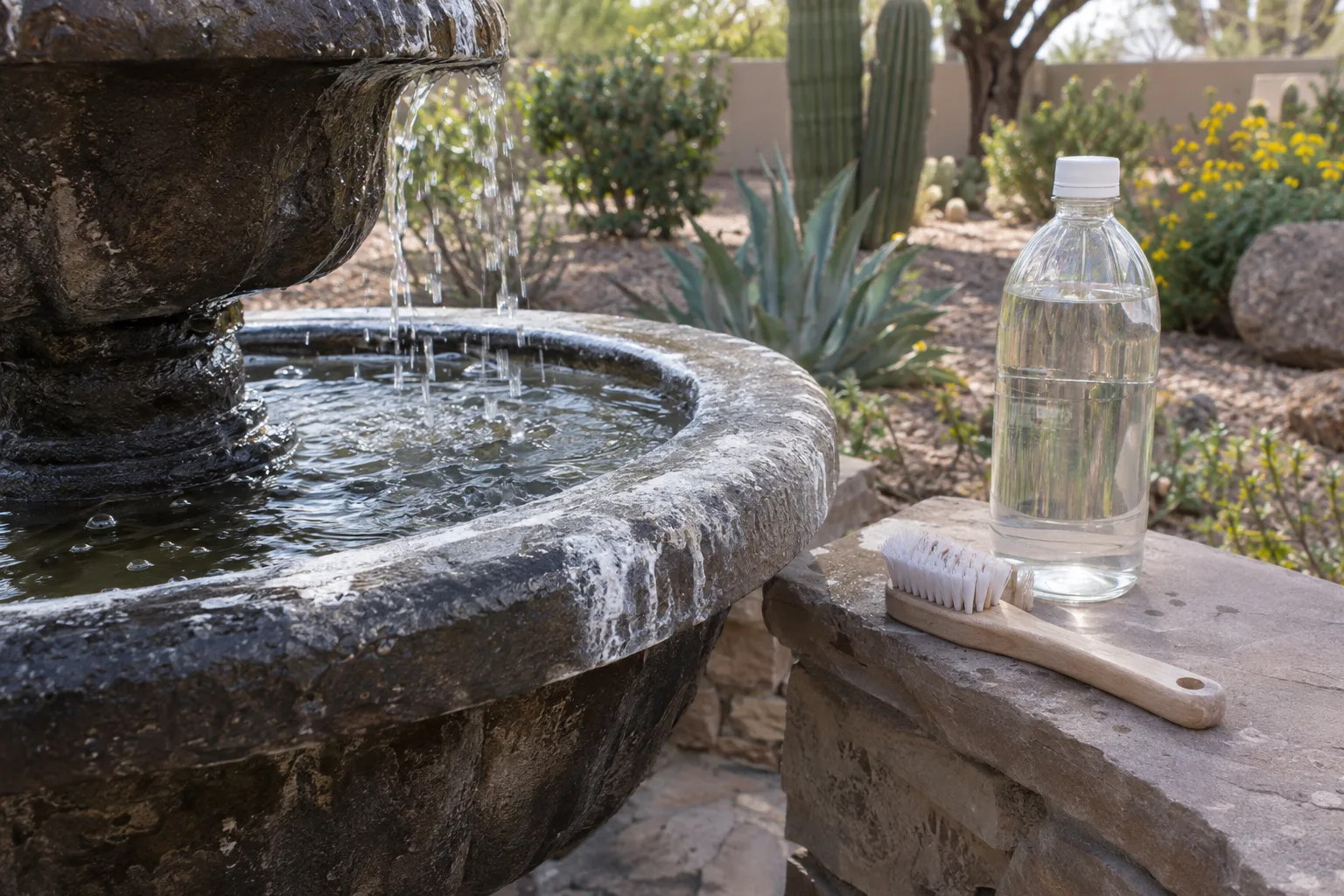
Wipe scale off every few weeks with a mix of white vinegar and water, and keep the fountain shaded and moving to hold algae down. Queen Creek and East Valley water is hard, so white mineral crust shows up on any surface water touches.
Soak the pump body in white vinegar for 30 to 60 minutes about once a month to clear mineral buildup from the impeller, then rinse it well. For stubborn crust on stone or glazed ceramic, apply undiluted vinegar with a stiff brush and rinse thoroughly.
Algae can turn water green within days in warm weather. If it does, drain the fountain, scrub the surfaces and refill. Use only treatments whose labels list decorative fountains and follow the directions exactly, since birds and pets may drink from the water. Pool chemicals are made for pools.
What mistakes shorten a fountain’s life?
Most failures come from the pump, the sun or the base. The fixes are cheap if you catch them early.
- Letting the water level drop below the pump, which can burn out the motor in minutes.
- Placing the fountain in full west sun, where water warms quickly and algae grows fast.
- Using thin plastic basins that crack or fade after a few summers.
- Running a long extension cord outdoors instead of using a GFCI outlet nearby.
- Skipping the intake screen check after a monsoon dust storm.
- Setting the pot on uneven ground, where it tilts and spills.
Frequently asked questions
Will a fountain attract mosquitoes?
A running fountain gives mosquitoes little to work with, because they lay eggs in still water. The risk rises if the pump stops for several days in warm weather. Keep the pump running or drain the basin, and use any mosquito product only if its label lists fountains, following the directions.
Can I keep fish in a DIY fountain?
A shallow container fountain is a poor home for fish. Water in a small sunny reservoir can warm well past what ornamental fish tolerate in July and August, and pump intakes can trap small fish. Fish need deeper, shaded, aerated water, so they belong in a purpose-built pond.
Do I need a permit to build a fountain?
Requirements vary by town, so call your local building department before you start. Ask about new outdoor outlets, buried wiring, excavation and wall-mounted features, since those are the parts most likely to involve review. If you belong to an HOA, ask the association about its fountain rules as well.
Which plants look good around a fountain?
Heat-tolerant plants that drain well look good beside a fountain. Mexican bush sage (Salvia leucantha) and yellow bells (Tecoma stans) are two varieties we commonly carry, though availability changes week to week and season to season. Keep them just outside the splash zone. Browse all plants for more ideas.
Should the pump run all day?
Most pumps can run all day, but a timer lowers wear and electricity use. Set it for the hours you are outside, such as morning to evening. Check your pump’s manual, because some manufacturers advise against frequent on and off cycling. The water must cover the pump at every hour.
Is a DIY fountain right for your yard?
A DIY fountain is worth building if you have a shaded spot within 6 to 12 feet of your seating, a GFCI outlet nearby and about 30 minutes a month for upkeep. A glazed container fountain is the safest first project. Skip it if the only available spot is full west sun, if you will be away for weeks in June without a float valve, or if you want fish without a proper pond. Visit us in Queen Creek to see fountains and pottery in person.