

March is a good time to divide houseplants in Arizona, and eight clumping plants split easily: snake plant, peace lily, spider plant, bird of paradise, cast iron plant, Boston fern, Chinese evergreen and aloe. Each needs a sharp knife, fresh mix and gentle aftercare.
Key takeaways
- Divide in March, when indoor temperatures are steady and roots are growing again, and wait 6 to 8 weeks before fertilizing.
- Water the plant 24 hours ahead, wipe your blade with isopropyl alcohol, and keep at least 3 to 5 stems or leaves plus a good clump of roots on each piece.
- Pot each division into fresh mix in a container only 1 to 2 inches wider than the root mass, then water again only when the top 2 inches are dry.
- Give divisions bright, indirect light for 2 to 3 weeks, away from hot south and west glass.
- Single-trunk plants such as fiddle-leaf fig cannot be divided. Snake plant, spider plant and aloe are the easiest first tries.
When should I divide houseplants in Arizona?
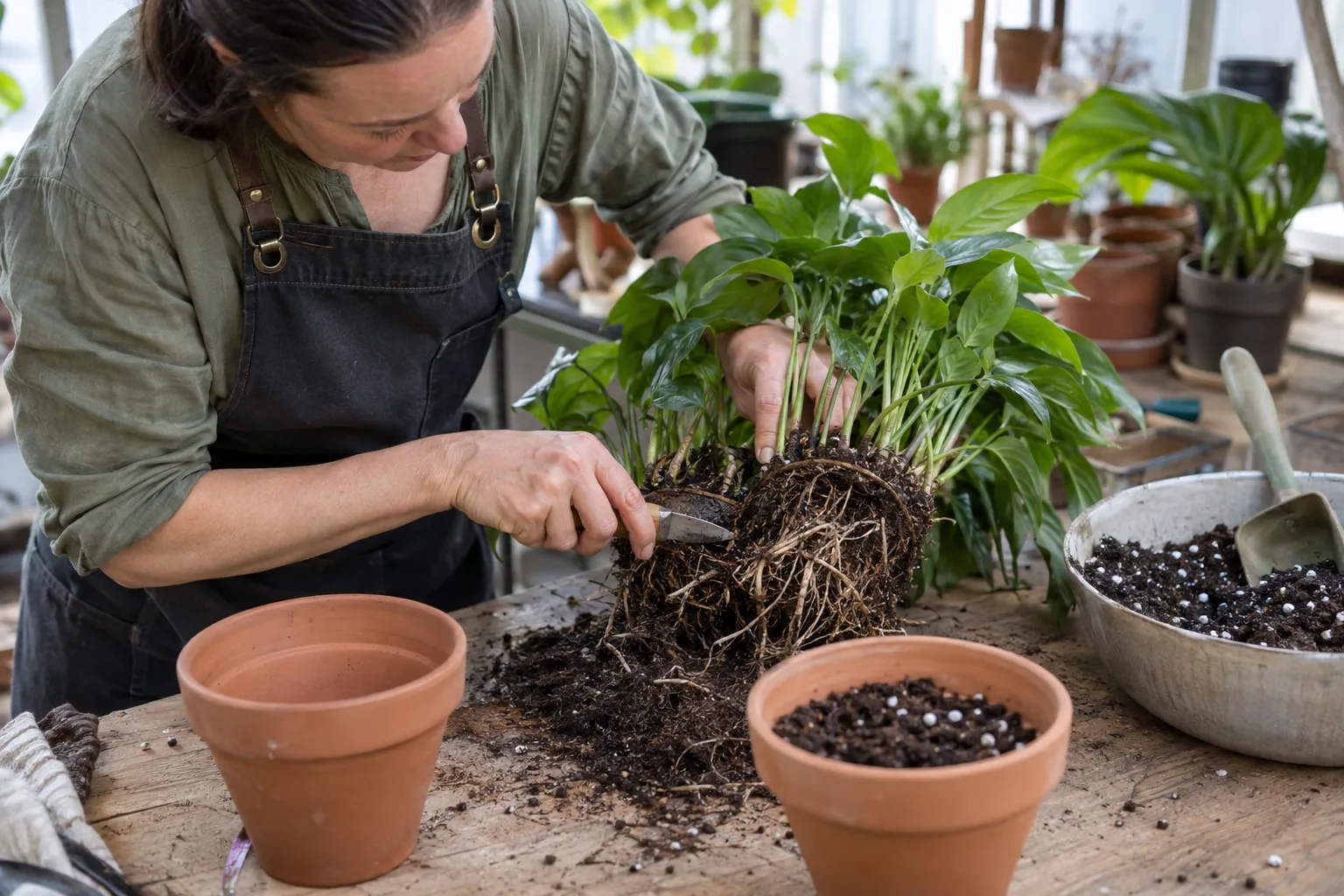
Divide houseplants in March. Roots are waking from the winter slowdown, indoor temperatures are steady, and the window light is brighter than in December but far gentler than in July, so cut roots callus and regrow quickly.
A March division gets roughly 8 to 10 weeks to settle before summer highs above 110°F push air conditioners hard and dry out the air indoors. That head start matters most for tropical plants such as peace lily and Boston fern.
Many of the plants below are varieties we commonly carry in our houseplant department, though availability changes week to week and season to season. If you already own a crowded pot, all you need to buy is fresh mix.
What do I need to divide a houseplant?
You need a sharp knife or pruners, clean pots with drainage holes, fresh potting mix and a tarp. A dull blade crushes roots instead of cutting them, and an unwiped blade can carry rot organisms from one root ball to the next, so clean it with isopropyl alcohol between plants.
- Sharp knife or pruners, wiped with isopropyl alcohol
- Two or three pots per plant, each with a drainage hole
- Fresh potting mix matched to the plant (see the table below)
- A tarp or old sheet for the mess
- A watering can for watering in each division right away
Do not reuse old, compacted mix. It drains poorly and has often built up mineral salts from hard water.
How do I divide a houseplant step by step?
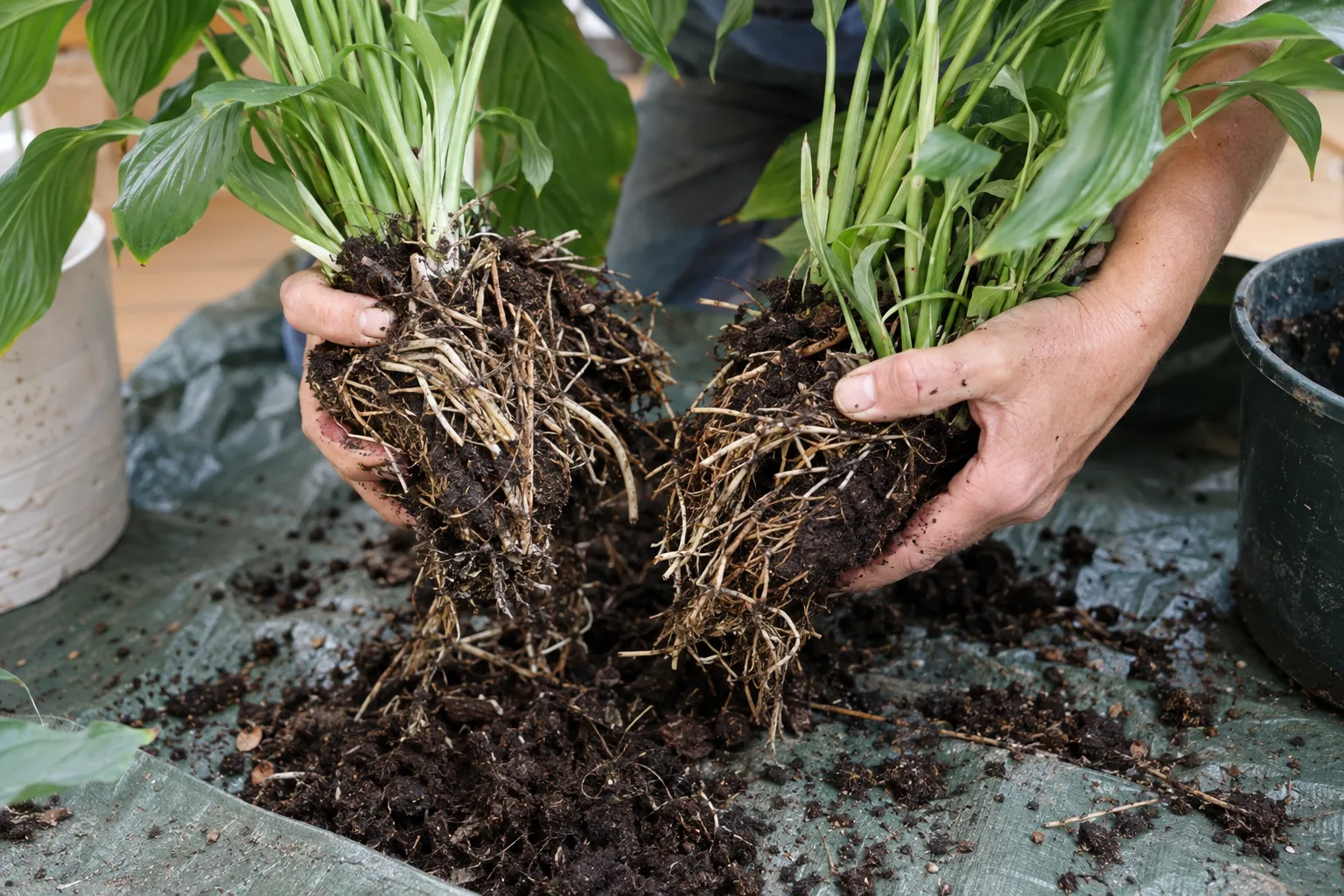
Water the plant a day ahead, slide it out of its pot, pull the root ball apart at its natural split lines, cut what will not separate by hand, and repot each piece at its original depth. Here is the sequence.
- Water the plant 24 hours before so the roots are pliable and the plant is well hydrated.
- Tip the pot on its side and slide out the root ball. Run a knife around the inside of a terracotta pot first, and never yank the plant by its stems.
- Loosen the outer roots with your fingers. A very tight root ball may need a 10 to 15 minute soak in a bucket of water.
- Find the natural break points between crowns, pups or clumps. Aim for pieces with at least 3 to 5 stems or leaves and a healthy handful of roots.
- Cut through stubborn roots with one firm stroke rather than sawing back and forth.
- Let cut surfaces on succulents and thick-rooted plants dry for several hours before potting.
- Set each piece in fresh mix at the same depth it grew before, press the mix gently around the roots to close air pockets, and water it in.
Which houseplants divide best in March?
Plants that form clumps, send up pups or spread by rhizomes divide best. Single-trunk plants such as fiddle-leaf fig cannot be divided, because there is only one stem and one root system to cut.
Snake plant (Dracaena trifasciata)
Mature size is 2 to 4 feet tall, depending on the variety. It grows in low to bright indirect light and wants water only when the mix is dry through the pot. Pull or cut free each pup that has its own roots. The drawback is rot, because wet mix quickly damages the thick underground rhizomes.

Peace lily (Spathiphyllum)
It reaches 1 to 3 feet tall and prefers low to medium indirect light, with water when the top inch of mix dries. Split the clump by hand into sections that each carry several leaves and their own roots, then keep them out of direct light for two weeks. It wilts dramatically when dry and browns at the tips in dry air.
Spider plant (Chlorophytum comosum)
Plants grow 1 to 2 feet tall, with runners that trail longer. Give bright indirect light and water when the top inch of mix is dry. Plantlets on the runners are ready to pot once they show small root nubs, and the mother plant can be split at the crown. Leaf tips brown in dry air or mineral-heavy water.
Bird of paradise (Strelitzia reginae)
Indoors it reaches 3 to 6 feet tall and wants bright light, including a few hours of direct sun near a window, with water when the top 2 inches are dry. The roots are thick and interlocked, so use a heavy knife and keep two or three fans of leaves per division. Expect a sulk of 3 to 4 weeks, and large plants are heavy to handle.
Cast iron plant (Aspidistra elatior)
Clumps reach 2 to 3 feet tall and tolerate low light to shade. Water when the top 2 inches are dry. Cut the rhizomes into sections that each have a few leaves. The drawback is speed, since it grows slowly and divisions take a long time to fill a pot.
Boston fern (Nephrolepis exaltata)
Fronds arch 2 to 3 feet. Give bright indirect light and keep the mix evenly moist. Pull the root ball into two or three sections with plenty of healthy fronds. It is the fussiest plant here, since dry indoor air and vent drafts brown the fronds, so a humidifier or a spot away from vents helps.
Chinese evergreen (Aglaonema)
Plants reach 1 to 3 feet tall and handle low to medium indirect light. Water when the top 2 inches are dry. Separate the stem clusters that have roots attached, and watch for new growth in 3 to 4 weeks. Cold air from a window or vent in winter damages the leaves, and overwatering rots the roots.
Aloe (Aloe vera)
Mature plants stay 1 to 2 feet tall and need bright light, ideally near a sunny window. Water thoroughly, then let the mix dry out completely. Twist or cut pups free where they join the mother plant’s roots, let the cuts dry for several hours, and pot them in cactus mix. Low light makes aloe stretch and flop, and wet mix rots it.
What soil and pots should divisions go into?
Match the mix to how dry the plant likes to be, and choose a pot only 1 to 2 inches wider than the root mass. A pot much wider than the root ball holds pockets of wet mix that roots cannot reach for weeks, which invites rot, especially in the humid monsoon months from July through September when mix dries more slowly.
| Plant | Mix | Pot |
|---|---|---|
| Snake plant, aloe | Cactus mix with about 20 percent perlite | Terracotta, which dries faster |
| Peace lily, Boston fern | Peat or coir-based mix with about 10 percent perlite | Glazed ceramic or plastic, which holds moisture longer |
| Spider plant, Chinese evergreen, cast iron plant | Standard potting mix with about 15 percent perlite | Plastic or terracotta |
| Bird of paradise | Rich potting mix with some compost | Heavy ceramic or large terracotta, which resists tipping |
Terracotta, glazed ceramic and plastic each change how fast mix dries, so compare them in our pottery and planters before you repot. Every pot needs a drainage hole.
How do I care for divisions after splitting?
Give divisions bright indirect light for 2 to 3 weeks, water only when the top 2 inches of mix are dry, and hold off on fertilizer for 6 to 8 weeks. A plant with fewer roots takes up water and nutrients slowly.
An east or north window suits recovery best. Hot south and west glass can scorch leaves that have lost part of their root system. Fertilizer can burn tender new root tips, so wait until you see steady new growth.
Fewer roots use less water, and wet mix around them rots easily, so check with a finger 2 inches down before you water. Air conditioning dries indoor air, which stresses ferns and peace lilies most. A small humidifier or a spot away from vents helps.

Why do divisions fail in Arizona homes?
Most failures come from pieces that are too small, mix that stays wet, or strong window light too soon. Tiny divisions with one or two leaves and few roots struggle in dry indoor air. Bigger pieces recover faster and look full sooner, so resist the urge to make as many plants as possible.
Overwatering is the usual cause of losses. A plant with a reduced root system sits in wet mix and rots before it can recover, so water once after potting and then wait until the top 2 inches are dry.
Dirty tools pass rot from one plant to the next. Oversized pots hold wet mix for weeks. Both are easy to avoid with a wiped blade and a snug container.
Frequently asked questions
Can I divide houseplants in summer or fall in Arizona?
Divide in fall rather than summer. October and November bring steadier indoor conditions, while July heat above 110°F outdoors pushes air conditioners hard and dries indoor air, which stresses plants with fewer roots. April and May also work. Our gardening calendars list other tasks by month.
How do I know a houseplant is ready to divide?
A plant is ready when roots circle the pot or poke out of the drainage holes. Other signs are water running straight through, several distinct crowns at the soil line, and a pot that dries out much faster than it used to. Many clumping houseplants need dividing every 2 to 3 years.
Do I need rooting hormone when dividing?
No, because divisions already carry roots, so rooting hormone adds little. It helps stem cuttings that have no roots at all. Snake plant and aloe also need their cut surfaces to dry, and hormone powder does not replace that step. Put your effort into clean cuts, fresh mix and the right light.
Why is my division wilting after splitting?
Some wilting in the first week is normal because the plant lost roots and cannot move water to its leaves as fast. Keep it out of direct sun and let the mix dry to 2 inches deep before watering again. If stems turn soft or mushy at the base after 10 to 14 days, check for rot.
Should I water divisions with tap water in the East Valley?
Tap water is fine for most divisions, but our water is hard, so minerals build up in small pots. Every 4 to 6 weeks, flush the pot with plenty of water so it drains freely. White crust on the mix or pot rim is mineral buildup. Rainwater or filtered water gives sensitive plants such as peace lily a gentler start.
Is dividing houseplants worth it for your home?
Yes, if you own a crowded snake plant, aloe, spider plant or peace lily and have a bright window for the divisions. The cost is a bag of fresh mix and an afternoon. Skip it for single-trunk plants, for plants that are not root-bound, or when you cannot give new divisions a few weeks of steady care. If you want to compare plants and pots before you start, visit us at the nursery in Queen Creek.
