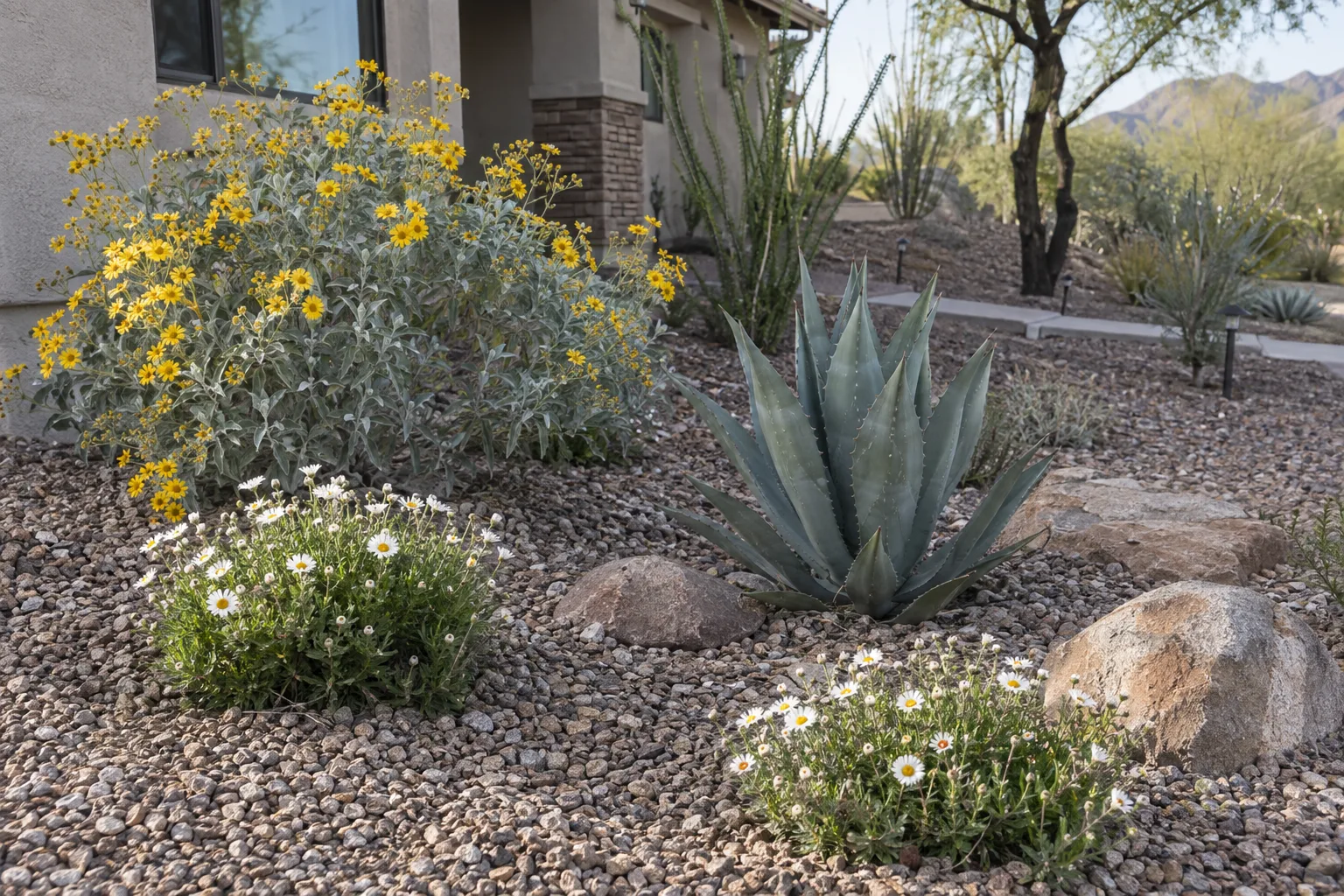
Plant brittlebush, blackfoot daisy, agave, desert marigold and palo verde in March in the Arizona low desert, when soil is warm and roots have a few months before summer heat. Saguaro, bougainvillea, tropical sage and desert willow do better if you wait until April.
Key takeaways
- Soil in the East Valley is usually warm enough for most desert plants by early to mid March, which gives roots roughly three months before highs pass 105°F.
- Palo verde, brittlebush, blackfoot daisy, agave and desert marigold are good March choices.
- Hold saguaro, bougainvillea and tropical sage until mid to late April, and plant desert willow once it is leafing out.
- Dig the hole 2 to 3 times as wide as the root ball and no deeper, and set the top of the root ball 1 to 2 inches above grade.
- Water new plants every 3 to 5 days for the first month, soaking the soil 12 to 18 inches deep each time.
When is the right time to plant desert plants in March?
Early to mid March suits most desert-adapted plants in Queen Creek, because the soil has warmed and summer heat is still a few months away. Nights in the East Valley can dip into the 40s early in the month, and a late cold snap is possible, so tender plants need more caution than tough natives.
Soil temperature is a better guide than the calendar. Desert plants root actively once the soil is around 60°F or warmer, and ground beside a south or west wall warms a week or two ahead of a north-facing bed. A soil thermometer pushed 4 inches down gives you a real reading. If you are still deciding what to buy, our plant department is a good place to start.
Which five desert plants can go in the ground in March?
Palo verde, brittlebush, blackfoot daisy, agave and desert marigold all settle in well when planted in March. These are varieties we commonly carry, and availability changes week to week and season to season. All five want full sun and fast drainage.
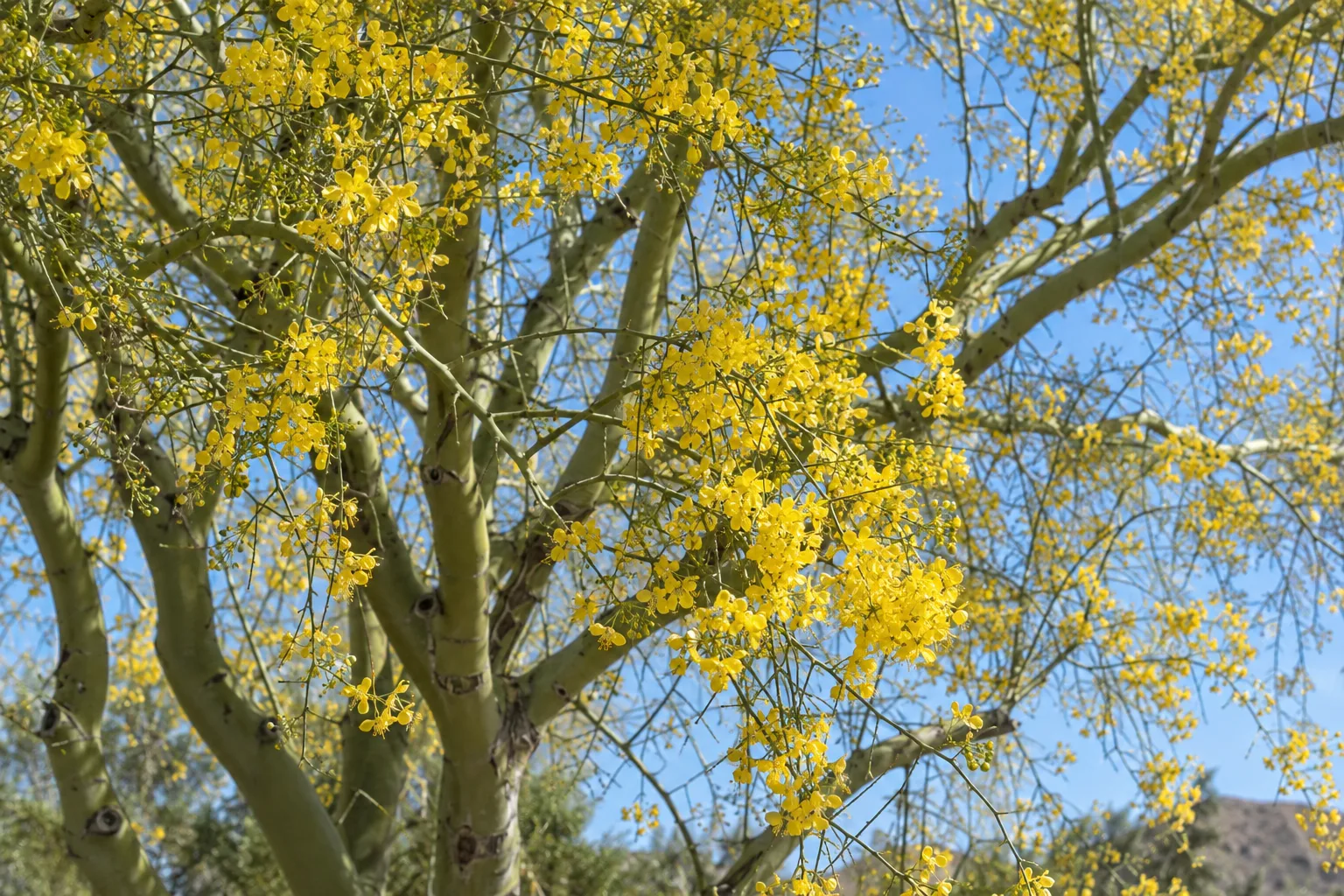
Palo verde (Parkinsonia species and hybrids)
Palo verde reaches 20 to 30 feet tall and wide, so give it 15 to 20 feet of clearance from walls, pools and power lines. Once established it needs a deep soak every couple of weeks in summer. A March planting gives the roots a full spring to anchor before the monsoon winds of July through September. The drawback is litter, because yellow petals and tiny leaflets drop for weeks. Our desert trees page shows the shade trees that suit our soil.
Brittlebush (Encelia farinosa)
Brittlebush forms a silver-gray mound 2 to 4 feet tall and wide, with yellow daisy flowers from late winter into spring. It needs very little water once rooted and handles reflected heat from walls and driveways. The drawback is a short life. Plants often decline after a handful of years, and they look sparse during dry summers.
Blackfoot daisy (Melampodium leucanthum)
Blackfoot daisy is a low mound about 8 to 12 inches tall and 1 to 2 feet wide, covered in small white daisies for months. It prefers gravelly, fast-draining ground and low water. It rots in soil that stays wet, so keep it out of beds that share a zone with thirsty plants.
Agave (Agave species)
Agave sizes vary widely. Agave parryi stays around 2 to 3 feet wide, while Agave americana can spread 6 to 8 feet. Warming March soil encourages new roots without the stress of 110°F days. Each leaf ends in a sharp spine, so keep agave away from walkways and play areas, and handle the root ball gently when you set it in.
Desert marigold (Baileya multiradiata)
Desert marigold grows 1 to 2 feet tall, with bright yellow flowers on long stems from spring into fall. It needs low water once established and reseeds itself. It is short-lived and looks ragged after heavy bloom, so cut spent stalks back and let a few seed heads drop.
Which four plants should wait until April or later?
Saguaro, bougainvillea, tropical sage and desert willow grow fine in the low desert, but each roots and grows better once nights and soil are warmer. An early March planting rarely kills them. It slows them down, and one cold night can set them back for weeks.
Saguaro (Carnegiea gigantea)
Saguaro roots best in warm soil, so wait until late April or later. Cool, wet soil around a fresh planting can lead to rot at the base. It is slow growing, adding only a few inches a year when young, and needs full sun after a gradual introduction if it was grown under shade.
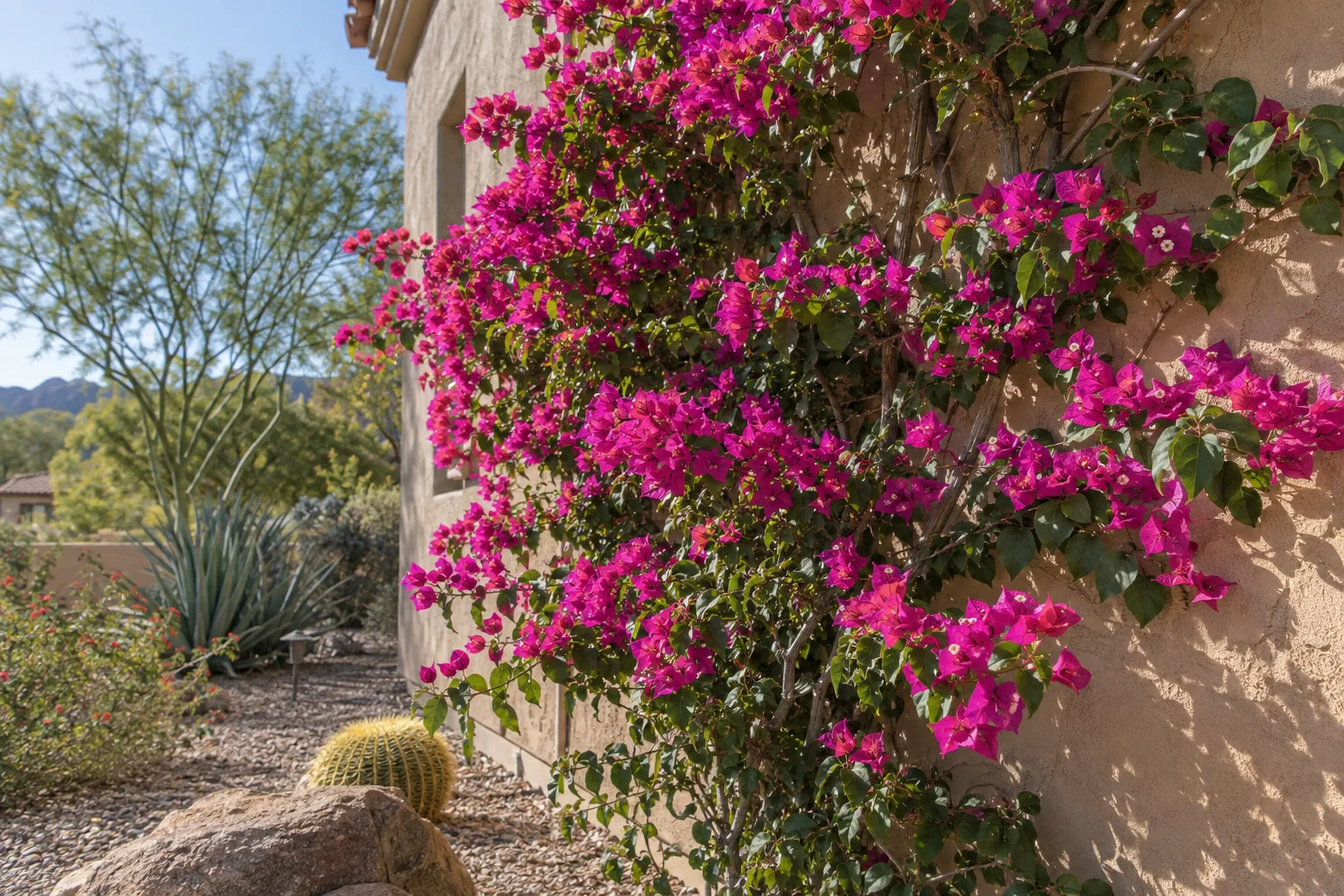
Bougainvillea (Bougainvillea hybrids)
Bougainvillea is frost-tender and sulks when nights fall below about 50°F, dropping leaves after a cold snap. Wait until mid to late April, when nights hold in the 50s. Vines run 15 to 30 feet in full sun. The drawback is sharp thorns and a heavy leaf and bract drop that needs regular raking.
Tropical sage (Salvia coccinea)
Tropical sage grows 2 to 3 feet tall with red flowers that hummingbirds visit, and it wants warmth before it grows well. Autumn sage (Salvia greggii) and Cleveland sage (Salvia clevelandii) can go in during March. Tropical sage is short-lived and reseeds freely, so expect volunteers.
Desert willow (Chilopsis linearis)
Desert willow is deciduous, reaches 15 to 25 feet, and carries pink to purple trumpet flowers from late spring into summer. It is bare or just leafing out in early March. Plant it in April once leaves are pushing, so you can see the roots are working. The drawback is seed pods and leggy growth if you never prune it.
This table sorts all nine plants by planting window.
| Plant | Plant in March? | Sun | Water once established |
|---|---|---|---|
| Palo verde | Yes | Full sun | Low |
| Brittlebush | Yes | Full sun | Very low |
| Blackfoot daisy | Yes | Full sun | Low |
| Agave | Yes | Full sun | Very low |
| Desert marigold | Yes | Full sun | Low |
| Saguaro | Wait until late April | Full sun | Very low |
| Bougainvillea | Wait until mid to late April | Full sun | Low to moderate |
| Tropical sage | Wait until April | Full sun to part shade | Low to moderate |
| Desert willow | Wait until leafing out | Full sun | Low |
How do I plant desert plants in March?
Dig a wide, shallow hole, set the plant slightly high, backfill with your own soil and soak it slowly. Most of our East Valley yards sit on alkaline soil with caliche somewhere below, and that shapes each step.
- Fill a 12-inch test hole with water. If it is still standing after a few hours, choose a raised mound or a different spot.
- Break through any caliche layer with a digging bar if you are planting a tree or large shrub.
- Dig 2 to 3 times as wide as the root ball and only as deep as the root ball.
- Tease apart roots that circle the bottom of the container.
- Set the top of the root ball 1 to 2 inches above the surrounding soil.
- Backfill with the native soil you removed and firm it gently. Skip peat moss and heavy compost.
- Build a low soil berm just outside the hole to hold water.
- Soak slowly, then add 2 to 3 inches of mulch, keeping it 3 to 4 inches away from trunks and crowns.
Planting too deep is a common cause of trunk and crown rot. Take care here.
How often should I water new desert plants in March?
Water every 3 to 5 days for the first month, with each soak wetting the soil 12 to 18 inches deep. Then stretch to about once a week in April and every 7 to 10 days in May for shrubs and perennials. Agave and cacti need less.
Frequent shallow sprinkles keep roots near the surface, where summer heat reaches them first. Hard irrigation water also leaves salts near the top of the soil, and a slow deep soak moves them below the root zone.By the following spring, most of these plants rely mostly on monsoon rain plus an occasional deep drink.
What else belongs on the March garden list?
March is a good month to check drip lines, plant warm-season vegetables and shop for next month’s plants. The University of Arizona Cooperative Extension vegetable planting calendar for Maricopa County lists what can go in during March, and our herbs and vegetables page covers the edible side.
Leave a few things alone. Do not prune frost-damaged growth on tender plants until nights stay warm, because the dead branches still protect the lower stems. Skip heavy fertilizer on natives. For month-by-month timing, see our gardening calendars, and check classes and events for hands-on planting help.
Frequently asked questions
Can I plant cacti in the ground in March?
Yes, most cacti such as prickly pear, cholla and barrel cactus can go in by mid to late March. Choose a spot with fast drainage and water sparingly for the first few weeks, because cool, wet soil can rot roots. Hold saguaro until late April or later.
Is March too late for wildflower seeds?
For most Sonoran wildflowers, yes. Seed sown from October to December gives the best bloom the following spring. Early March seed of desert marigold or globe mallow can still sprout with regular watering, but expect thinner, later bloom.
Should I amend the soil before planting?
Usually no. Backfill with your native soil, because a hole packed with rich compost can hold water around the roots while the surrounding soil stays dry and hard. If your soil is heavy clay, plant 1 to 2 inches high and mix in a little coarse sand or decomposed granite.
What if a cold night follows planting?
Cover tender plants overnight with frost cloth or an old sheet, and remove it in the morning. Cover to the ground rather than only the top. The five March plants above handle brief 35°F to 40°F nights, but bougainvillea and tropical sage are the ones to protect.
Should I fertilize at planting time?
Skip it at planting. Fresh roots are tender, and desert plants grow slowly through their first weeks. Wait until you see new leaves, then apply a light feeding at the label rate. Water in the plant first, and feed only if growth looks pale.
Is March the right month to plant your desert garden?
Yes, if you can water new plants every few days for four weeks and you choose from the first five. March is a poor fit if you want a saguaro or bougainvillea in the ground right away, or if you will be traveling through April. Those plants need another month, and a few weeks of patience costs you little. Stop by our nursery in Queen Creek and we will help you match plants to your yard.