April is the last comfortable month to plant desert plants in the Arizona low desert. Trees, shrubs, perennials, cacti and agaves planted in April get six to eight weeks to root in before highs pass 105°F, then 110°F.
Key takeaways
- Finish planting desert trees, shrubs and perennials by the end of April, before daytime highs settle above 105°F in late May.
- Dig each hole 2 to 3 times as wide as the container and only as deep as the root ball, with the top of the root ball level with or just above the soil.
- Water deeply every 2 to 3 days for the first 2 weeks, then stretch to every 5 to 7 days as May warms up.
- Cacti and agaves can go in through April and into early May, but they need a wide hole and fast drainage.
- Hold fertilizer, cool-season plants and heavy soil amendments until fall, and plan to plant trees and perennials again in September or October.

Which desert plants should I plant in April in the Arizona low desert?
Choose plants adapted to low desert heat, alkaline soil and little water once established. The table below covers eight that suit April planting, and they are varieties we commonly carry in our plant departments, though availability changes week to week and season to season.
| Plant | Mature size | Sun | Water once established | Main drawback |
|---|---|---|---|---|
| Desert willow (Chilopsis linearis) | 15 to 25 feet tall | Full sun | Low | Drops its leaves in winter |
| Blue palo verde (Parkinsonia florida) | 20 to 30 feet tall and wide | Full sun | Very low | Needs a lot of room |
| Velvet mesquite (Prosopis velutina) | 20 to 30 feet tall | Full sun | Low | Thorns and heavy litter |
| Red bird of paradise (Caesalpinia pulcherrima) | 5 to 10 feet tall | Full sun | Low | Freezes back in hard frost |
| Autumn sage (Salvia greggii) | 2 to 3 feet tall | Full sun to part shade | Low to moderate | Blooms slow in peak summer heat |
| Blackfoot daisy (Melampodium leucanthum) | 6 to 18 inches tall | Full sun | Low | Rots in soggy soil |
| Brittlebush (Encelia farinosa) | 2 to 4 feet tall | Full sun | Very low | Looks ragged in summer drought |
| Golden barrel cactus (Echinocactus grusonii) | 2 to 3 feet tall | Full sun | Very low | Sharp spines, rots in wet soil |
Mature size is the detail people miss. A blue palo verde that reaches 25 feet wide does not belong 6 feet from a block wall, so check each plant’s room before you buy.
Why is April a good month to plant in the low desert?
April gives new roots warm soil and mild air with summer still weeks away. A plant fresh from its container has a small root system that cannot keep up with the water its leaves lose, so it needs a few moderate weeks to spread into the surrounding ground. April planting buys roughly six to eight weeks of that.
By June, highs in Queen Creek, Gilbert and Chandler sit above 105°F and often pass 110°F, and the monsoon follows from roughly July through September. Established desert plants handle those conditions well. Plants that go in the same week the heat arrives struggle. Early April is better than late April.
Which desert trees can I plant in April?
Desert willow, blue palo verde and velvet mesquite all establish well in April, because warm soil pushes root growth before summer arrives and each one needs only occasional deep watering once settled. You can compare more options in our desert trees selection.
Desert willow
Desert willow is a fast native tree that often adds 2 to 4 feet a year with regular deep watering. It carries trumpet-shaped flowers in pink to purple shades from late spring into summer, and hummingbirds visit them. It is deciduous. Once established it wants deep, infrequent watering, because shallow daily sprinkling keeps roots near the surface.
Blue palo verde
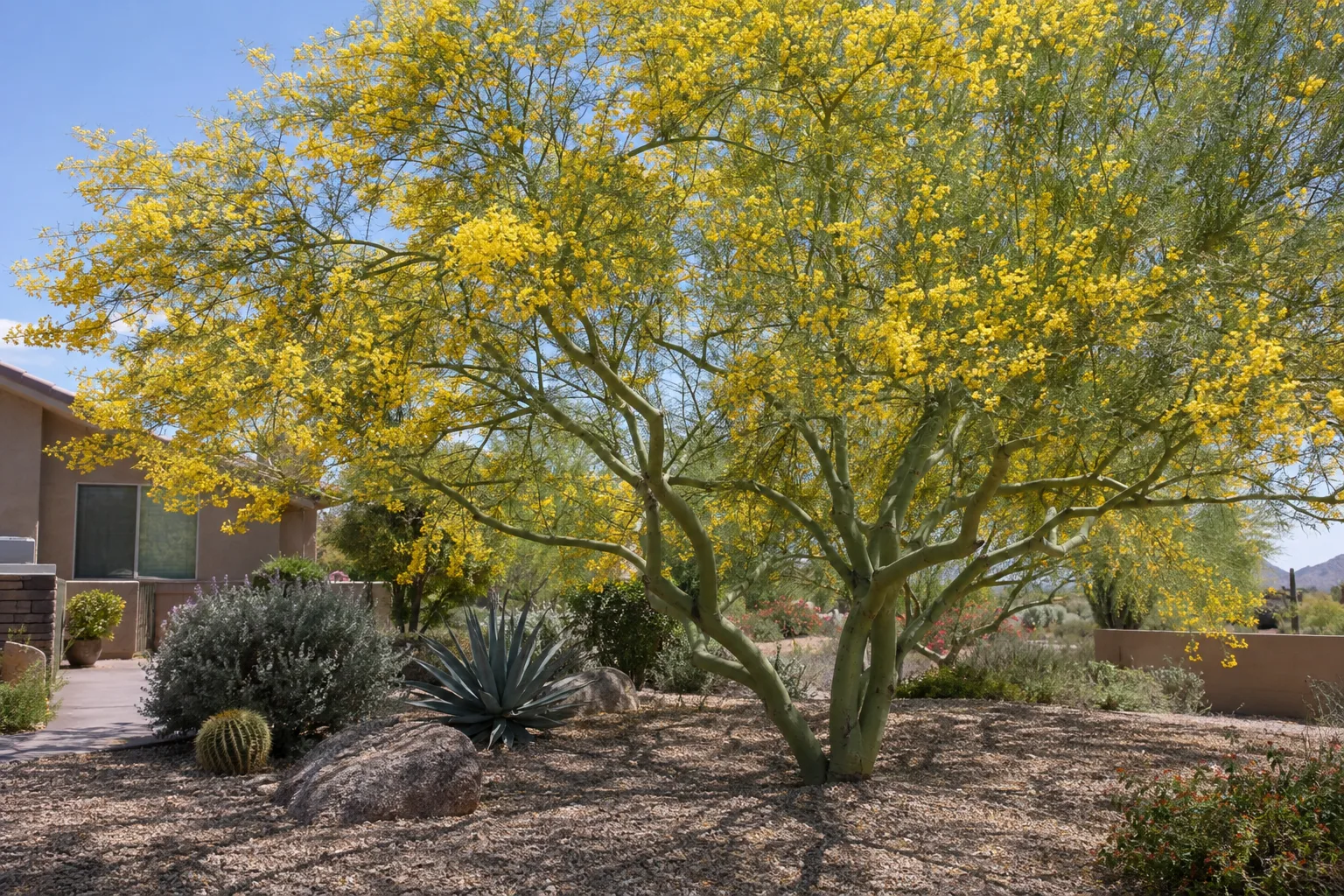
The blue-green bark of blue palo verde photosynthesizes, so the tree stays active after it drops its tiny leaflets in the hottest weeks. Yellow flowers cover it in spring. Canopies reach 20 to 30 feet wide, so give it space. Too much water produces fast, weak branching, and a tree sitting on a lawn irrigation schedule is at risk.
Velvet mesquite
Velvet mesquite is a Sonoran Desert native that casts dense shade and produces seed pods wildlife eat. It has thorns and a wide canopy, so plant it away from walkways, pools and play areas. Roots chase deep water, and April planting gives them a few weeks to start down.
Which shrubs and perennials establish fast in April?
Red bird of paradise, autumn sage, blackfoot daisy and brittlebush all root quickly and fill the layer between trees and ground level with color. Each handles full sun and reflected heat from walls and gravel, which describes most East Valley yards.
Red bird of paradise
Red bird of paradise blooms in orange and red from late spring into fall and likes the heat bouncing off a south or west wall. A hard frost freezes it to the ground, and it usually resprouts in spring. Wait until frost danger has passed before cutting it back.
Autumn sage
Autumn sage grows 2 to 3 feet tall and comes in red, pink, coral and white. It blooms heavily in spring and fall, slows in the hottest weeks and draws hummingbirds. Give it fast drainage and afternoon shade if the spot bakes. Water well through its first season, then taper off.
Blackfoot daisy and brittlebush
Blackfoot daisy stays under about 18 inches and covers itself in small white daisies from spring into fall. Brittlebush forms a silver-gray mound with yellow spring flowers and needs very little water. Soggy soil kills both. Plant them in gravelly, fast-draining ground and water deeply but rarely after the first month.
Can I plant cacti and agaves in April?
Yes, cacti and agaves root well in warm April soil and can keep going into early May. Golden barrel cactus, Engelmann’s prickly pear (Opuntia engelmannii) and most agaves are common April choices. The main risks are rot from poor drainage and sunburn on plants that spent their lives in shade.
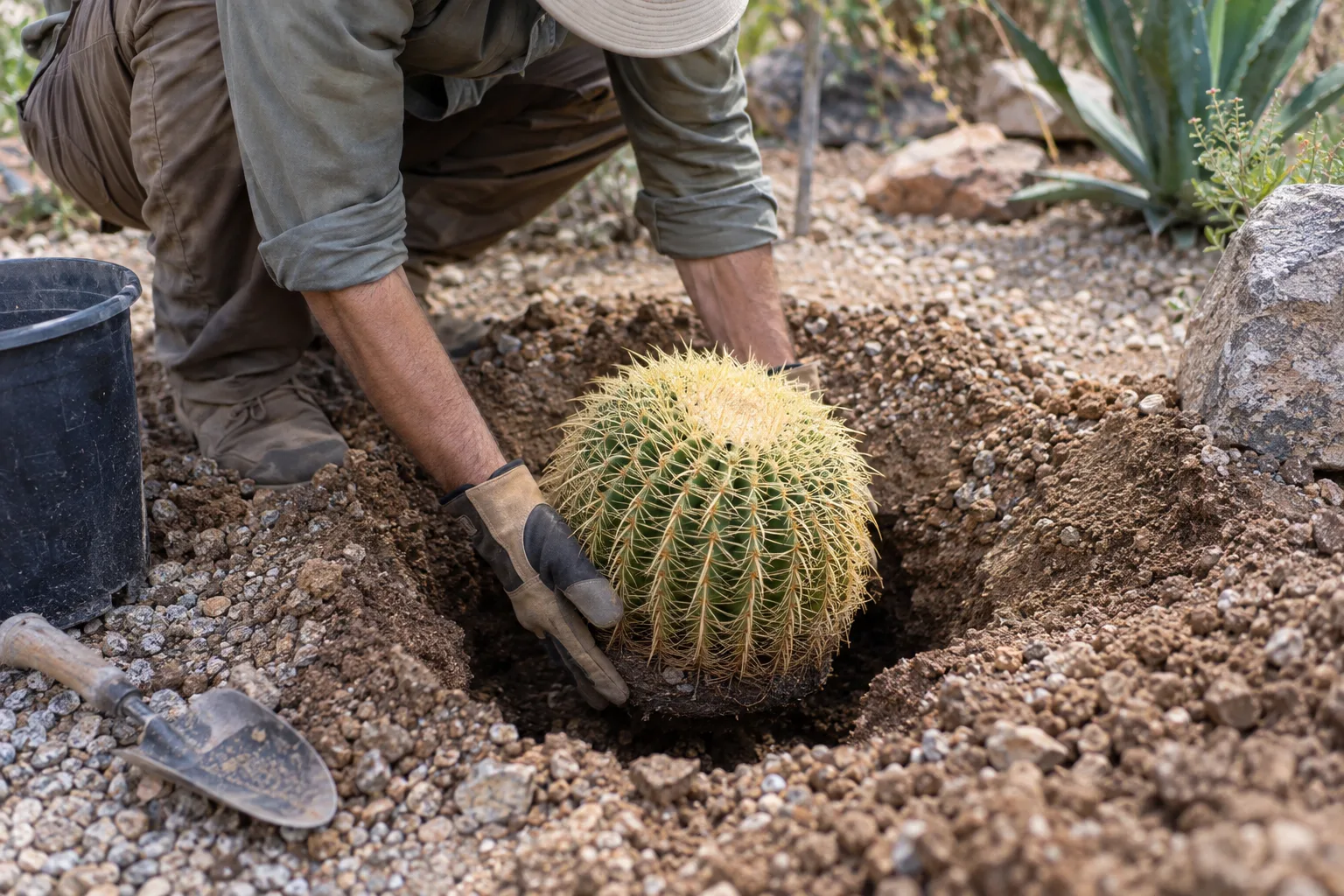
- Dig the hole at least twice as wide as the root ball and no deeper than it. A cactus set too deep rots at the base.
- Face the plant the same direction it faced before, since the side that grew in shade scorches fastest in full sun.
- Water in well at planting, then wait about a week before the next watering so roots reach out for moisture.
- Skip fertilizer at planting.
- Use 30 percent shade cloth over small or freshly moved plants for the first few weeks.
How do I plant desert plants in April, step by step?
Plant in the early morning or evening, dig wide rather than deep, and water deeply right after planting. Afternoons in April can already reach the 90s, and a plant set into hot ground in midday loses water faster than its roots can replace it.
- Water the container the evening before so the root ball is moist.
- Dig a hole 2 to 3 times as wide as the container and exactly as deep as the root ball.
- Break through caliche, the pale, cement-hard layer common in Queen Creek soil, with a digging bar or drill drainage holes through it, so water does not pool in the hole.
- Set the plant so the top of the root ball sits level with or just above the surrounding soil, and loosen any circling roots.
- Backfill with the native soil and tamp it lightly to remove large air pockets.
- Build a low soil berm around the hole to form a watering basin.
- Fill the basin slowly, let it drain, then fill it again so the whole root zone is soaked.
- Spread 2 to 3 inches of mulch and keep it a few inches away from the trunk or stem.
Heavy soil amendment is unnecessary for most desert plants. Amended pockets hold water and keep roots circling inside the hole instead of reaching out.
How often should I water new plants in April and May?
Water deeply every 2 to 3 days for the first two weeks, then every 5 to 7 days as May warms up. These are starting points, and sandy soil dries faster than clay, so check the soil 4 to 6 inches down before each watering.
- Weeks 1 and 2: every 2 to 3 days, soaking the full basin.
- Weeks 3 and 4: every 4 to 5 days.
- May into early June: every 5 to 7 days, with extra water during spikes above 105°F.
- First summer: trees and larger shrubs need regular deep watering, while established shrubs can often stretch to 10 to 14 days.
- Monsoon season: cut back after soaking rain, since wet soil and heat together invite root rot.
Soil still moist at 4 inches means skip the watering. Roots need oxygen as well as water.
What should I leave until fall?
Leave planting in late May through August, heavy fertilizing and cool-season plants for fall. Even tough desert plants fail more often when they go in just as highs settle above 105°F, and shade-loving or cool-climate plants struggle in the heat that follows April.
If you miss April, September and October bring warm soil and cooling air, which gives roots another easy start. Our gardening calendars can help you plan month-by-month timing. Skip heavy pruning of frost-damaged shrubs until you see new growth, because the damaged branches protect the crown.
Frequently asked questions
Do I need to amend the soil when planting desert plants in April?
No, backfilling with the native soil works best for most desert plants. Heavy amendment creates a soft pocket that keeps roots circling instead of reaching into the surrounding ground. In very sandy soil, a small amount of compost in the backfill is fine, and in heavy clay, wide holes and a slightly raised root ball help drainage.
Should I fertilize new desert plants at planting?
Skip fertilizer at planting. Most desert natives do not need it, and a push of top growth competes with the roots you want to build. Wait until you see active new growth and the plant has been in the ground several weeks, then use a light, slow-release feed if the plant needs one.
How can I tell heat stress from underwatering in a new plant?
Check the soil 4 to 6 inches down. Wilting during the 2 to 5 p.m. heat that recovers by evening is usually heat stress, and the soil will still be slightly moist. Wilting that continues overnight, with dry, papery leaves and dry soil, points to underwatering. Give heat-stressed plants afternoon shade and underwatered plants a deep soak.
Which desert plants fit a small yard?
Desert marigold (Baileya multiradiata), blackfoot daisy, autumn sage and golden barrel cactus all stay under about 3 feet. Desert marigold reaches 1 to 2 feet and blooms for much of the year, with a heavy flush in spring. Parry’s agave (Agave parryi) forms a tidy rosette roughly 1 to 2 feet across. Check mature size on each plant tag.
Can I still plant in May if I miss April?
Early May works for tough plants such as agave, golden barrel cactus and red bird of paradise if you water carefully. Trees and perennials do better waiting until September or October, when soil is still warm and the air is cooling. Check our classes and events page for gardening workshops that cover planting timing.
Is April planting right for your yard?
April planting suits you if you can water new plants on a steady schedule for the first month or two and have chosen plants that match your sun and space. It does not suit a yard with no irrigation access, or a gardener who travels through May and June. In that case, wait for September or October, when cooling air gives roots an easy start. Come visit us in Queen Creek and talk through your planting spot with our staff.