
The best desert perennials for containers in Queen Creek are blackfoot daisy, desert marigold, red yucca, autumn sage, globe mallow, angelita daisy and penstemon. Give them a pot at least 12 inches wide, a fast-draining mix and afternoon shade in summer.
Key takeaways
- Use a pot 12 to 15 inches wide and deep for one plant, and 20 to 24 inches wide for a mix of two or three.
- Fill it with roughly half cactus and succulent soil, 30 percent pumice or perlite and 20 percent fine decomposed granite.
- Plant from late September through November or from February to mid-April, and avoid July.
- Water deeply when the top 2 inches of mix are dry: every 2 to 4 days in early summer, every 7 to 14 days in winter.
- Give pots afternoon shade from June through September and lift them off hot concrete.
Which desert perennials grow best in containers?
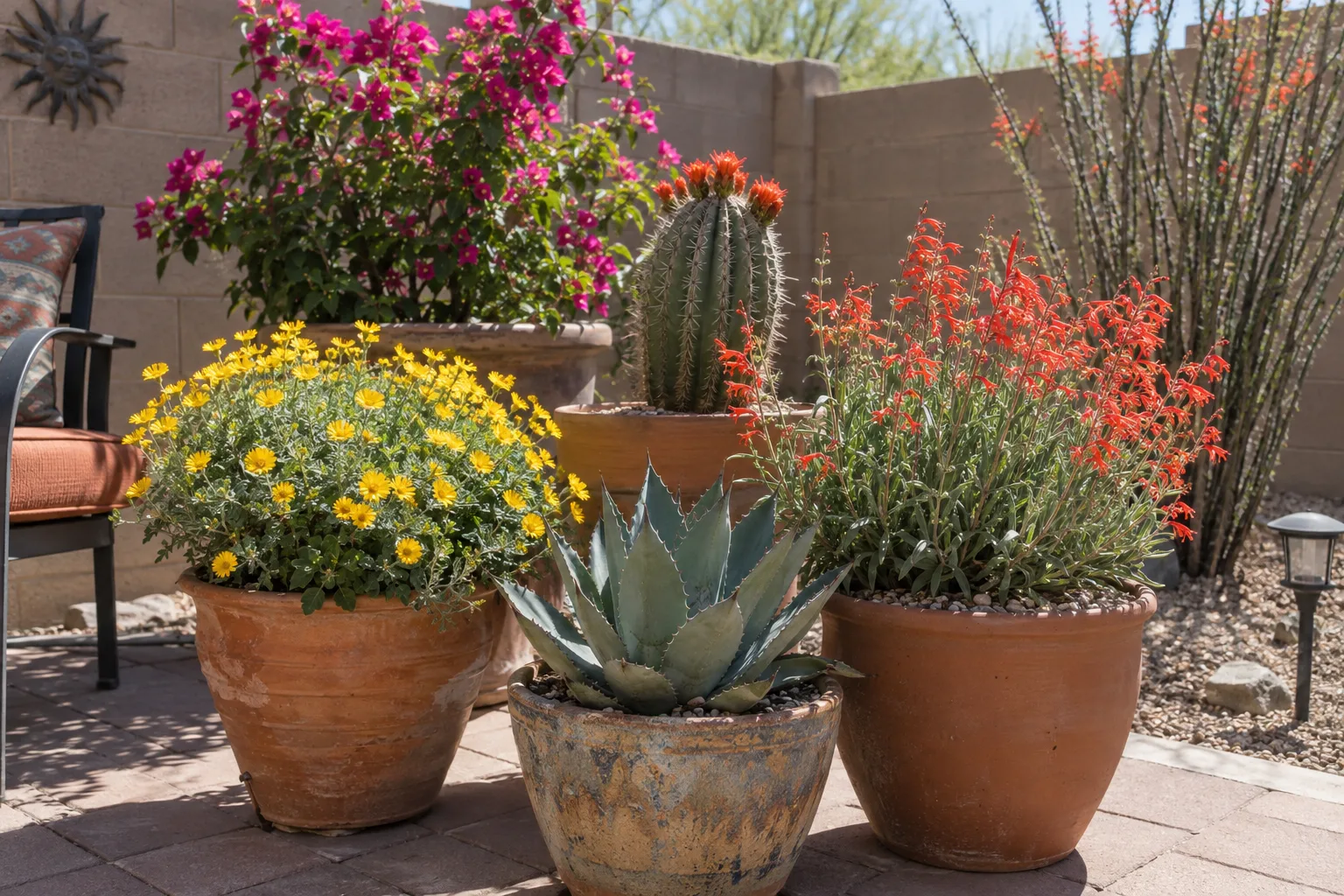
Blackfoot daisy, desert marigold, red yucca, autumn sage, globe mallow, angelita daisy and penstemon are the seven we recommend. Each stays a workable size in a pot, flowers for weeks at a time and needs little water once established. They are varieties we commonly carry, though availability changes week to week and season to season, so ask before planning around one. Browse our plants department and match each one to a container from our pottery and planters. Sizes below assume pot culture.
Blackfoot daisy (Melampodium leucanthum)
Blackfoot daisy forms a rounded mound 6 to 12 inches tall and 12 to 18 inches wide, covered in white flowers with yellow centers. It wants full sun and low water once established. Bloom is heaviest in spring and returns in fall. The drawback is lifespan: it can fade after a few years, and a mix that stays wet through the monsoon shortens that further.
Desert marigold (Baileya multiradiata)
Desert marigold makes a silvery-gray clump about 12 inches tall and wide, with bright yellow flowers on stalks that reach 18 inches or more. It takes full sun and low water. Flowering runs from spring into fall, strongest in spring. The drawback is a short life and a ragged look once the seed heads dry, so shear old stalks back to the foliage.
Red yucca (Hesperaloe parviflora)
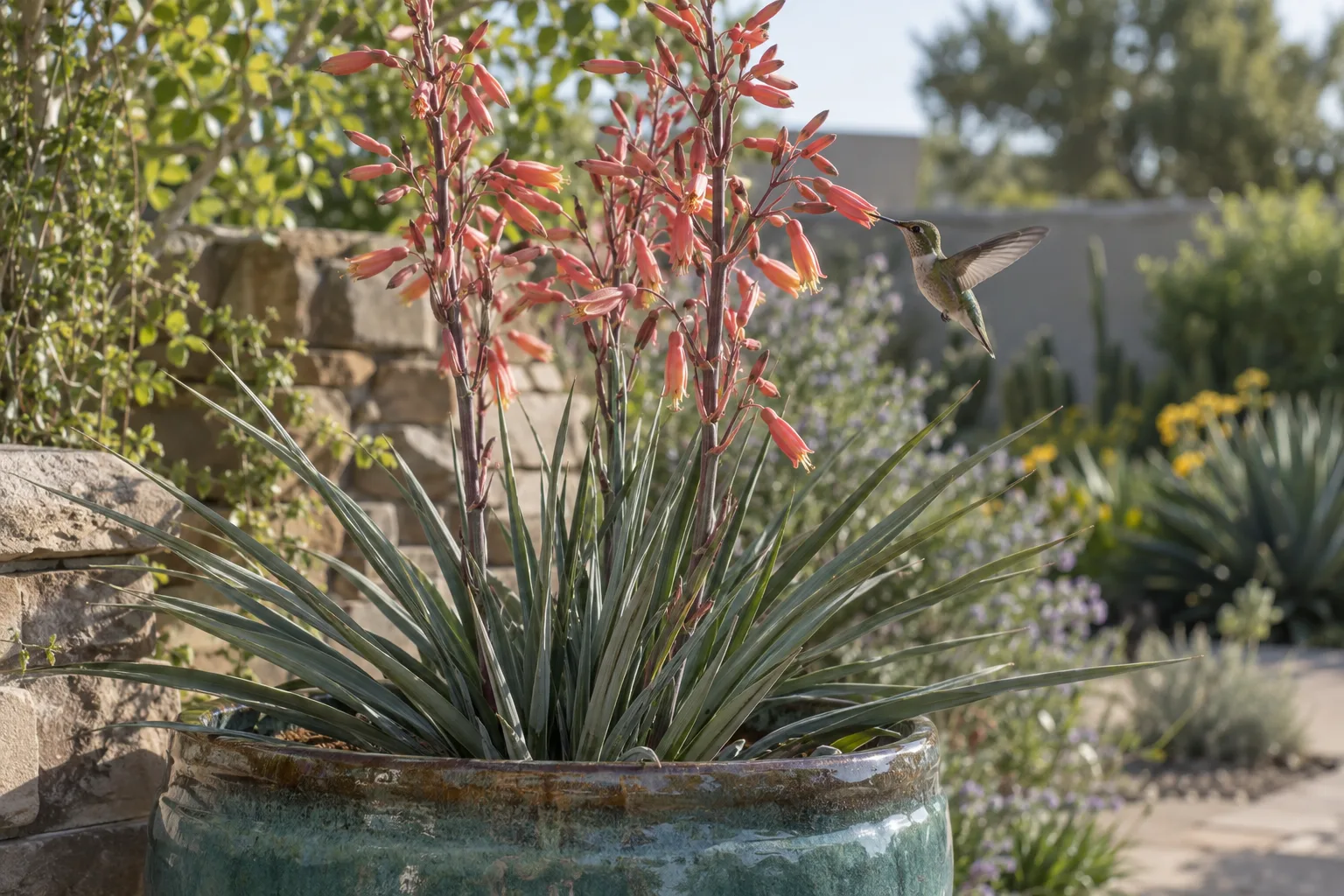
Red yucca is a clump of arching, grass-like leaves 2 to 3 feet tall and wide, with coral-pink flower stalks that rise 3 to 5 feet in spring and early summer. It is not a true yucca. Hummingbirds visit the tubular flowers. It takes full sun and very little water. Its drawback is size, because a tall flower stalk on a light pot tips over in monsoon wind, so choose a heavy container at least 16 inches wide.
Autumn sage (Salvia greggii)
Autumn sage grows 2 to 3 feet tall and wide, with red, pink, coral or white flowers in spring and fall, and some bloom through summer with afternoon shade. It takes sun to light afternoon shade and low to moderate water. The drawback is thirst and shape. It is native to Texas and northern Mexico rather than Arizona, needs more water than the daisies, and turns leggy unless you shear it by about a third in late winter.
Globe mallow (Sphaeralcea ambigua)
Globe mallow grows 2 to 3 feet tall and wide, with apricot-orange flowers from late winter through spring and again after summer rain. It takes full sun and low water, and its gray-green leaves handle reflected heat. The drawback is a loose, sprawling habit. It also reseeds freely, so cut it back after bloom and remove seed heads before they scatter.
Angelita daisy (Tetraneuris acaulis)
Angelita daisy stays 8 to 12 inches tall and about as wide, with yellow flowers close to a tidy mound of narrow leaves. Bloom runs nearly year-round, with peaks in spring and fall. It wants full sun and low water. The drawback is rot: the crown declines fast in wet mix, and its small size lets bigger neighbors crowd it out in a shared pot.
Penstemon (Penstemon eatonii and Penstemon parryi)
Both penstemons send up flower spikes 2 to 4 feet tall above a low rosette of leaves. Eaton’s penstemon has scarlet tubes and Parry’s penstemon has hot-pink ones, and both bloom from late winter through spring. They take sun to light afternoon shade and low water. The drawback is a single main bloom season, followed by spent stalks you will need to cut back, and a lifespan of only a few years.
What kind of pot works in 110°F heat?
A thick-walled pot of glazed ceramic, fiberglass or concrete, at least 12 to 15 inches wide and deep, protects roots best. Thin or dark pots heat quickly, and small ones can dry out in a single summer day, so go larger than you think you need. Every pot needs drainage holes.
| Material | Summer heat performance | Best placement |
|---|---|---|
| Thick glazed ceramic | Good insulation, heavy | Permanent spots with afternoon shade |
| Fiberglass or resin | Low heat transfer, light | Full-sun patios you rearrange |
| Concrete or hypertufa | Thick walls buffer temperature, very heavy | Tall plants such as red yucca |
| Unglazed terracotta | Dries fast, sun-side wall heats up | Shade or morning sun only |
| Thin metal | Heats roots quickly | Avoid in full sun |
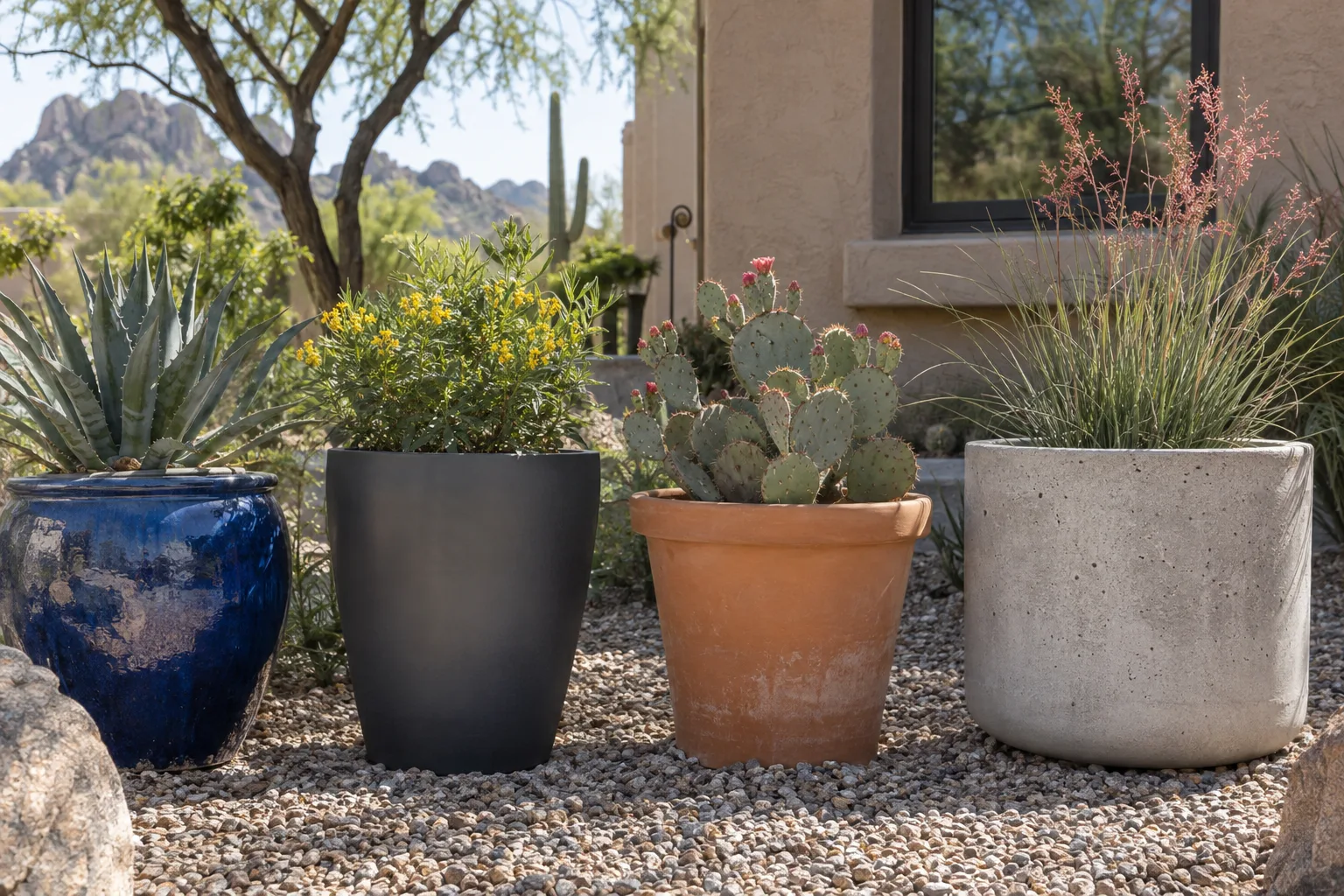
Concrete patios radiate heat into pot walls from below. Set pots on pot feet or a wooden platform so air moves underneath, and keep them a few feet from west-facing block walls when you can.
What soil mix should I use for desert perennials in pots?
Use a fast-draining mix of roughly half cactus and succulent soil, 30 percent pumice or perlite and 20 percent fine decomposed granite. Bagged potting soil holds too much water for these plants and tends to settle into a dense mass within a season or two. A lean mix copies the gravelly soils these plants grow in. Skip peat-heavy blends. Finish the pot with a 1 inch top dressing of decomposed granite or small gravel to slow evaporation and keep the crown dry.
Our tap water is hard, and salts build up in a pot over months as a white crust on the soil or rim. Every month or two, water slowly until a generous amount runs out the bottom to flush them. Feed lightly, with a slow-release fertilizer once in early spring, and skip fertilizer in summer.
How often should I water desert perennials in containers?
Water when the top 2 inches of mix feel dry, and soak the pot until water runs from the drainage holes. In full sun during June and early July that is often every 2 to 4 days, and in cool months it stretches to every 7 to 14 days. Pot size, material and exposure change the interval, so check with a finger instead of following a calendar. Soggy mix does more harm than dry.
The monsoon, roughly July through September, brings humidity and occasional storms, so check the mix before watering and skip a session after a soaking rain. Empty saucers after watering, because a pot standing in water can rot roots.
When should I plant desert perennials in containers?
Plant from late September through November or from February to mid-April. Fall planting gives roots a mild winter to settle before summer, and spring planting works if the plants are in their pots by mid-April, leaving 6 to 8 weeks before the heat arrives. Summer is the hardest time, because young roots struggle when soil temperatures are highest. If you must plant in July, shade the pot after noon and check moisture daily. Our gardening calendars show what else to do each month.
How do I pot up a desert perennial?
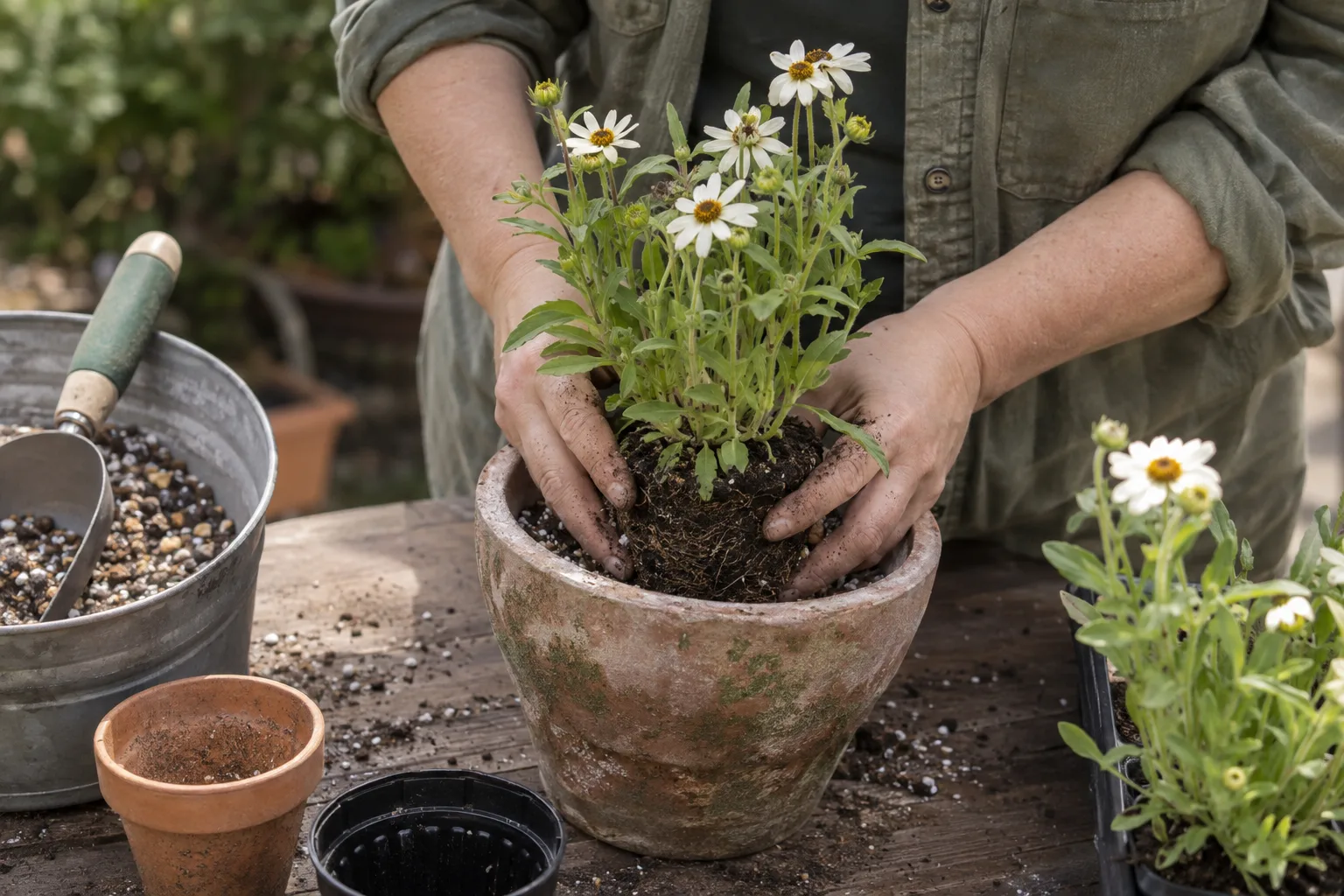
Set the plant at the same depth it grew in its nursery pot, in a clean container filled with fast-draining mix, and water deeply right away. The steps are short.
- Check that the pot has drainage holes, and cover each with a piece of window screen so the mix stays in.
- Fill the pot about one-third full with your mix.
- Slide the plant out of its nursery pot and loosen any circling roots with your fingers. If they are tightly wound, make two or three shallow vertical cuts.
- Set the root ball so the crown sits level with or slightly above the mix, with the pot rim about 1 inch higher to hold water.
- Fill around the root ball, pressing gently to remove air pockets, and keep mix away from the stem.
- Water slowly until it drains freely, then add the 1 inch top dressing of gravel.
- Place the pot where it gets morning sun and afternoon shade from June through September.
What mistakes shorten a container perennial’s life?
Five habits cause most of the losses, and each is easy to change.
- Pots that are too small. A 6 inch pot can dry out within a day in summer, while a 12 to 15 inch pot holds moisture far longer.
- Bagged potting soil. It stays wet around the crown and invites rot.
- Pots on hot concrete or against a west wall. Reflected heat can overheat roots from below and from the side.
- Fertilizing in summer. It pushes soft new growth that scorches above 110°F.
- Frequent light watering. A daily splash wets only the top inch and keeps roots shallow.
Frequently asked questions
Do container perennials need frost protection in Queen Creek?
Yes, on nights forecast near freezing. Roots in a pot are exposed on all sides and chill faster than roots in the ground. Move pots against the house or under a patio cover, or drape frost cloth over them until morning. The plants here handle light frost in the ground, and a few cold hours rarely harm a well-watered pot.
Can I plant several of these in one large pot?
Yes, in a container 20 to 24 inches wide, if the plants share similar sun and water needs. Red yucca in the center with angelita daisy and blackfoot daisy around the edge makes a workable trio. Give autumn sage its own pot, since it wants more water than the daisies and the daisies rot when kept wet.
Which of these plants attract hummingbirds?
Red yucca, autumn sage and both penstemons have tubular flowers that hummingbirds visit. Native bees and other pollinators visit the daisies, desert marigold and globe mallow. Bloom windows differ, from late winter for penstemon to spring through early summer for red yucca, so several pots grouped together give a longer season of flowers.
How often should I repot?
Repot every 2 to 3 years, or when roots circle the inside of the pot or poke from the drainage holes. Fall and early spring are the best times. Move up one pot size, about 2 to 4 inches wider, refresh the mix and water deeply afterward. A pot that dries out within a day even after soaking usually holds a root-bound plant.
Can I add annual color to these pots?
Grow annuals in their own pots instead. Most need water more often than desert perennials, so a shared container ends in soggy roots or wilted flowers. Our annual flowers and foliage section suits pots you water more often, and you can set them beside the perennial pots for a mixed display.
Are container desert perennials right for your patio?
Yes, if your pots get morning sun and some afternoon shade from June through September, and you can check moisture every few days in early summer. Choose these perennials for color, hummingbirds and low water use once established. Skip them if you want lush tropical foliage, or if the only spot you have is a west-facing concrete slab you cannot shade or elevate, because that heat stresses roots even in a thick pot. Come see the pots and plants in person at our nursery in Queen Creek.