

Desert modern garden design pairs clean lines with a short list of low-water plants and plenty of open space. In Arizona it suits our heat and alkaline soil. Plan structure and irrigation first, choose five to eight plant types, and finish with decomposed granite.
Key takeaways
- Use 5 to 8 plant species, repeated in groups, with open gravel between them.
- Lay out hardscape and drip irrigation before any plant goes in, then spread 2 to 3 inches of decomposed granite last.
- Plant from October through March so roots establish before summer highs above 110°F.
- Test each planting hole for caliche by filling it with water; if water is still standing after 24 hours, break through the hard layer.
- Expect the yard to look its best after 3 to 4 years of growth, and water new plants more often for the first year or two.

What is desert modern garden design?
Desert modern garden design applies the straight lines and restraint of mid-century and contemporary architecture to a yard planted with desert-adapted species. Beds have crisp edges, steel, block and stone are left looking like themselves, and open ground between plants counts as part of the design. Gravel replaces turf.
The style suits Queen Creek’s conditions. Summer highs run above 110°F, our soil is alkaline with caliche underneath, and the monsoon arrives roughly July through September, so plants that evolved in the Sonoran Desert need far less coaxing than most. Drip irrigation to a handful of plants also uses much less water than a lawn.
Which plants work in a desert modern yard in the East Valley?
Choose plants with a strong shape and a clear job: one or two large focal plants, a mid-layer of structured shrubs and succulents, and a tree for shade. These are varieties we commonly carry in our desert-adapted plants department, and availability changes week to week and season to season. Here are reliable choices.
- Whale’s tongue agave (Agave ovatifolia): a broad blue-gray rosette, roughly 3 to 5 feet tall and 4 to 6 feet wide, in full sun. The leaf tips are sharp, so keep it back from paths.
- Desert spoon (Dasylirion wheeleri): a globe of narrow gray-green leaves, about 3 to 5 feet tall and wide, with very low water needs once established. The leaf edges carry small hooked teeth.
- Red yucca (Hesperaloe parviflora): arching leaves about 3 to 4 feet tall and coral-pink flower stalks in spring and summer that hummingbirds visit.
- Brittlebush (Encelia farinosa): a silver-gray mound near 3 feet tall with yellow daisies from late winter into spring. It looks ragged after bloom, so tidy it lightly.
- Golden barrel cactus (Echinocactus grusonii): a round, sculptural form that reaches 2 to 3 feet across very slowly. Young plants can scar in a hard frost.
- Muhly grass (Muhlenbergia species): fine texture and movement, about 3 to 4 feet tall. Cut it back in late winter.
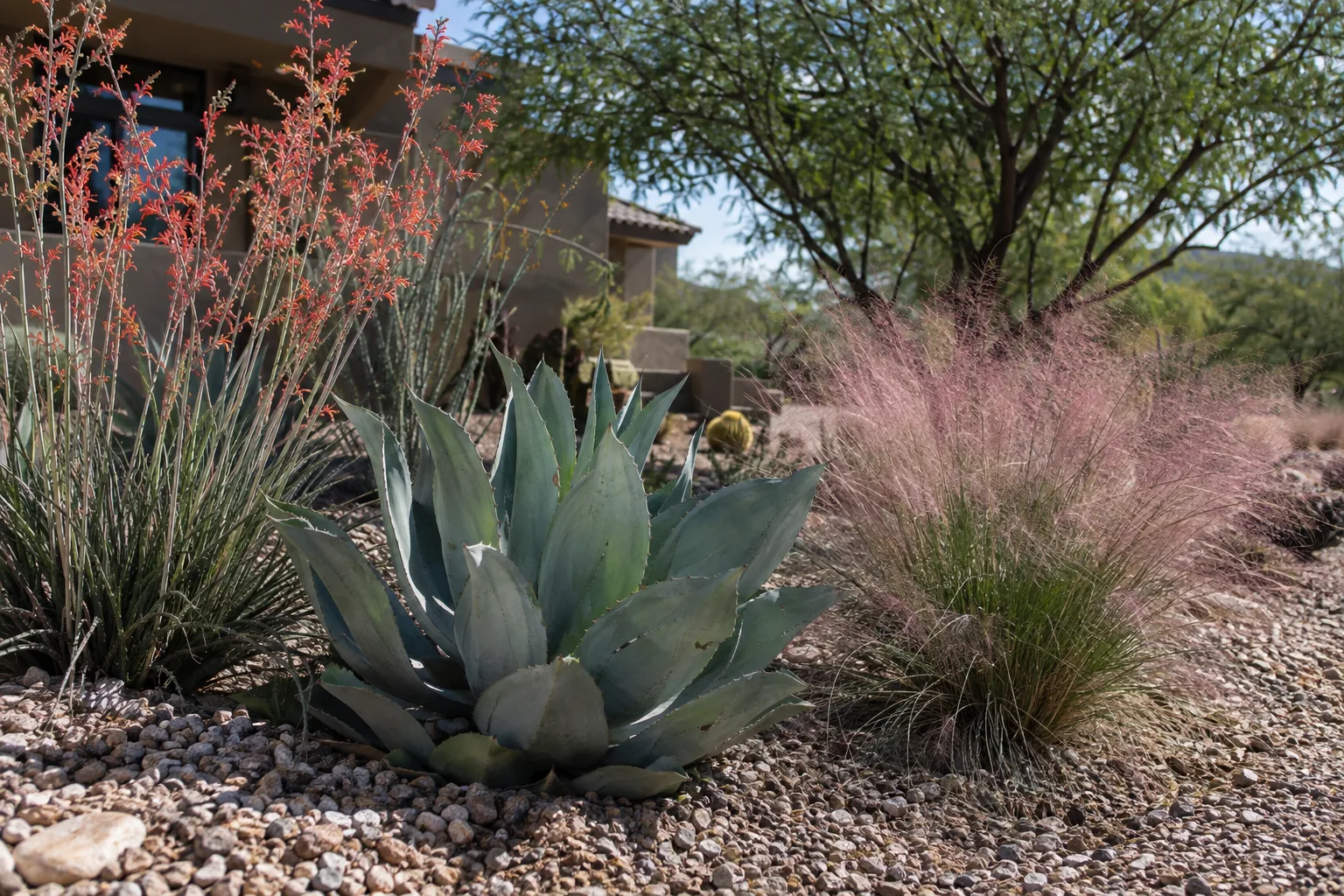
For shade, a thornless palo verde such as Parkinsonia ‘Desert Museum’ (usually 20 to 25 feet tall) casts light, dappled shade that keeps the gravel and plants beneath visible. Compare other options in our desert trees department. Give any tree room, because a 25-foot canopy planted 5 feet from a wall needs constant pruning.
When should I plant a desert modern yard in Arizona?
October through March is the best planting window in the low desert. Fall planting gives roots a full cool season to establish before the first summer, while plants set out from May through August face highs above 110°F and need frequent watering and shade cloth. Spring planting works with extra attention.
Our gardening calendars list what to do each month, which helps you pace a project across the seasons. Hardscape and irrigation can go in during summer, leaving the planting for fall.
What do I need before I start?
You need a scaled sketch of the yard, a few basic tools and a set of drip irrigation supplies before any plant goes into the ground. Gather everything first. Trenching or re-digging after planting damages roots.
- Graph paper or a printed site plan, a measuring tape and marking paint for laying out beds
- A round-point shovel, a digging bar for caliche and a wheelbarrow
- Drip tubing, emitters, a filter, a pressure regulator and a timer with a rain sensor
- Edging such as steel or block, plus landscape fabric if you want a weed barrier under the gravel
- Decomposed granite in one color, enough to cover beds 2 to 3 inches deep
How do I plan and build a desert modern yard?
Work from structure to plants: hardscape first, then irrigation, then specimens, with fill plants and gravel last. Following this order prevents most rework, and each step below builds on the one before it.
- Walk the yard in the afternoon and note the full-sun spots, the shade cast by the house, and where water collects after a monsoon storm.
- Stand at the front door, the kitchen window and the main seating area, and sketch what you see from each, since those views decide where focal plants go.
- Draw paths, bed edges and walls. Hardscape is costly to move later.
- Set your palette: one gravel color, one or two hardscape materials, and 5 to 8 plant species repeated in groups.
- Mark the specimen plants and the tree before anything else, then probe each spot for caliche.
- Run drip lines and emitters to every planting zone before spreading any gravel.
- Plant the mid-layer shrubs and succulents around the specimens, leaving open ground between groups.
- Spread 2 to 3 inches of decomposed granite and add low-voltage lighting aimed at your best plants.
If you want to ask questions as you plan, see our classes and events page for upcoming sessions.
Which hardscape materials fit a desert modern yard?
Choose one or two main materials and repeat them across the yard, because repetition is what ties the design together. Decomposed granite, steel, block, flagstone and boulders all suit the style, and each behaves differently in our heat.
| Material | Best use | East Valley note |
|---|---|---|
| Decomposed granite | Ground cover and paths | Drains well and is easy to rake and refresh; a warm tan or buff blends with the surrounding desert |
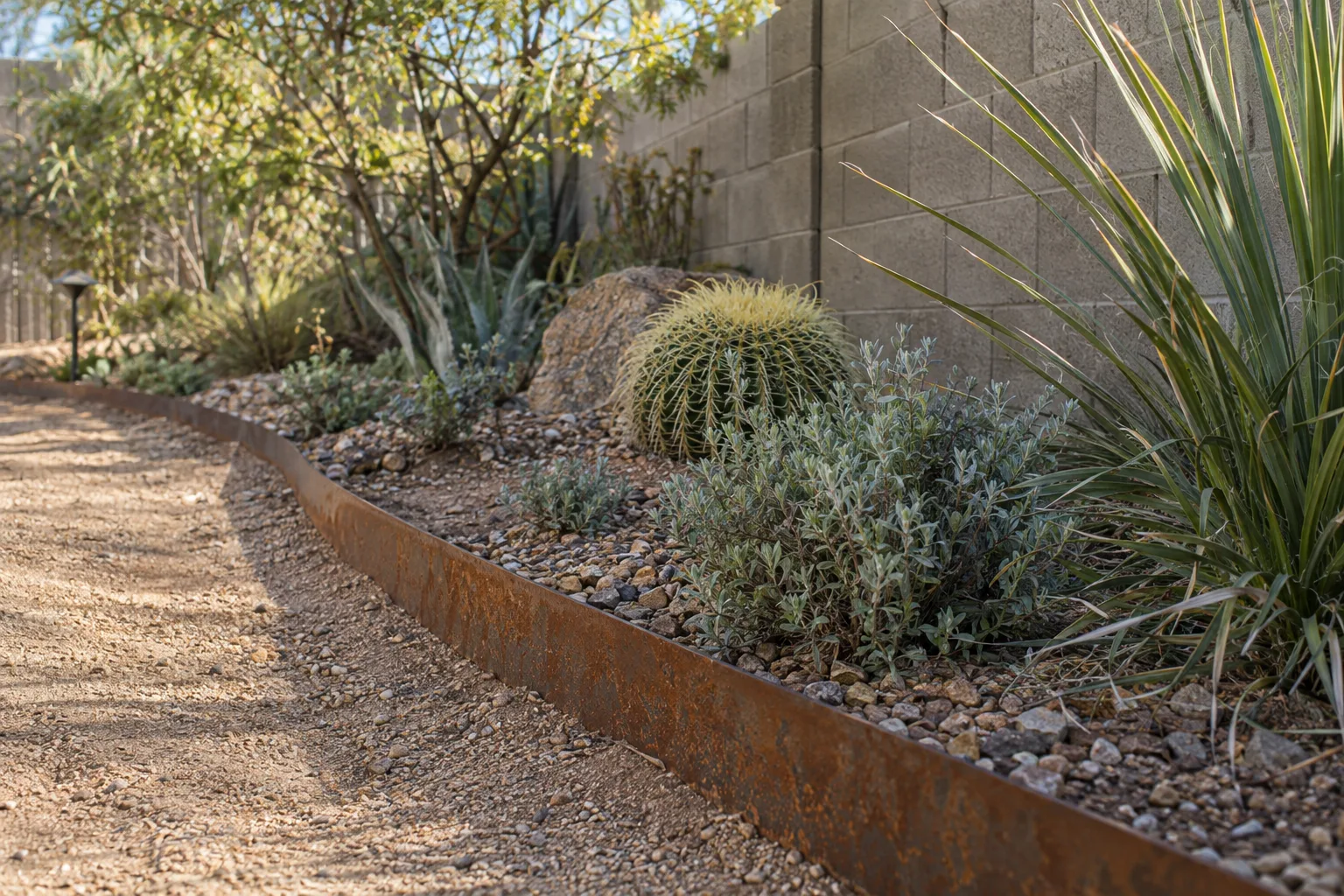
| Cor-Ten steel | Bed edging and raised planters | Weathers to a rust color over several months; runoff can stain nearby concrete |
| Concrete block | Walls, seating and raised beds | Handles heat well; finish with stucco or paint to match the house |
| Flagstone | Patios and stepping stones | Absorbs heat and can be hot underfoot on summer afternoons |
| Boulders | Focal points and dry creek beds | Bury about a third of each one so it looks like it belongs |
Cor-Ten steel starts as bare steel and weathers to a stable rust-colored surface over several months, with no paint or sealer needed. Its runoff stains light concrete and pavers during that time, so keep it at the edge of gravel beds rather than beside a patio. Plan for the stain.
How should I water a desert modern yard?
Use drip irrigation with emitters at each plant, and water deeply and infrequently. New plants need water every few days at first, then less often as roots spread over the first year or two. Once established, many desert plants do well with a deep soak roughly every 10 to 14 days in summer, though agaves, yuccas and trees differ.
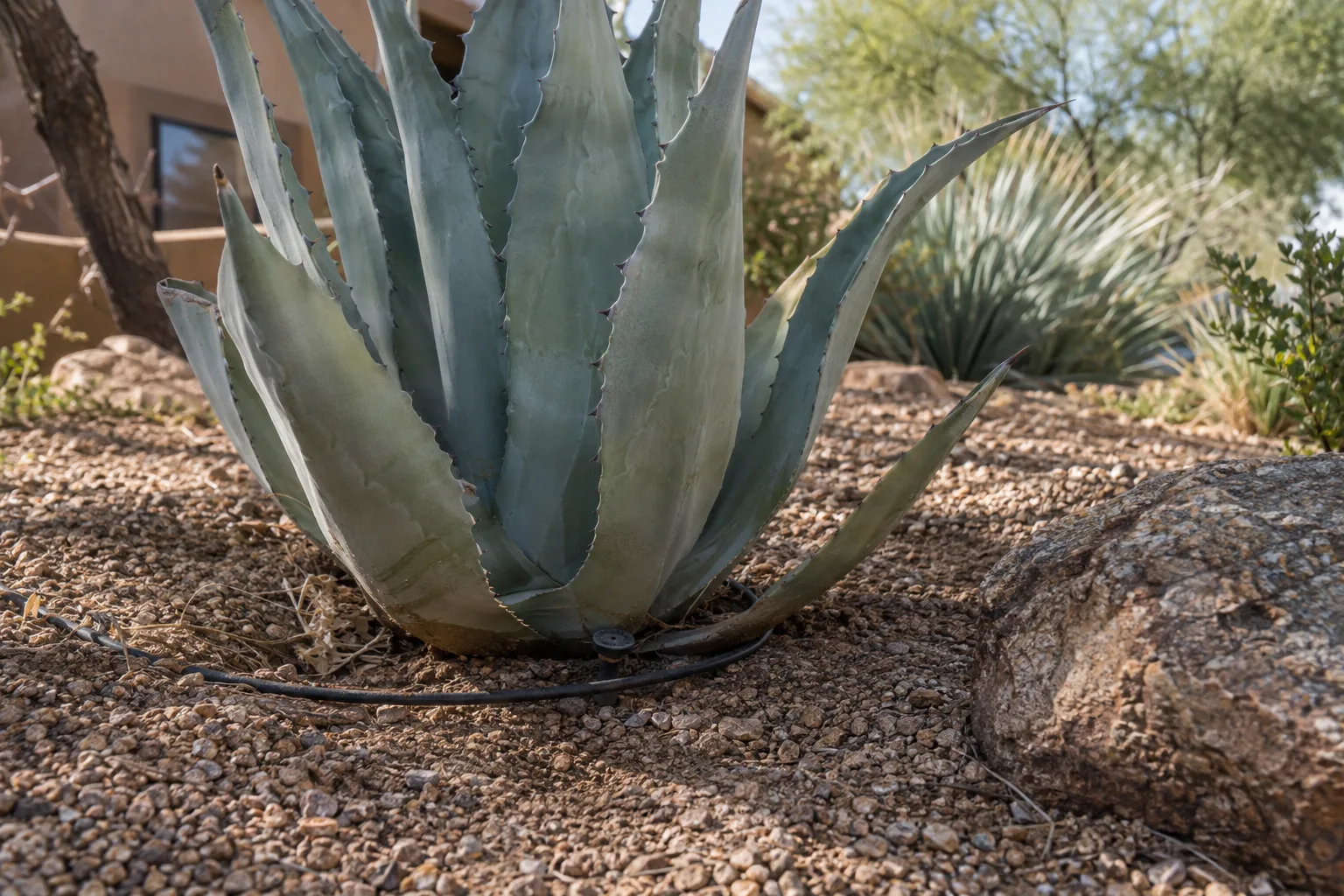
Caliche is a hard, cement-like layer of calcium carbonate that often sits a foot or two below the surface in our soil. It holds water around roots and can rot plants that want sharp drainage. Dig each hole, fill it with water and watch: if water is still standing after 24 hours, break through the layer with a digging bar before you plant.
Hard water leaves a white mineral crust on emitters, so check them monthly and replace any that clog. Add a rain sensor or a smart controller so the system skips cycles during the monsoon.
What mistakes ruin a desert modern yard?
Most failures trace back to too many plants, the wrong rock color or skipped prep work. These five are the easiest to avoid.
- Too many species. A bed with 12 or 15 kinds of plants reads as a collection. Stay with 5 to 8 and repeat them.
- Very light rock. White or pale gravel throws heat and glare onto plants and walls, while tan, buff or charcoal looks natural.
- Small plants in a wide bed. Young plants look lost for years, so put the largest specimens at focal points and fill in around them.
- Skipping the caliche check. A palo verde or agave set in a hole that holds water can decline, so test drainage first.
- Planting in peak heat. Large plants set out in summer need extra water and shade, and waiting for October is easier on them.
Frequently asked questions
How much maintenance does a desert modern yard need?
A well-established yard needs a few hours a month. Expect to cut back grasses in late winter, tidy brittlebush after it blooms, pull weed seedlings after monsoon rain and check emitters. Timers also need seasonal adjustment. That is far less than a lawn, though no yard is zero maintenance.
How do I keep weeds out of decomposed granite?
Lay woven landscape fabric under the granite, keep the layer 2 to 3 inches deep and pull seedlings while they are small. Fabric slows weeds from below but cannot stop seeds that land on top, so expect some hand-pulling after rain. Avoid solid plastic sheeting, which blocks water from reaching roots.
Can I do desert modern in containers on a small patio?
Yes, a single agave, golden barrel or muhly in a large container gives the same look in a small space. Choose simple shapes in one color with drainage holes, such as those in our pottery and planters. Pots dry out faster than ground soil in summer, so check them often.
How long until a desert modern yard looks finished?
Most yards look established after 3 to 4 years of growth. Plants fill out slowly, and the open space that looks sparse at planting is part of the design. Resist adding extra plants in the first year, which crowds the layout later.
Does Cor-Ten steel stain concrete?
Yes, rust runoff can stain light concrete, pavers and stucco, especially in the first year or two while the steel weathers. Keep it at the edge of gravel beds, or leave a gravel strip between the steel and any concrete. A sealer on nearby concrete may reduce staining.
Is desert modern right for your yard?
Desert modern suits homeowners who want a tidy, low-water front yard with strong structure and who will plan before planting. It is a poor match if you want a lush cottage garden, a play lawn for kids and pets, or a quick weekend makeover, since good results depend on doing the work in order and waiting 3 to 4 years for growth. Stop by Desert Horizon Nursery in Queen Creek with your sketch and we will help you choose plants.
