The best desert landscape ideas for Arizona yards in spring are layered planting, grouped native plants, mixed ground textures, real shade and drainage planned for the monsoon. Late February through April is the window to start, before summer highs pass 110°F.
Key takeaways
- Plant between late February and April so roots settle in before summer highs above 110°F. Mid-September through November is the second good window.
- Build the yard in four layers: canopy trees, mid-height shrubs, groundcovers under 3 feet, and accents such as agave.
- Group plants in clusters of three, five or seven, and put plants with similar water needs on the same drip zone.
- Place shade trees on the west and southwest sides of patios and windows, and check mature size before you buy.
- Plan for the monsoon (roughly July through September) with dry creek beds or swales, and keep agaves and cacti out of low spots.
Why is spring a good time to redo a desert yard?
Late February through April gives new plants several weeks of mild weather to root in before summer highs pass 110°F in Queen Creek. A shrub planted in March has a working root system by June, while the same shrub planted in August spends its first weeks in heat stress and needs daily attention.
Spring also shows you which plants came through winter. A January or February frost can blacken tender growth on bougainvillea, lantana and citrus, and by March you can see what is sprouting again and what needs replacing. Wait for new growth before you cut anything back. Fall planting works too.
Our gardening calendars lay out what to plant and do in each month, which helps you sequence a bigger project across the season.
How does layered planting work in a desert yard?
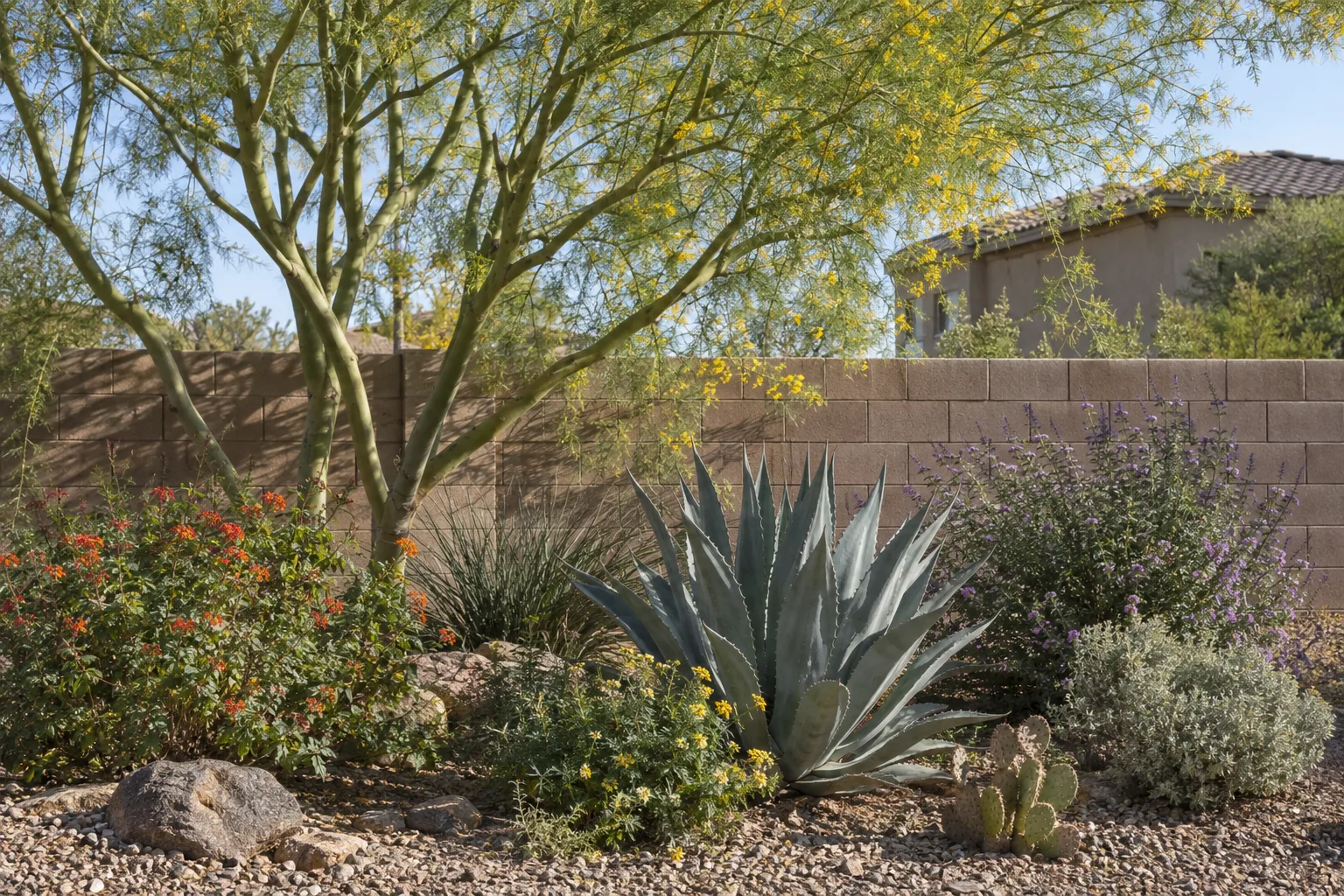
Layered planting stacks four heights of plants, the way a natural desert is built. Flat yards with a tree here, a cactus there and gravel everywhere feel hotter and look sparse. Layers shade the soil, soften reflected heat from block walls and paving, and give birds cover.
| Layer | Typical height | Examples |
|---|---|---|
| Canopy | 15 to 30 feet or more | Desert willow (Chilopsis linearis), blue palo verde (Parkinsonia florida), Chilean mesquite |
| Mid-story | 3 to 8 feet | Brittlebush (Encelia farinosa), Texas sage (Leucophyllum frutescens), feathery cassia |
| Groundcover | Under 3 feet | Trailing rosemary, blackfoot daisy (Melampodium leucanthum), lantana |
| Accent | Varies | Agave, yucca, barrel cactus |
You do not need every layer in every bed. A small front yard might carry one tree, a few shrubs and a groundcover, with an agave as the focal point. Browse our plants department to see what fits each layer.

Why plant in groups of three, five or seven?
Odd-numbered clusters look natural because wild plants grow in colonies, not in single spaced-out specimens. Think of brittlebush spilling down a hillside or ocotillo lining a dry wash. A cluster of one plant type also reads as a deliberate design instead of a scattered collection.
Groups make irrigation easier. Plants with similar water needs share a drip zone, so you are not overwatering a barrel cactus because the bougainvillea beside it needs more. Mulch also covers a grouped bed more evenly than it covers a dozen separate plants.
Pollinators favor clusters. A block of flowering sage or penstemon gives hummingbirds and native bees a reliable stop, while a single plant draws far fewer visits.
Which plants suit a spring refresh in Queen Creek?
These are varieties we commonly carry, though availability changes week to week and season to season. Each one handles full sun and alkaline soil once established, and each has a drawback worth knowing before you plant.
Desert willow (Chilopsis linearis)
This small native tree reaches 15 to 25 feet and bears trumpet-shaped pink, lavender or white flowers from spring into summer that hummingbirds visit. It needs little water once established. The drawback is that it drops its leaves in winter and sets seed pods that need cleaning up.
Autumn sage (Salvia greggii)
Autumn sage grows 2 to 3 feet tall and wide and blooms from spring through fall in red, pink, coral or white. It takes full sun with moderate to low water. It turns leggy if you skip a hard cut back in late winter.
Parry’s agave (Agave parryi)
Parry’s agave forms a tight, blue-gray rosette, usually under 3 feet across, and handles frost better than many agaves. Water it sparingly. The leaf tips are sharp, so keep it away from walkways and play areas.
Bougainvillea (Bougainvillea species)
Bougainvillea climbs fences and pergolas with magenta, orange, red or white bracts for months. It likes full sun and little water once established. Frost burns it back, so plant it in spring, keep it in a warm spot against a wall, and cover it during cold snaps.
Blue palo verde (Parkinsonia florida)
This tree grows 15 to 30 feet, carries green bark that keeps photosynthesizing when leaves drop, and covers itself in yellow flowers in spring. It needs deep, infrequent water. Expect litter from blossoms and tiny leaves, and keep it clear of pools.

For more options, see our flowering trees.
What can I use on the ground besides plain decomposed granite?
Decomposed granite works well as one layer of the ground plane, combined with river rock, boulders and flagstone. It is affordable and suits the climate, but a whole yard of one gray or tan surface reads as flat and holds heat.
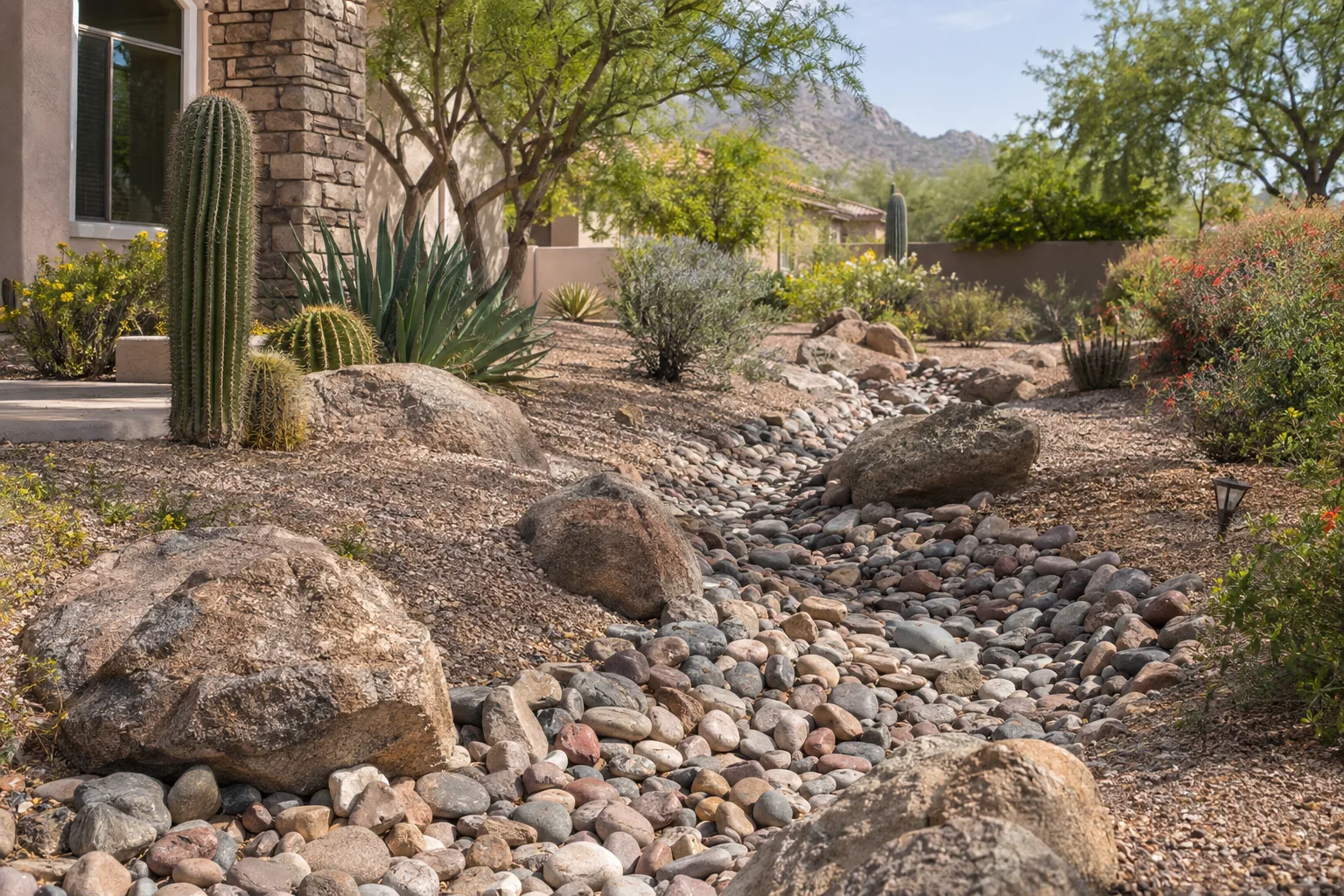
Dry creek beds made from rounded river rock look good year-round and carry water during storms. Bury boulders about a third of their height so they look placed by nature. Flagstone paths give you a firm walking surface through plantings. Set a few DG samples against your stucco in morning and afternoon light before ordering a truckload, because color shifts a lot between a bag and a full yard.
A 2 to 3 inch layer of gravel mulch over root zones slows evaporation and keeps soil cooler. Large planters from our pottery and planters add height and color at entries and patios.
Where should shade trees and structures go?
Put shade on the west and southwest sides of the spaces you use, since that is where afternoon sun is strongest from May through September. A mature tree can make the area under its canopy noticeably cooler than open gravel.
Check mature size before you choose. A Chilean mesquite can pass 30 feet with a canopy just as wide, which suits a large lot but overwhelms a small courtyard. Desert willow stays closer to 15 to 25 feet. Keep trees well back from walls, roofs, pools and overhead lines.
A pergola or shade sail gives relief while a young tree grows. Browse our desert trees to compare sizes and canopy shapes.
How do I plan for monsoon drainage?
Plan where water goes before you plant, because monsoon storms from roughly July through September can drop heavy rain in a short time. Water that pools against a foundation or around a root zone causes damage fast.
Dry creek beds and gravel swales channel runoff away from walls and patios and toward planting areas or the street. Plants placed along the flow get a natural soaking and often push new growth afterward. Keep agaves, cacti and other desert plants out of low spots, because their roots rot if the soil stays wet.
Test a planting hole by filling it with water and watching how fast it drains. Slow drainage often points to caliche, the hard calcium layer under much of the East Valley. Plant on a low berm if it will not drain.
What should I do first, and what should I leave alone?
Start by looking at what you have, then work from the biggest problems to the smallest. Spring projects go smoothly when the order is clear.
- Walk the yard and photograph everything, noting survivors, struggling plants and outgrown shrubs.
- Mark problem spots, such as a west wall that radiates heat or a corner where water pools.
- Sketch a rough layout with dimensions so you can count plants before you buy.
- Remove plants that show no new growth by mid-March.
- Dig wide planting holes and break up any caliche you hit, or plant on a low berm above it.
- Lay drip lines and test each emitter, then plant trees first, shrubs next, groundcovers and accents last.
- Mulch with 2 to 3 inches of gravel and check emitters weekly for the first two months.
Leave frost-damaged branches in place until new growth shows, since the dead wood shields the lower stems. Skip heavy soil amendments, because desert plants do not need rich soil. Avoid planting in June and July, when highs regularly pass 110°F.
Frequently asked questions
How much water do established desert plants need in summer?
Established desert plants still need deep, infrequent watering in summer, and the interval depends on plant type, soil and exposure. Large trees usually go longest between soakings, shrubs need water more often, and cacti and agaves need the least. Check the soil a few inches down before each watering and adjust for monsoon rain.
Which desert plants add color with little water?
Autumn sage, brittlebush, blackfoot daisy, lantana and bougainvillea all give color with low water once established. Brittlebush brings yellow flowers in spring, while sage and lantana can bloom for months. Mix plants with different bloom windows so something is always in flower, rather than everything peaking in the same few weeks.
How do I keep a gravel yard from looking like a parking lot?
Vary the ground surface, plant in groups and mix heights. Combine river rock, boulders and flagstone with decomposed granite, then edge the beds with larger stones. Add trees and tall accents so the eye has something to follow. Mulching close to plant bases removes the bare gaps that make a yard look unfinished.
Can I plant in fall instead of spring?
Yes, mid-September through November is a good planting window in the low desert. Soil is still warm enough to encourage rooting, and the air is cooler. Frost-tender plants such as bougainvillea do better planted in spring, so they have a full season of growth before their first cold snap.
What helps attract hummingbirds and native bees?
Flowers that bloom in different seasons attract both. Autumn sage, desert willow, penstemon and globe mallow cover spring through fall. Plant them in clusters so pollinators find a dependable source, and leave a few patches of bare soil or loose rock for ground-nesting bees and for lizards that eat garden pests.
Is a desert landscape refresh right for your yard?
A refresh makes sense if you have a mostly bare gravel yard, a hot west wall, or a lawn you no longer want to water. Start with one bed and let it set the pattern for the rest. It is a poor fit if you want a lush, green lawn feel or cannot adjust your irrigation, since desert plantings need a drip system matched to each group. Stop by the nursery in Queen Creek and talk through your yard with us.