The best desert-friendly backyard ideas for Arizona heat start with shade, then drip irrigation, then plants suited to the low desert. These ten ideas work in Queen Creek and across the East Valley, where summer highs pass 110°F and soil is alkaline.
Key takeaways
- Build shade on the west and south sides first, since it can cool a patio by roughly 15 to 20°F.
- Run drip irrigation early in the morning on a timer, with separate zones for trees, shrubs and containers.
- Plant trees and shrubs from late September through November so roots establish before the next summer.
- Use 2 to 3 inches of gravel or decomposed granite around plants, and break up caliche where you dig.
- Set raised vegetable beds with morning sun and 30 percent shade cloth from April through September.

Why should shade come first in a desert backyard?
Shade changes how much of your yard you can use between May and October. A ramada, pergola or shade sail on the west and south sides can lower the temperature underneath by around 15 to 20°F. Plan it before you plant or pave.
Shade cloth rated at 70 to 80 percent blockage works over seating areas and tender plants. Aluminum frames resist rot and handle heat expansion better than untreated wood. For a living roof, vines such as queen’s wreath (Antigonon leptopus) can cover a sturdy frame, and it drops leaves in winter so you get sun back in the cool months.
Which plants handle heat in an Arizona backyard?
Plants native to or adapted to the low desert handle 110°F days with little fuss once established. The ones below are varieties we commonly carry, though availability changes week to week and season to season. Browse the full range on our plants page.
Flowering shrubs and perennials
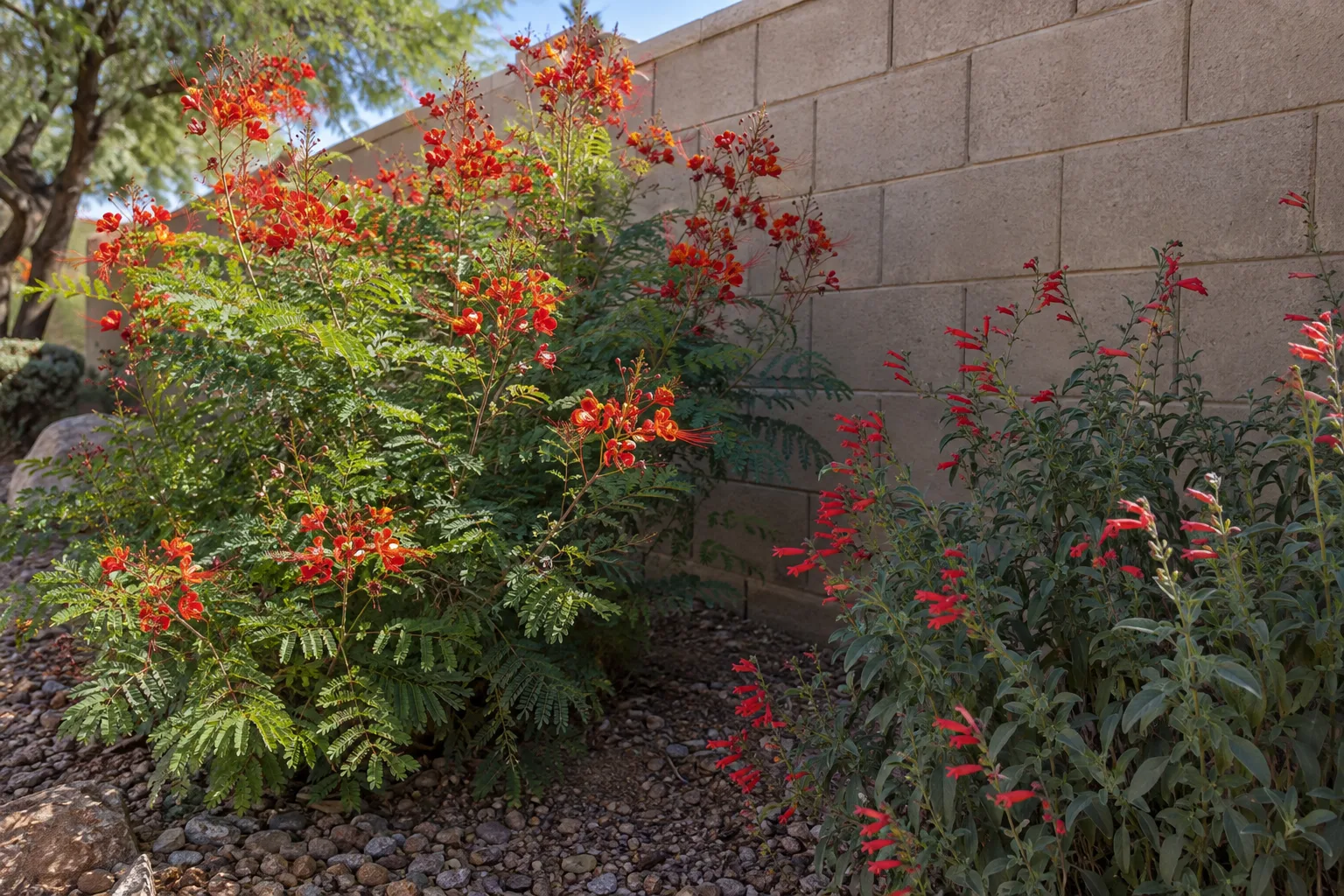
Desert marigold (Baileya multiradiata) blooms yellow for much of spring and fall and stays 1 to 2 feet tall. Autumn sage (Salvia greggii) grows 2 to 3 feet tall, draws hummingbirds, and prefers some afternoon shade against hot block walls. Red bird of paradise (Caesalpinia pulcherrima) reaches 6 to 8 feet and blooms through summer. It freezes back in hard winter frost.
Groundcovers and accents
Trailing lantana (Lantana montevidensis) spreads fast and flowers for months, but it can freeze back in cold winters. Blackfoot daisy (Melampodium leucanthum) stays about 1 foot tall with white flowers. Blue agave (Agave tequilana) and golden barrel cactus (Echinocactus grusonii) add structure, though both have sharp spines or tips that need room away from walkways.
| Plant | Water | Mature height | Main drawback |
|---|---|---|---|
| Red bird of paradise | Low | 6 to 8 feet | Freezes back in hard frost |
| Desert marigold | Very low | 1 to 2 feet | Short-lived, reseeds |
| Autumn sage | Low to moderate | 2 to 3 feet | Wants afternoon shade |
| Trailing lantana | Low | 1 to 2 feet | Frost damage in winter |
| Blue agave | Very low | 3 to 5 feet | Sharp tips |
How should I water a desert backyard?
Drip irrigation on a programmable timer is the most practical setup. It delivers water to the root zone and loses much less to evaporation than spray heads, so set it to run in the early morning, roughly 4 a.m. to 6 a.m.
Give trees, shrubs and containers their own zones, because their needs differ. Established desert-adapted shrubs generally want a deep soak once or twice a week in summer and much less in winter. Pressure-compensating emitters help on sloped lots. Deep, infrequent watering pushes roots down where soil stays cooler. Shallow daily watering keeps roots near the surface.
What groundcover works best: decomposed granite or gravel?
Decomposed granite (DG) is affordable, permeable and tidy, and a 2 to 3 inch layer of gravel around plants helps hold moisture. Fine DG can compact and shed water, so coarser crushed granite suits plant beds better.
Where caliche sits close to the surface, break through it at planting holes so rain can drain. Avoid big expanses of white rock, which reflect glare onto walls and plants. River rock about 2 inches across makes a good decorative top dressing and holds less heat than fine DG.
Which shade trees suit Queen Creek yards?
Desert-adapted trees such as blue palo verde, desert willow and mesquite handle heat, alkaline soil and dry spells. Look through our desert trees for options that fit your lot, and keep in mind that availability varies.
Palo verde (Parkinsonia florida) gives light, dappled shade that lets plants grow beneath it. Desert willow (Chilopsis linearis) reaches roughly 20 to 30 feet and flowers from spring into summer. Mesquite (Prosopis species) casts denser shade but drops seed pods. Water new trees deeply every one to two weeks for the first two summers, then taper off. Place trees away from foundations, pools and block walls.
How do I make a patio comfortable in summer?
Combine overhead shade, light-colored surfaces and moving air. Travertine and other light pavers stay noticeably cooler underfoot than dark concrete or stone, which can get hot enough to burn bare feet at 2 p.m. in July.
Misters work best when humidity is low, so they help in the dry weeks before the monsoon and much less once humidity climbs in July. A ceiling fan under a covered patio keeps air moving. Evenings are often the most pleasant time, with temperatures falling to the 90s or high 80s after sunset.

How do I grow vegetables in raised beds in the low desert?
Raised beds at least 12 inches deep let you control the soil instead of fighting caliche and alkaline ground. A blend of quality compost with garden soil works well for most vegetables.
Cool-season crops such as lettuce, kale, broccoli, carrots and beets generally go in from fall through winter. Warm-season crops such as tomatoes, peppers and squash go in during late winter, with a second planting for fall in late summer. Check the University of Arizona Cooperative Extension planting calendar for exact dates, or see the UA Cooperative Extension vegetable planting calendar for Maricopa County. Shade cloth of about 30 percent in the hottest months protects against sun scald. Our herbs, vegetables and berries page shows what we grow for local gardens.
What order should I follow for a backyard makeover?
Work from the structure down to the finishing touches, because retrofitting shade or irrigation around mature plants is much harder.
- Walk the yard at 10 a.m., 2 p.m. and 5 p.m. to note shade, hot walls and low spots that hold monsoon water.
- Break through caliche where trees and large shrubs will go.
- Build shade structures.
- Lay irrigation lines before hardscape and gravel.
- Plant trees, then install patios and paths.
- Plant shrubs and perennials in the fall planting window.
- Spread gravel or DG last, working around plants, and finish with lighting and furniture.
Can a water feature cool a backyard?
A small recirculating fountain adds a little cooling and masks street noise. Keep it modest, because an open surface in dry heat loses water fast.
Place it in shade, where evaporation and algae slow down. A bubbling urn or narrow spillway loses less than a wide still pond. Keep water moving and clean, since standing water in monsoon season can breed mosquitoes. You can see styles on our fountains page.
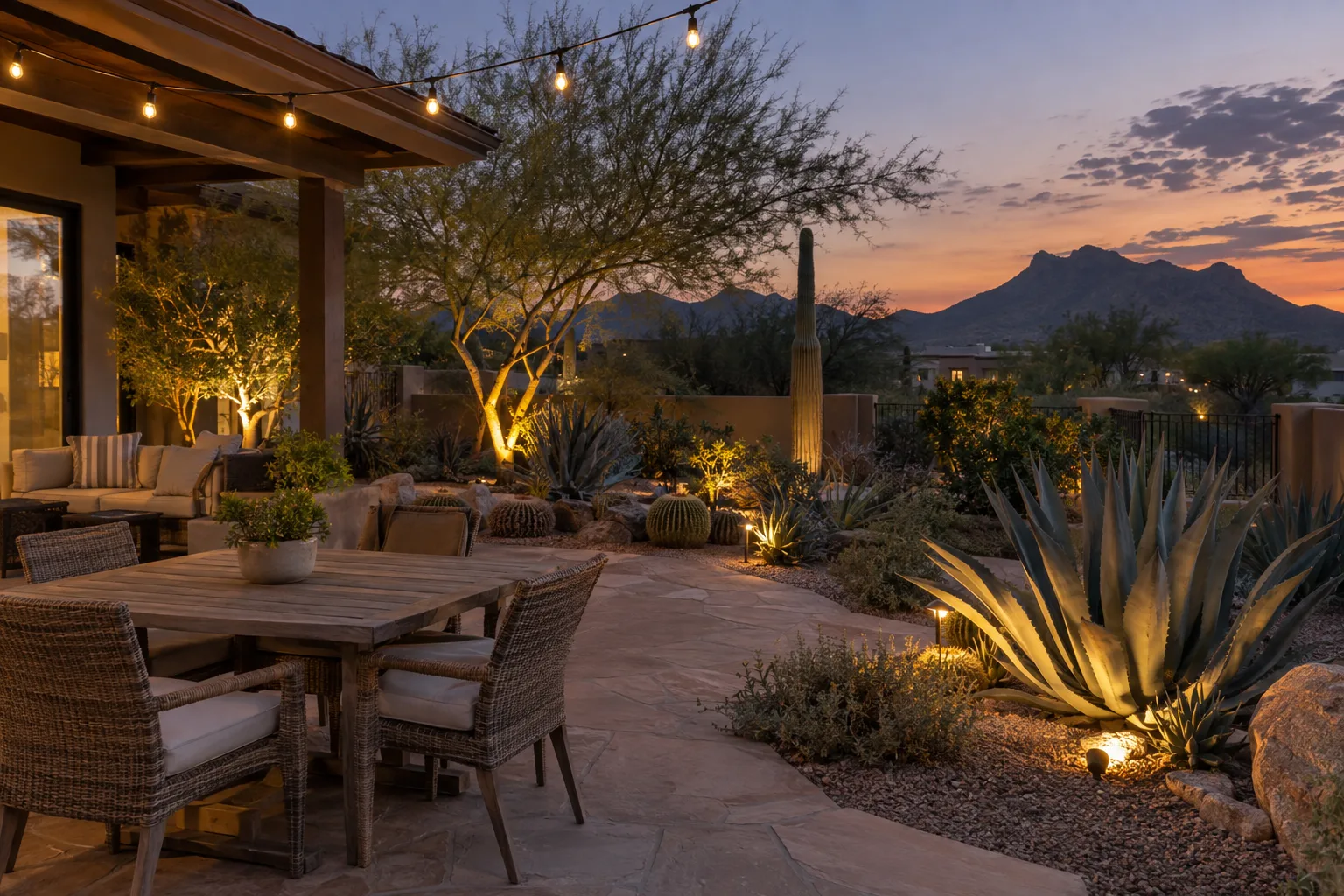
What makes a backyard enjoyable after dark?
Plan for evening use. Low-voltage path lighting, string lights under a ramada and uplights on sculptural agaves or palo verde trunks give the yard a second life after sunset.
Night-fragrant plants such as four o’clocks (Mirabilis jalapa) open in the evening. A fire pit earns its place from November through February, when nights drop into the 40s and 50s. A gardening calendar helps you time each project to the season.
Frequently asked questions
What can replace a lawn in a desert backyard?
Decomposed granite with drought-tolerant plantings is the most common replacement. Low groundcovers such as lantana or blackfoot daisy add color with little water. Artificial turf is another option, though it absorbs heat. Choose based on how you use the space, such as pets, play or entertaining.
When is the best time to plant in the East Valley?
Fall, from late September through November, is the best window for most trees, shrubs and perennials, since roots establish over mild months. Late February through March is the second window. Summer planting is possible but demands frequent watering and shade for new plants.
How do I deal with caliche?
Caliche is a hard, cemented calcium carbonate layer in many local soils. Break through it at each planting hole with a pick or caliche bar, and test that water drains before planting. Raised beds sidestep it for vegetables and herbs.
How should I prepare a yard for monsoon storms?
Check that the grade slopes away from the house and that low spots can drain. Permeable DG and gravel handle runoff better than solid paving. Thin dense tree canopies before July, since storm winds can snap weak branches.
Do desert plants still need water?
Yes. New plants need regular water for the first one to two years while roots establish. Established plants need much less but still benefit from deep watering in summer. Slowly lengthen the interval between waterings as plants mature.
Is a desert-friendly backyard right for you?
For most East Valley homeowners, yes. Shade, drip irrigation and plants suited to the low desert cut maintenance and make the yard usable for more months. It may not suit you if you want a large lawn for play or sports, since that needs far more water. Start with one project, such as shade or a new bed, and build from there. Stop by our nursery in Queen Creek and we will help you plan it.