The best desert-adapted plants to start in April are the ones that root fast before summer: palo verde, desert willow, Texas sage, brittlebush, agave, red yucca, blackfoot daisy and desert marigold. April gives them several weeks of mild weather before regular 100°F days arrive.
Key takeaways
- Plant by the end of April, because East Valley highs usually pass 100°F in May and summer highs climb above 110°F.
- Dig each hole 2 to 3 times as wide as the pot and only as deep as the root ball.
- Fill the hole with water before planting. If it is still standing after 24 hours, caliche is blocking drainage and needs to be broken up.
- Water new shrubs every 4 to 5 days in April and May, then stretch the interval as roots spread and monsoon storms arrive.
- Skip fertilizer for the first season, since it pushes soft growth that scorches in summer heat.
Why is April a good month to plant in the low desert?
April works because the soil is warm enough for roots to grow while the air is still mild enough that new plants are not under heat stress. Highs in Queen Creek usually sit in the 80s to low 90s, then pass 100°F in May or June, so roots that get a few mild weeks are better prepared for summer.
That window is short. A shrub planted in late April gets roughly 6 to 8 weeks before the first real heat, while a plant installed in June has to establish in hot soil. If you miss April, October gives roots the whole winter to settle in.
Every plant below falls under our plants department, and our gardening calendars show what else belongs in the ground each month.
How do I deal with caliche and alkaline soil before planting?
Test drainage first, then backfill with mostly the soil you dug out. Most East Valley yards have alkaline soil, often with a pH above 7.5, and many have caliche, a cemented layer of calcium carbonate that can sit anywhere from a few inches to a few feet down.
To check, push a steel rod or rebar into the planting spot. If you hit a hard layer within 18 inches, break through it with a digging bar. Then fill the hole with water. Standing water after 24 hours means roots would sit in a bathtub during monsoon storms.
Desert plants grow well in lean soil. A hole packed with rich compost gives roots little reason to leave it, so mix in only a modest amount of compost or decomposed granite for drainage and refill mostly with native soil.
Which desert-adapted plants can I start in April?
Eight good choices follow, ranging from shade trees to low borders. These are plants we commonly carry, and availability changes week to week and season to season, so check with us before making a special trip.
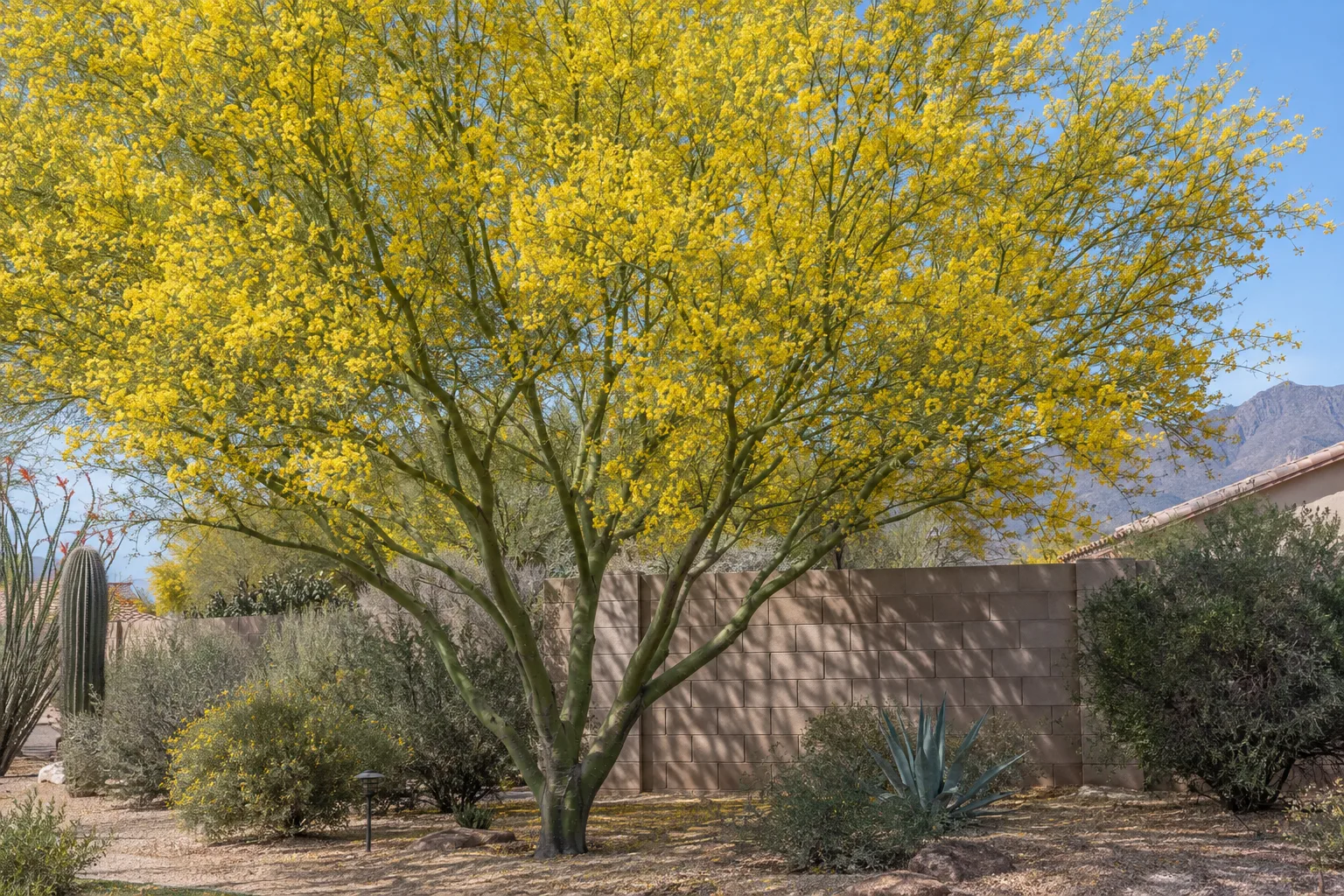
1. Desert Museum palo verde (Parkinsonia ‘Desert Museum’)
This hybrid palo verde is a fast-growing shade tree that covers itself in yellow flowers in spring. It reaches 20 to 30 feet tall and 20 to 25 feet wide in full sun. Established trees need a deep soak only once or twice a month in summer. The drawback is size: give it at least 15 feet from walls, and expect fine leaflets and petals underneath. Browse more options in our desert trees.
2. Desert willow (Chilopsis linearis)
Desert willow is a small, airy tree with pink, lavender or white trumpet-shaped flowers from late spring into summer. Expect 15 to 25 feet tall and 10 to 20 feet wide, depending on the selection, in full sun. Water deeply about weekly through the first summer, then every few weeks. It drops its leaves in winter and leaves long seed pods behind. More shade and bloom options are in our flowering trees.
3. Texas sage (Leucophyllum frutescens)
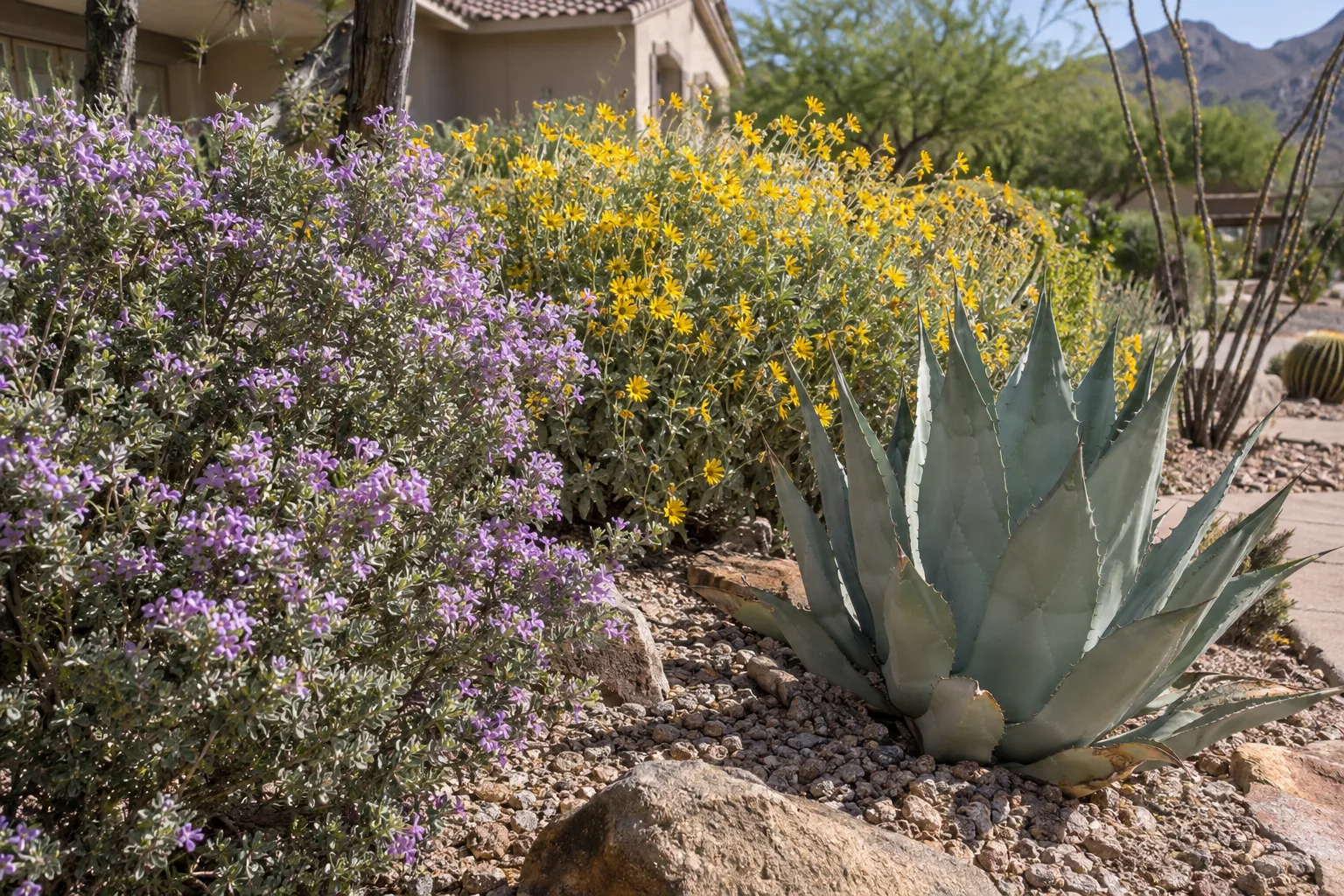
Texas sage, also called cenizo, is a silver-gray evergreen shrub from Texas and northern Mexico that handles reflected wall heat well. Depending on the variety it grows 4 to 8 feet tall and wide, in full sun with little water once settled. Purple, pink or white flowers often appear soon after humidity rises or rain falls. The drawback is overwatering, which causes dieback quickly, and shearing it into a ball removes the flower buds.
4. Brittlebush (Encelia farinosa)
Brittlebush is a silvery native shrub with yellow daisy flowers from late winter through spring. It grows 2 to 4 feet tall and wide in full sun and needs little water once established. The drawback is its summer look: leaves shrivel and drop in the heat, and plants often live only several years, though seedlings tend to fill the gaps.
5. Parry’s agave (Agave parryi)
Parry’s agave forms a tight blue-gray rosette 2 to 3 feet tall and wide, a good fit for smaller yards. It wants full sun, fast drainage and watering about every 10 to 14 days in its first summer, then far less. The drawback is the sharp spine at each leaf tip, so keep it away from walkways and wear leather gloves when planting.

6. Red yucca (Hesperaloe parviflora)
Red yucca is a clumping, grass-like plant that sends up 4- to 6-foot stalks of coral-pink flowers from spring into summer, and hummingbirds visit them. The clump itself stays 3 to 4 feet tall and 3 to 5 feet wide. It takes full sun and low water once established. Spent flower stalks look untidy, so cut them to the base after bloom.
7. Blackfoot daisy (Melampodium leucanthum)
Blackfoot daisy is a low, mounding perennial with small white flowers from spring through fall. It stays 6 to 12 inches tall and 1 to 2 feet wide, wants full sun and tolerates lean, rocky soil. The drawback is a short life span and a tendency to rot in heavy or wet soil, so plan to replace a few over time.
8. Desert marigold (Baileya multiradiata)
Desert marigold sends slender stalks of yellow flowers above gray-green foliage from spring into fall. It grows 1 to 2 feet tall and wide in full sun with low water. It reseeds freely, which fills gaps in a natural planting. The drawback is a ragged look after bloom, plus a short life that depends on those seedlings.
How do I plant them step by step?
Dig wide, set the plant level with the surrounding soil, and water deeply right away. Wear gloves for agave.
- Pick a spot with at least 6 hours of direct sun and room for the plant’s mature size.
- Dig the hole 2 to 3 times as wide as the pot and no deeper than the root ball, so the top of the root ball sits level with or slightly above the soil.
- Run the drainage test described above, and break through caliche if water stands.
- Slide the plant out of the pot and loosen any circling roots with your fingers.
- Backfill with the native soil you removed, firming it lightly to close air pockets.
- Build a low berm of soil around the hole to form a watering basin.
- Fill the basin slowly two or three times so water soaks 12 to 18 inches deep.
- Spread 2 to 3 inches of decomposed granite or other mulch, keeping it a few inches back from trunks and crowns.

Planting too deep is a common error, and in caliche country a deep hole acts like a bucket. Another is skipping the basin, which lets water run off toward the patio instead of the roots.
How often should I water new plants through the first summer?
New plants need water every few days at first, then less often as roots spread and the monsoon arrives. The table gives starting ranges for the first season only.
| Plant group | April and May | June | July to September |
|---|---|---|---|
| Trees (palo verde, desert willow) | Every 4 to 7 days | Every 5 to 7 days | Every 7 to 14 days |
| Shrubs (Texas sage, brittlebush, red yucca) | Every 4 to 5 days | Every 5 to 7 days | Every 10 to 14 days |
| Perennials (blackfoot daisy, desert marigold) | Every 3 to 4 days | Every 4 to 6 days | Every 7 to 10 days |
| Agave | Every 7 to 10 days | Every 10 to 14 days | Every 14 to 21 days |
Treat these as starting points. Sandy soil dries faster than clay, and west-facing walls reflect heat that speeds evaporation. Push a screwdriver 4 to 6 inches down before irrigating, and skip a cycle if the soil is damp. Deep, less frequent soaks push roots downward, while light daily sprinkles keep them near the surface where summer heat reaches them. Once monsoon storms begin, usually in July, cut back and watch low spots for pooling water.
What should I leave alone until fall?
Leave fertilizer, heavy pruning and extra soil amendments alone. Desert plants put on soft, thin growth when fed in spring, and that growth scorches in 110°F heat.
On new trees, remove only broken or crossing branches, because big cuts expose bark to hot sun. Let Texas sage keep its natural shape so the flower buds stay on. If brittlebush or desert marigold looks tired in July, wait until fall before replacing it, since both go dormant in summer heat and often recover. Our classes and events page lists workshops if you want to see planting technique in person.
Frequently asked questions
Can I still plant in May?
Yes, but the odds drop as temperatures climb. Highs often pass 100°F by May, so use smaller plants, water more often and shade new plantings with temporary shade cloth in the afternoon. October is the safer second window, because roots grow all winter before the next summer arrives.
Do established desert plants still need irrigation?
Most do, though far less. Even after two or three years, desert willow, Texas sage and palo verde look better with a deep soak every few weeks in June and July, while agave and brittlebush can often go longer. Reflected heat from walls and pavement raises water demand.
Is a bigger plant better?
Not always. A smaller plant often catches up to a larger one within a few seasons because it adjusts to native soil faster, and a heavy root ball is harder to set at the right depth. Choose based on how quickly you want shade and how much you can water.
Can I grow these in pots?
Yes for Parry’s agave, red yucca, blackfoot daisy and desert marigold. Use a pot with drainage holes and a gritty mix. Containers heat up and dry out faster than ground soil in summer, so check moisture often. See our pottery and planters for options.
Will winter frost hurt them?
Established plants usually handle low-desert winters, though brittlebush and young Texas sage can show tip damage in a hard freeze. Queen Creek gets occasional winter frost, so cover new plants on forecast frost nights during their first winter and trim damaged tips in spring.
Is April planting right for your yard?
April planting suits you if you can water new plants every few days through May and June and you have a spot with at least 6 hours of sun. These eight cover shade, flowers and low borders with modest water once established. It is a poor fit if you travel all summer without irrigation backup, or if your yard holds standing water after storms. In either case, wait for October. Stop by our Queen Creek nursery and walk through these plants in person.