

Deep watering means soaking the soil slowly to 18 to 36 inches, then letting it dry partway before the next soak. In the Arizona low desert, this builds deeper roots that handle summer highs above 110°F far better than frequent shallow sprinkles.
Key takeaways
- Soak shrubs to 18 to 24 inches and trees to 24 to 36 inches, then let the soil dry partway before watering again.
- Start in February and shorten the interval as highs pass 95°F in April and May, keeping each soak just as deep.
- Build a 4 to 6 inch soil basin at the drip line and add 3 to 4 inches of mulch over the root zone.
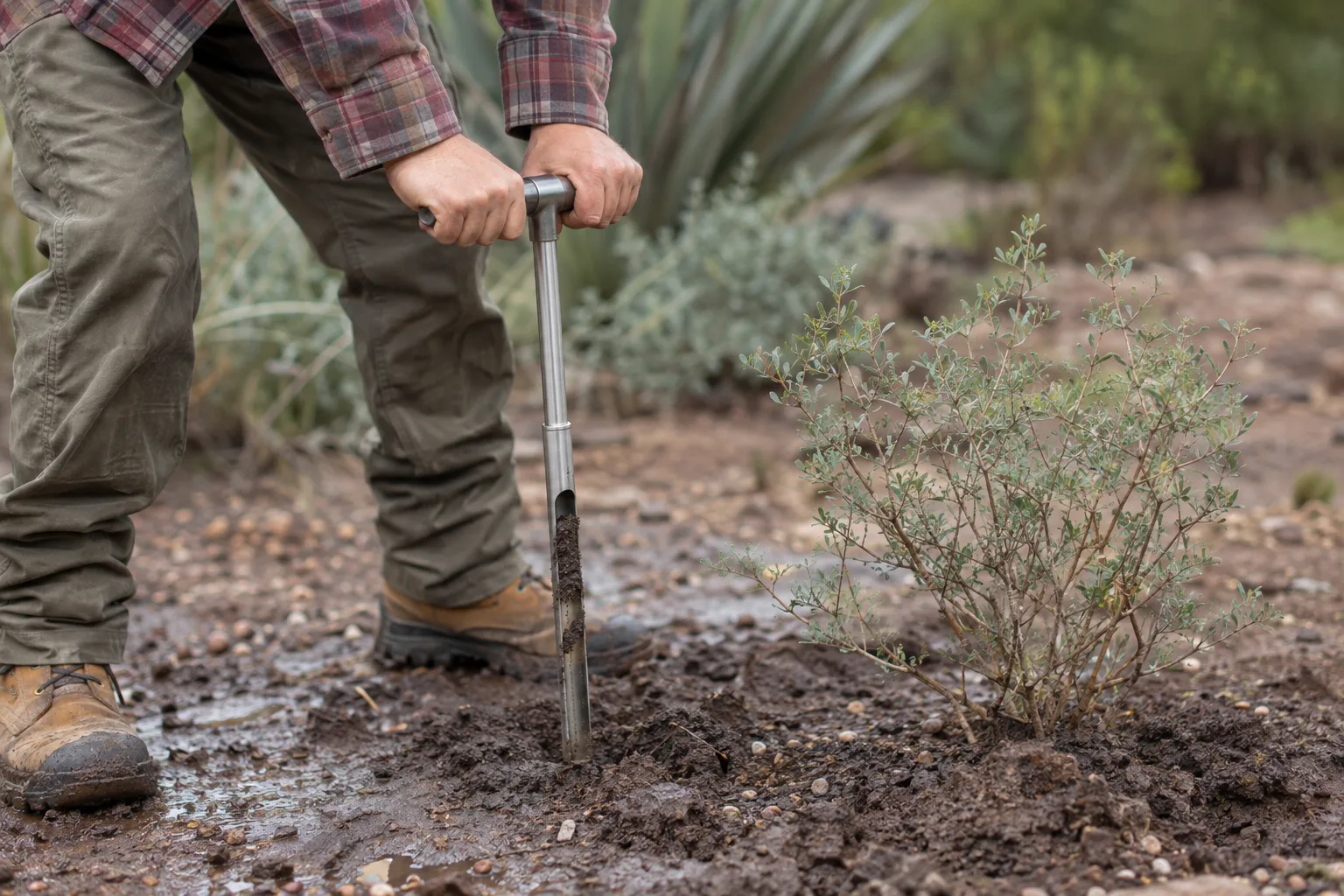
- Probe the soil an hour after watering; a rod that stops short of 18 inches often signals caliche.
- Run drip zones 45 to 90 minutes instead of 15 to 20, then adjust for emitter output and soil type.
Why does deep watering matter in the Arizona low desert?
Deep watering matters because roots grow toward water and oxygen, so the depth of your irrigation sets the depth of the root system. Roots that stay in the top 6 inches meet the hottest, driest soil of the year and dry out within hours once summer arrives. Deeper soil stays cooler and holds moisture longer. This applies to nearly every in-ground plant in our plant department.
Deep roots also anchor. Trees with shallow root systems can lean or topple in monsoon winds, which arrive from roughly July through September. Our hard irrigation water adds a second reason, because a long soak moves dissolved salts below the root zone, while light daily watering leaves them building up near the surface.
When should I start deep watering in Arizona?
Start in February, when plants begin pushing new growth, and continue through May. Cool air means slow evaporation and long gaps between soaks early on. As highs climb, shorten the gap but keep each soak just as deep. Our gardening calendars list what else to do each month.
These intervals are starting points for established plants, and your soil and weather will move them:
- February to early March (highs about 65 to 80°F): trees every 14 days, shrubs every 10 days, perennials every 7 days.
- Mid-March to April (highs about 80 to 95°F): trees every 10 to 12 days, shrubs every 7 to 8 days, perennials every 5 to 6 days.
- May (highs about 95 to 110°F): trees every 7 to 10 days, shrubs every 5 to 7 days, perennials every 3 to 5 days.
Adjust to the actual weather. A cool, cloudy week lets you wait a few extra days, and a heat spike in March calls for an earlier soak. Check before you skip a cycle after rain, because a short storm often wets only the top inch or two.
How deep should the water go for each plant?
Target depth follows root depth, from about 8 to 12 inches for annuals and vegetables to 24 to 36 inches for mature trees. The table gives starting depths and spring intervals for established plants.
| Plant type | Target water depth | Typical spring interval |
|---|---|---|
| Annuals and vegetables | 8 to 12 inches | Every 2 to 3 days |
| Perennials and ground covers | 12 to 18 inches | Every 5 to 7 days |
| Established shrubs | 18 to 24 inches | Every 7 to 10 days |
| Established trees | 24 to 36 inches | Every 10 to 14 days |
| Cacti, succulents and established natives | 12 to 24 inches | Every 14 to 21 days |
Citrus (Citrus species) sits at the deep end during spring bloom and fruit set, so a long soak every 10 to 14 days works better than frequent sprinkling. Our citrus trees page shows the kinds we commonly carry, though availability changes week to week and season to season.
Mesquite (Prosopis species) and palo verde (Parkinsonia species) need deep soaks for their first two or three years. After that, an established desert tree needs far less. Browse our desert trees to compare options. Overwatering is a common reason desert natives decline.
What do I need to deep water?
You need a soil probe, a way to deliver water slowly, and mulch. A 3 to 4 foot length of rebar or a long screwdriver works as a probe and costs little.
- Soil probe, rebar or long screwdriver to check moisture depth
- Drip emitters rated 1 to 2 gallons per hour for mature shrubs and trees
- Soaker hose, or a deep-root watering stake that attaches to a hose
- Shovel for building a basin, and organic mulch such as shredded wood
Emitters rated 0.5 gallons per hour suit small plants but deliver too little for a large shrub or tree to soak deeply in a reasonable time. Soaker hoses looped in rings around the drip line and run 2 to 4 hours give even clay soil time to absorb the water. A deep-root stake puts water 12 to 18 inches down, which suits a single tree but is slow for covering many plants.

How do I deep water a tree or shrub, step by step?
Build a basin at the drip line, deliver water slowly, and check depth with a probe. Follow these steps.
- Probe first. Push your probe into the soil near the drip line. If it slides in past 12 inches and comes out moist, skip this cycle.
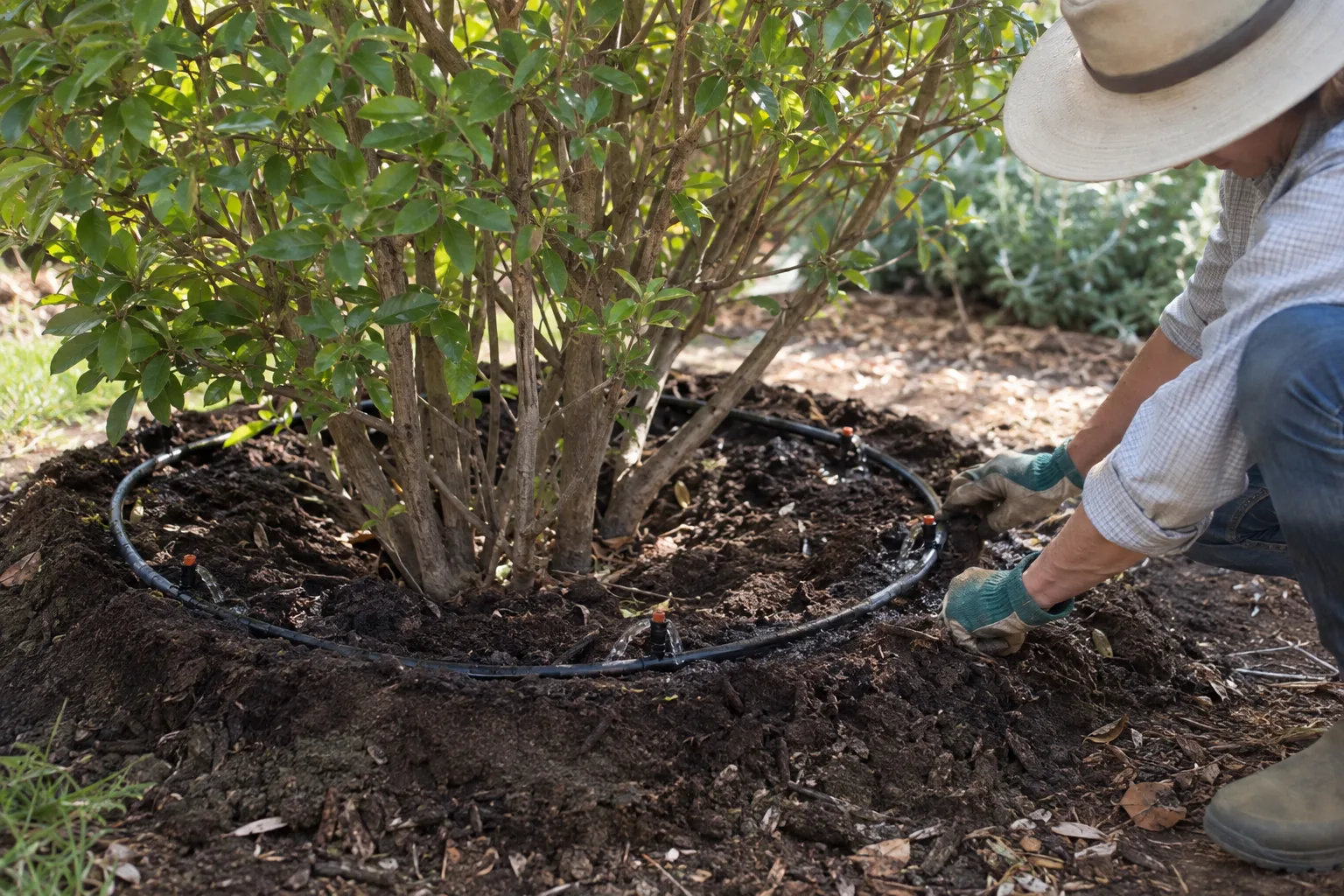
- Build a basin. Mound a soil ring 4 to 6 inches high at the drip line, the outer edge of the canopy, where the fine feeder roots take up water. The trunk area does not need it.
- Place emitters or a soaker hose inside the basin, spaced around the plant, and keep water off the trunk.
- Run the water slowly. Runoff or pooling means the soil cannot absorb water that fast. Many drip zones need 45 to 90 minutes, and heavy clay may need slower, longer cycles.
- Probe again an hour later. Look for moist soil at 18 inches or deeper for shrubs and 24 to 36 inches for trees. Lengthen the next cycle if you fall short.
- Mulch. Spread 3 to 4 inches of organic mulch over the root zone, pulled back a few inches from the trunk, to slow evaporation and keep the surface cooler.
- Reset the controller. Use one long cycle per zone instead of several short ones, and watch for sturdy new growth over the next 2 to 3 weeks.
How do I know the water is reaching deep enough?
Push a probe into the soil an hour after watering, and moist soil at your target depth means yes. A rod that stops hard above 18 inches in damp soil usually points to caliche, the cemented calcium carbonate layer common in East Valley yards, which can sit anywhere from 6 inches to several feet down. Water pools on top of it.
If you find caliche, water slower in longer sessions so the soil above can absorb it. Breaking through the layer when planting a tree gives roots a path down.

Shallow watering shows up as stress, usually by May or June. Watch for these signs:
- Wilting in the afternoon even though you irrigated that morning
- Brown, crispy leaf edges
- Trees that lean or rock in the soil after wind
- Pale or yellowish new growth
- Spider mites and aphids, which favor stressed plants
What mistakes keep water from going deep?
The most common are watering at the trunk, trusting the timer without checking, and skipping irrigation after a monsoon storm.
Watering at the trunk
Feeder roots reach the outer edge of the canopy or beyond. Water at the base of a trunk reaches mostly structural roots that absorb little. Move emitters and soaker hoses outward to the drip line as the plant grows.
Trusting the timer
A controller cannot know that a clay layer sits at 10 inches or that one emitter is clogged. A two-minute probe check catches both problems before a plant shows stress.
Assuming monsoon rain soaked in
Monsoon storms often drop 0.5 to 1 inch in 20 minutes, and much of that runs off compacted, alkaline soil. Probe the soil after the storm before you skip your next cycle.
Keeping the soil constantly wet
Deep watering describes depth per soak. The soil should dry partway between soaks so roots get oxygen, and a constantly soggy basin invites root rot.
Frequently asked questions
How long should I run my drip system to water deeply?
Run 1 gallon per hour emitters for roughly 60 to 90 minutes on established shrubs and 90 to 120 minutes on trees, then probe an hour later. Add time until you reach the target depth. Heavy clay absorbs slowly and may need longer, slower cycles, while sandy soil drains fast and may need more frequent soaks.
Can I water too deeply?
Yes, if the soil never dries between soaks. The soil should dry partway before the next one. Constantly wet soil starves roots of oxygen and invites root rot, especially in heavy clay or above a caliche layer where water collects. Probe before every soak and wait if the soil is still moist at 6 inches.
Do established desert natives need deep watering in spring?
Usually only a few soaks. Established natives such as palo verde, brittlebush and desert marigold need far less water than non-natives, but a deep soak or two in March and April helps after a dry winter. Let the soil dry well between soaks to avoid root rot.
Is morning or evening better for deep watering?
Early morning, roughly 4 to 9 a.m., is best. Water soaks in before heat builds, and leaves dry before night, which lowers fungal disease risk. Midday watering from April onward loses more water to evaporation before it penetrates. Evening works when mornings are impossible, though wet foliage overnight raises disease risk.
How do I deep water plants in containers?
Water until it drains freely from the bottom holes, then wait until the top 1 to 2 inches of soil dry. This soaks the full root ball, the container version of deep watering. In spring, large pots often need water every 3 to 5 days, and daily checks once highs pass 100°F. Choose pottery and planters with multiple drainage holes.
Is deep watering worth the effort in your yard?
Yes, for any yard with trees, shrubs or citrus, because a soil probe and a few timer changes cost little and build roots that carry plants through July. Gardeners with mostly established desert natives on minimal water can skip the full routine and give those plants a soak or two in spring. If you cannot adjust your irrigation at all, start with one tree. Stop by our nursery in Queen Creek and bring your questions.
