

Costa’s hummingbirds visit Arizona low desert yards from late winter through spring. To attract Costa’s hummingbirds in Queen Creek, plant nectar-rich desert bloomers by fall, then add a clean feeder and a source of moving water.
Key takeaways
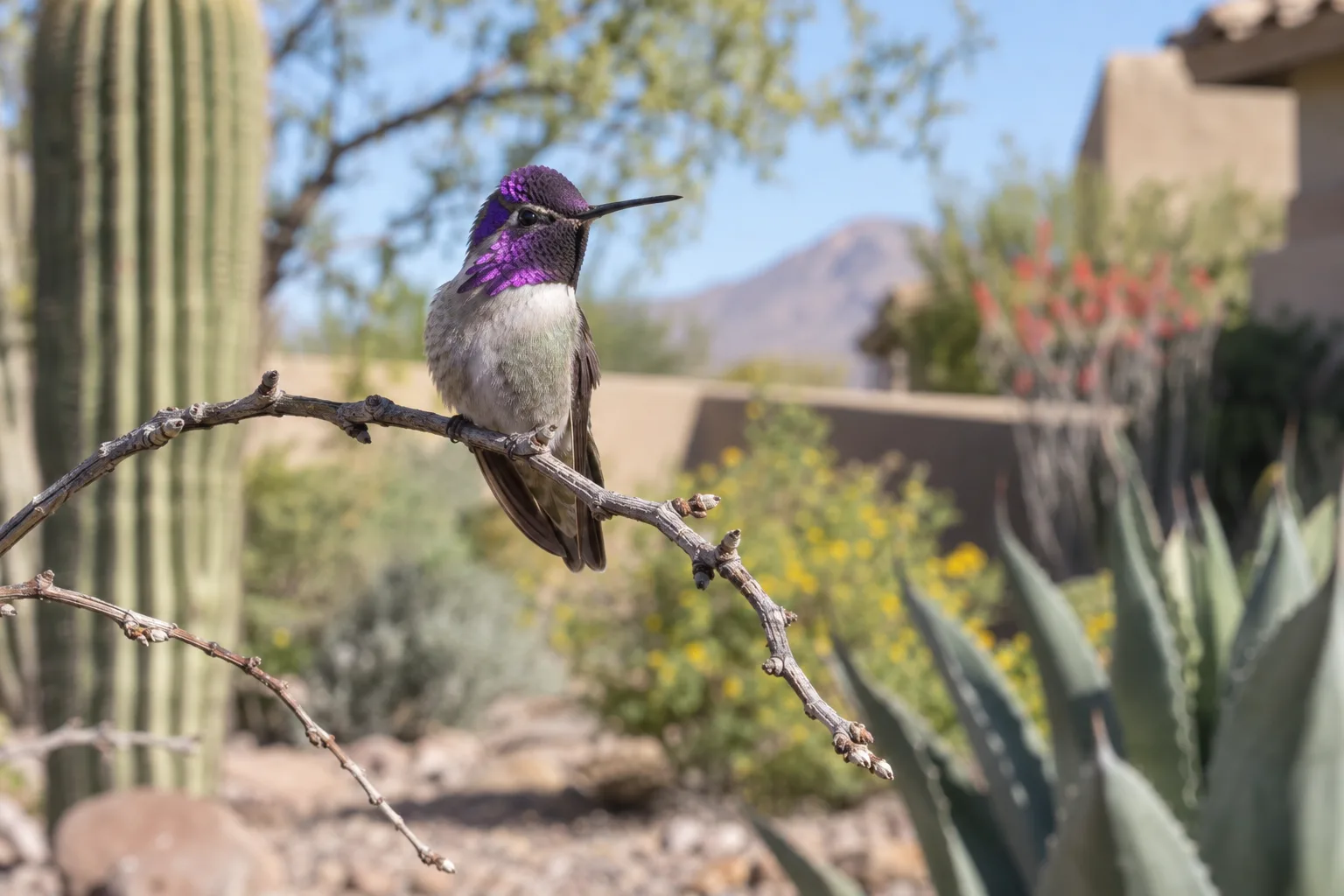
- Adult male Costa’s hummingbirds are about 3 inches long and show a violet crown and throat that flares out at the sides.
- Expect them from roughly January or February through May, with the most display flights in March.
- Plant chuparosa, Parry’s penstemon and fairy duster in October or November so they are in bloom by late winter.
- Mix feeder nectar at 1 part plain white sugar to 4 parts water, with no red dye and no honey.
- Hang two feeders 10 to 15 feet apart, because a dominant male will guard a single feeder.
What does a Costa’s hummingbird look like?
A male Costa’s hummingbird has a bright violet-purple crown and throat patch that flares outward like a small cape. In full sun it can flash from deep purple to vivid violet. Males measure about 3 inches long and weigh around 3 grams.
Females are plainer, with a green back, pale gray-white underparts and only a faint tint of color at the throat. Anna’s hummingbird, which stays in the East Valley all year, is a little larger and has a rosy-red crown. Male Costa’s make a high, whistling whine during their dive displays, and that sound is often how you notice one before you see it.
When do Costa’s hummingbirds arrive in the East Valley?
Costa’s hummingbirds typically show up between January and February, and activity peaks from March through May. Timing shifts from year to year with winter weather and with when the desert flowers open.
These birds use the Sonoran Desert as a late-winter and spring breeding ground. By June, when daytime highs often pass 105°F, most have moved on to other areas, and the hummingbirds you see through summer are mostly Anna’s. A feeder that went up in January can sit quiet for a few weeks before the first male finds it, so give it time.
Which plants attract Costa’s hummingbirds in Queen Creek?
Plants with tubular red, orange or pink flowers that bloom between January and May work best. The six below are all suited to our alkaline soil and summer heat. They are varieties we commonly carry in our plant department, though availability changes week to week and season to season.
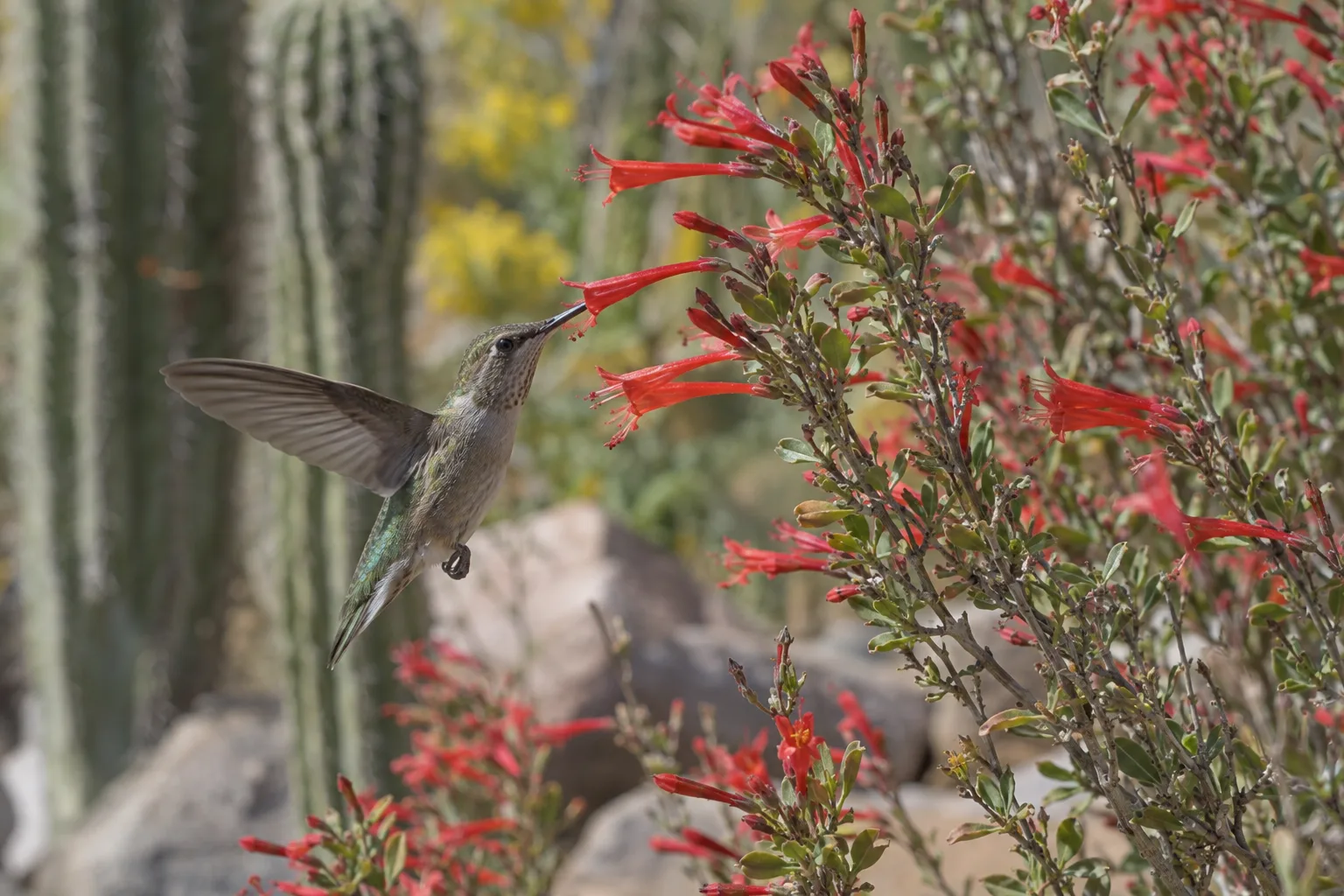
Chuparosa, Justicia californica
Chuparosa is a sprawling shrub that reaches 3 to 5 feet tall and wide, with tubular red flowers from late winter into spring. It wants full sun and little water once established. The drawback is frost: a hard freeze can burn it back, and it can look ragged until new growth fills in.
Parry’s penstemon, Penstemon parryi
Parry’s penstemon sends up pink-magenta flower spikes that reach 3 to 4 feet, usually from late February through April. That bloom window lines up well with peak Costa’s activity. It likes full sun, sharp drainage and low water. The drawback is a short life, so it depends on reseeding, and the flowers are finished by about May.
Fairy duster, Calliandra eriophylla
Fairy duster is a low, airy shrub, about 2 to 3 feet tall and wide, covered in pink powder-puff flowers from late winter into spring. It needs full sun and little water. It has a thin, open look and can lose leaves in cold or drought, so tuck it among fuller plants.
Ocotillo, Fouquieria splendens
Ocotillo grows 8 to 20 feet tall, and its spring flower clusters at the stem tips are a favorite stop for hummingbirds. It needs full sun, excellent drainage and very little water once rooted. It grows slowly, stays mostly bare-stemmed for much of the year, and resents wet soil around the base.
Desert willow, Chilopsis linearis
Desert willow is a small tree, 15 to 25 feet tall, with pink to lavender trumpet flowers from spring into summer. It likes full sun and low to moderate water. It blooms after the earliest Costa’s weeks, so pair it with earlier bloomers. It drops leaves in winter and litters seed pods. You can compare options in our desert trees.
Red yucca, Hesperaloe parviflora
Red yucca forms a clump of grassy leaves 3 to 4 feet across, with coral-pink flower stalks that rise to about 5 feet. It takes full sun and low water. Its main bloom comes in late spring and early summer, after the peak Costa’s weeks, so it extends the season rather than starting it.
When should I plant for the spring arrival?
Plant in October or November, so roots are established before the January to March bloom. A shrub set out in February may bloom lightly or not at all in its first spring. Our gardening calendars give month-by-month planting guidance for the low desert.
Dig each hole 2 to 3 times as wide as the pot and no deeper than the root ball. Break up any caliche at the bottom so water can drain. Water deeply and regularly through the first few months, then taper off as the plant settles in.
Layer the planting. Put low shrubs like fairy duster in front, chuparosa in the middle and ocotillo or desert willow behind, and leave some bare twigs at 4 to 8 feet, since males perch there to watch their territory.
How do I set up a hummingbird feeder in Arizona?
Fill it with 1 part plain white sugar dissolved in 4 parts water, with no red dye, no honey and no flavoring. Cool the mixture before filling. Hang the feeder in shade, or on the east side of the house, to slow fermentation.
Change the nectar every 2 to 3 days in mild spring weather and more often once highs climb past the 90s, since sugar water spoils fast in desert heat. Throw out anything cloudy. Scrub the feeder with hot water and a small brush, not soap. Saucer-style feeders are easier to clean than tall bottles with narrow ports.
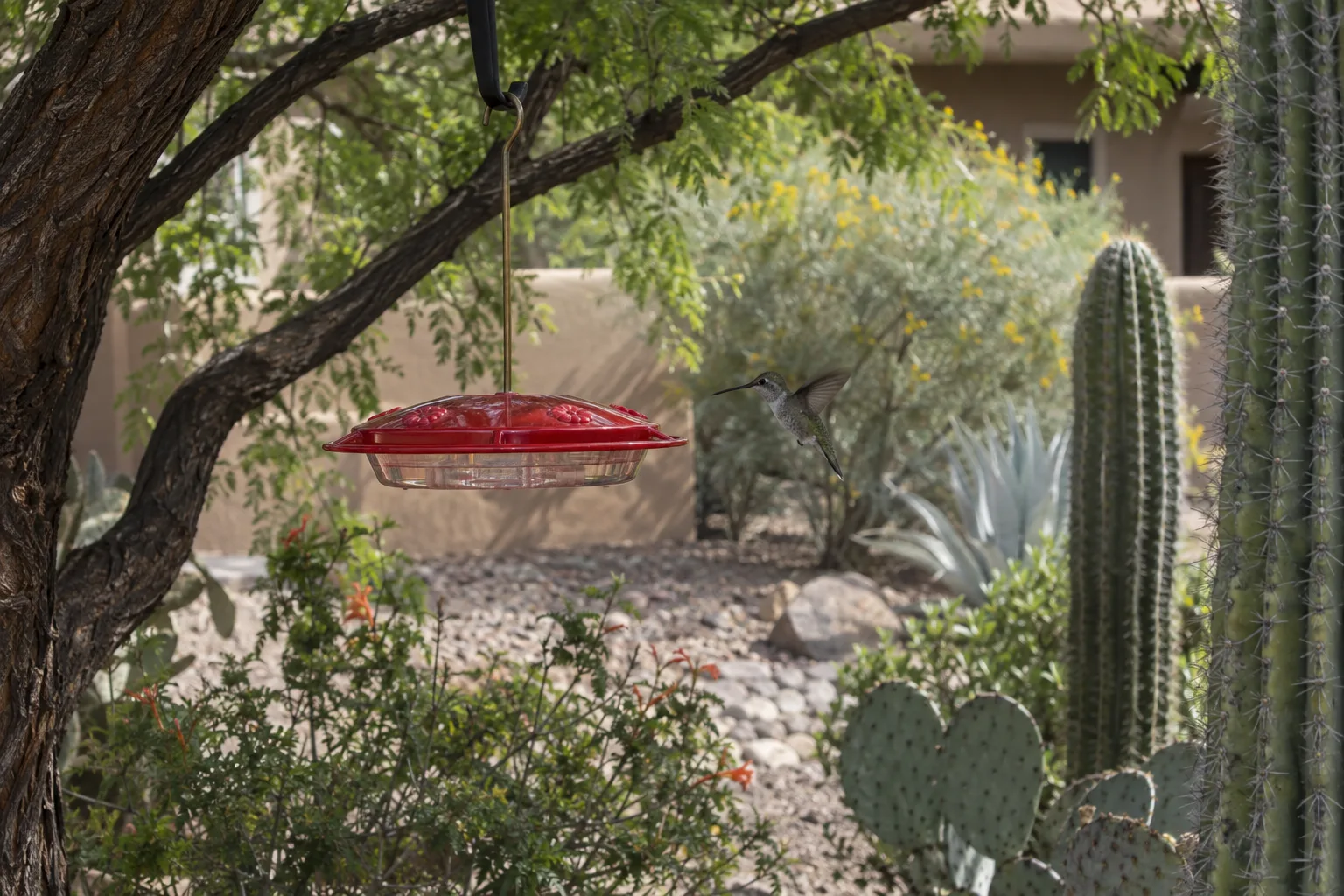
Put up two feeders, 10 to 15 feet apart and out of each other’s line of sight. A dominant male will chase rivals away from a single feeder, but he cannot guard two that he cannot see at once.
Does moving water help attract hummingbirds?
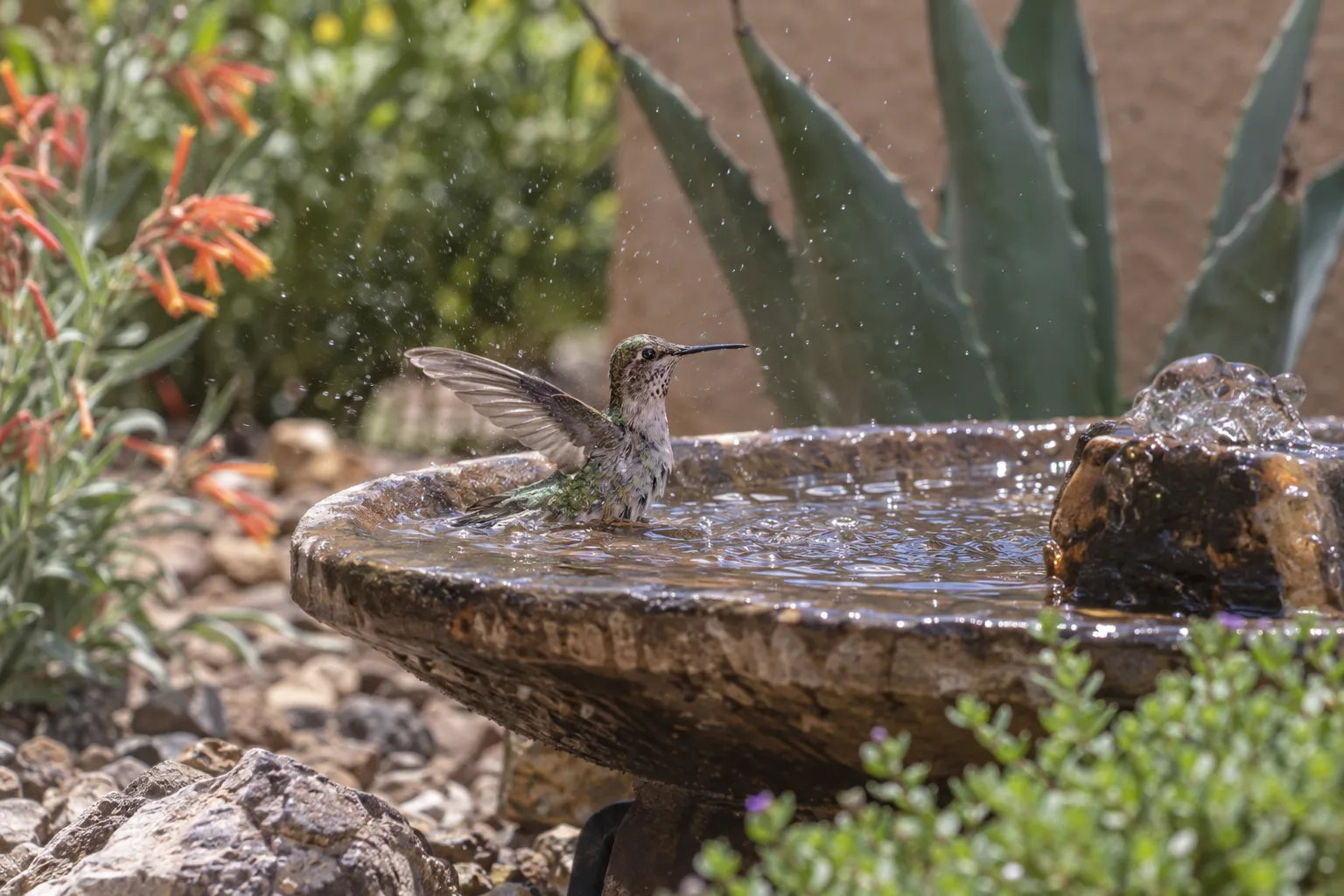
Yes, hummingbirds will bathe in a fine mist or a steady drip, and they often prefer that to a still birdbath. A mister or dripper over a shallow dish or flat rock gives them a place to wet their feathers while hovering or perched.
A small recirculating fountain with a gentle spray can do the same job. Browse our fountains for options that fit a patio or planting bed. Rinse any basin weekly, because standing water in summer grows algae quickly.
Where do Costa’s hummingbirds nest?
Females nest alone, usually 3 to 8 feet up on a shrub branch, often under an overhang that gives shade. The male takes no part after mating. Nests are small cups of plant fibers held together with spider silk, which lets the walls stretch as the chicks grow.
Incubation runs about 15 to 17 days, and chicks leave the nest roughly three weeks after hatching. The whole cycle takes around 6 weeks. Hold off on heavy pruning of nearby shrubs from February through May, so you do not remove nectar flowers or a nest site.
Frequently asked questions
Do Costa’s hummingbirds eat insects?
Yes, they eat small insects and spiders along with nectar. Nectar supplies quick energy for their very fast metabolism, while the insects provide protein for feathers, muscle and egg production. A yard with flowering plants usually carries enough tiny insects, so you do not need to supply them separately.
Should I take my feeders down in summer?
You can leave them up, but only if you can refresh them often. Anna’s hummingbirds stay through summer and will keep visiting. Nectar can spoil within a day or two at 105°F, so change it every 1 to 2 days and keep the feeder in shade. If you cannot manage that, take it down.
Why do I see males but rarely females?
Males perch in the open and perform loud display dives, so they are easy to notice. Females forage quietly among the flowers and spend much of their time near the nest. If chuparosa or penstemon is blooming in your yard, females are probably visiting. Watch the shrubs quietly for several minutes.
Will they visit non-native plants?
Sometimes, yes. Costa’s will sip from tubular non-native flowers such as Mexican bush sage (Salvia leucantha), though that plant blooms mostly in fall. Desert natives and adapted plants with late-winter and spring bloom match the Costa’s schedule better, so use non-natives to fill gaps rather than as your main planting.
Is the Costa’s hummingbird rare?
No, it is not considered threatened. The IUCN lists it as a species of least concern, and populations appear fairly stable. Development and invasive grasses are still shrinking desert habitat in parts of its range, so a yard with desert flowers and water adds a small amount of useful habitat.
Is a Costa’s hummingbird garden right for your yard?
It is a good fit if you have a sunny spot with decent drainage and can plant by November. A handful of desert bloomers, a feeder and a drip of water is enough to start. It is a poor fit if you want year-round action from Costa’s, since most leave by June, or if you cannot keep feeders clean in summer. Stop by our Queen Creek nursery, and we will help you choose bloomers that fit your yard.
