
The best succulents for container gardening in Arizona are agave, aloe, echeveria, ghost plant, golden sedum, elephant bush, firesticks and jade. Plant them in gritty, fast-draining mix in pots with drainage holes, and water only after the soil dries.
Key takeaways
- Mix roughly half potting soil with half coarse sand or perlite, and use pots with at least one drainage hole.
- Choose pots 10 to 12 inches wide or larger, because pots under 6 inches dry out fastest in summer heat.
- Water when the mix is dry 2 inches down, usually every 1 to 3 weeks in summer and every 3 to 6 weeks in winter.
- Give echeveria, aloe and jade morning sun with afternoon shade, and save full western exposure for agave, elephant bush and firesticks.
- Cover or move frost-tender succulents when overnight lows are forecast near 30°F.

What soil mix keeps container succulents healthy in Arizona?
A mix of about half potting soil and half coarse sand or perlite drains fast enough for most succulents. Regular potting soil holds too much water, and during the monsoon, roughly July through September, it can stay wet long enough to rot roots. Small pots do best with an even grittier mix, up to 60 percent mineral material.
Skip mixes heavy in peat moss. Peat turns hard to rewet once it dries out completely, then holds too much water after it finally soaks. Containers also sidestep the caliche and alkaline native soil common in Queen Creek, and you can move them when a heat wave pushes past 115°F. Set pots on pot feet or small pavers so rain cannot pool underneath and wick back into the mix.
Which eight succulents work best in Arizona containers?
These are eight succulents that handle low desert heat, alkaline water and fast-draining pots. They are varieties we commonly carry, though availability changes week to week and season to season. Sizes below are for container-grown plants and vary by variety.
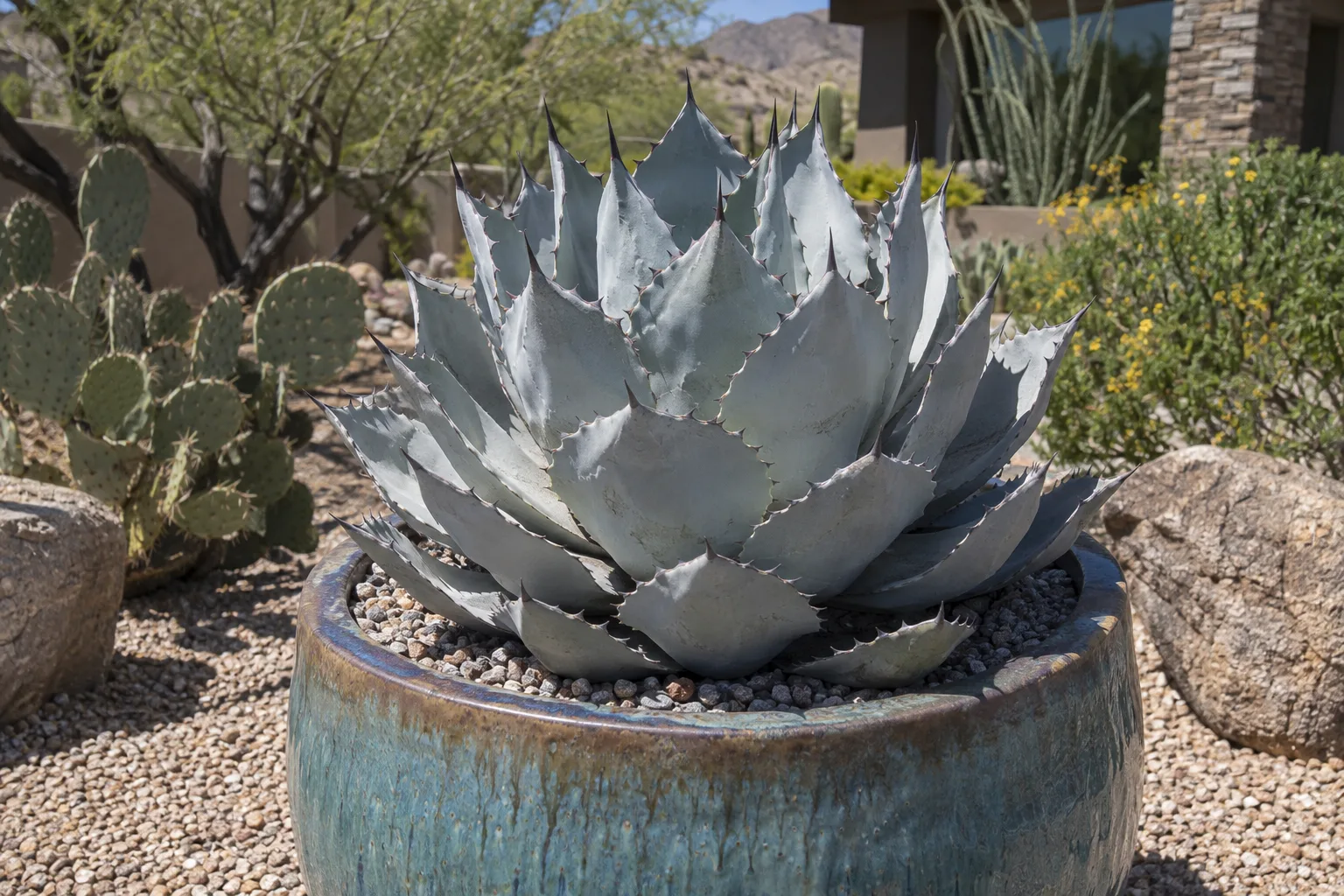
Parry’s agave (Agave parryi)
Parry’s agave forms a blue-gray rosette that stays about 2 to 3 feet wide, so it fits a large pot for years. It takes full sun and reflected heat well. Water every 2 to 3 weeks in summer and about once a month or less in winter. Its leaf tips carry a sharp spine, so keep it away from walkways and seating.
Aloe vera (Aloe vera)
Aloe vera grows about 1 to 2 feet tall and wide and sends up pups that fill out the pot. It does best with morning sun and shade in the afternoon. Water every 10 to 14 days in summer and less in winter. The drawback is leaf damage: strong western sun browns the tips, and frost turns the leaves to mush.
Echeveria (Echeveria species)
Echeverias are rosette succulents that range from about 4 to 12 inches wide depending on the species. They want morning sun and afternoon shade. Water every 1 to 2 weeks in warm weather, letting the mix dry between drinks. Western exposure in July will scorch them, so they suit east-facing patios and covered spots best. Cool nights and slightly less water deepen their pink and purple tones.
Ghost plant (Graptopetalum paraguayense)
Ghost plant makes silvery-lavender rosettes 3 to 6 inches wide on stems that trail 1 to 2 feet over the pot edge. It tolerates bright light and partial shade. Water about every 2 weeks in summer and monthly in winter. Leaves break off at a touch and root wherever they land, which fills a pot quickly but means loose leaves in neighboring pots.
Golden sedum (Sedum adolphii)
Golden sedum is a low, spreading plant, about 6 to 12 inches tall, that turns orange-yellow in strong light. Morning sun with afternoon protection suits it. Water about every 2 weeks in summer. It is brittle and sheds leaves when handled, and it is the quickest on this list to sulk when monsoon humidity keeps the soil damp.
Elephant bush (Portulacaria afra)
Elephant bush has small, glossy leaves on reddish stems and stays around 2 to 4 feet tall in a pot. It takes full sun to light afternoon shade and tolerates reflected heat from walls. Water every 10 to 14 days in summer. You can prune it into shape. It is frost-tender, so move it under cover on cold nights.
Firesticks (Euphorbia tirucalli)
Firesticks has pencil-thin stems that turn orange and red in cool weather, and in a container it usually reaches 3 to 5 feet. It wants full sun and water about every 2 weeks in summer. The milky sap irritates skin and eyes, so wear gloves and eye protection when pruning. Check with a veterinarian or poison control before placing it where pets or children roam.
Jade plant (Crassula ovata)
Jade plant grows slowly into a tree-like shape, about 2 to 4 feet tall in a pot. It likes morning sun and filtered afternoon light, such as an east or north-facing patio. Water about every 2 weeks in summer, and let the mix dry fully between drinks. It is frost-sensitive and can get top-heavy, so use a wide, stable pot.
How often should I water container succulents in Arizona?
Water when the mix is dry about 2 inches down, which usually means every 1 to 3 weeks in summer and every 3 to 6 weeks in winter. Pot size, pot material and sun exposure change that timing, so check the soil before you water instead of following a fixed schedule.
- Soak the mix until water runs out of the drainage hole, then stop.
- Water in the morning so leaves and soil dry during the day.
- Ease off during the monsoon. Humid air and rain slow evaporation, and a pot in the open may need water only every 3 to 4 weeks.
- Read the leaves. Wrinkled, soft leaves point to thirst, and mushy or yellow leaves at the base point to too much water.
Hard local irrigation water leaves white mineral crust on the soil surface over time. Flushing a pot with a thorough soak now and then helps wash salts through the drainage hole.
Which pot material holds up best in the summer heat?
Glazed ceramic and light-colored resin pots handle summer best, because they stay cooler and hold moisture longer than bare terra cotta. A pot that is too hot can cook roots even when the plant above looks fine.
Terra cotta breathes well and guards against overwatering, but it heats and dries quickly, so keep it in morning-sun spots. Dark pots absorb more heat than pale ones, especially on a south or west patio. Concrete containers have good thermal mass but are heavy and can raise the soil pH over time. Lightweight resin is easy to shift when the season changes.
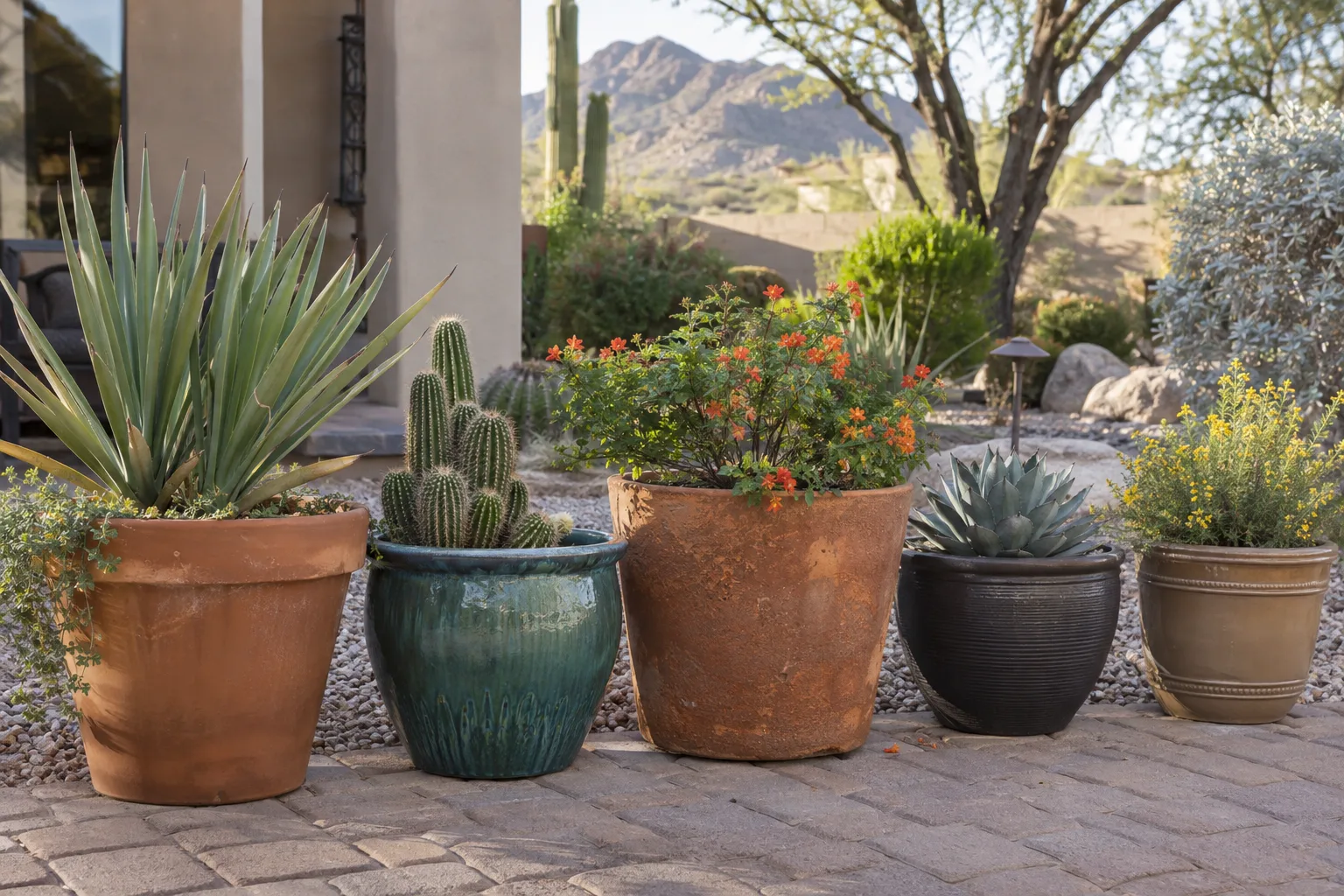
Size matters as much as material. Pots under 6 inches dry out so quickly in summer that they need near-daily checking. Start with pots 10 to 12 inches across, since larger soil volume buffers heat and gives roots room to settle. You can browse our pottery and planters to compare materials and sizes in person.
Do container succulents need shade or frost cover?
Yes, some do. Summer shade protects echeveria, aloe and jade, and frost cover protects aloe, jade, elephant bush and firesticks. Agave and ghost plant handle more extremes in both seasons.
In June, before monsoon clouds arrive, highs can pass 110°F. Move shade-sensitive pots to morning sun, or hang 30 to 50 percent shade cloth over them. Lift pots off concrete so air can move underneath.
In winter, occasional frost reaches the East Valley, usually on clear nights in December and January. When lows are forecast near 30°F, move tender pots under a patio roof or drape frost cloth over them. Pots are more exposed than in-ground plants because their roots have no surrounding soil to insulate them. Take freeze forecasts seriously.
Can I plant several succulents in one pot?
You can, as long as the plants share similar light and water needs. Mixing a sun-loving agave with a shade-preferring echeveria leaves one of them unhappy within a season.
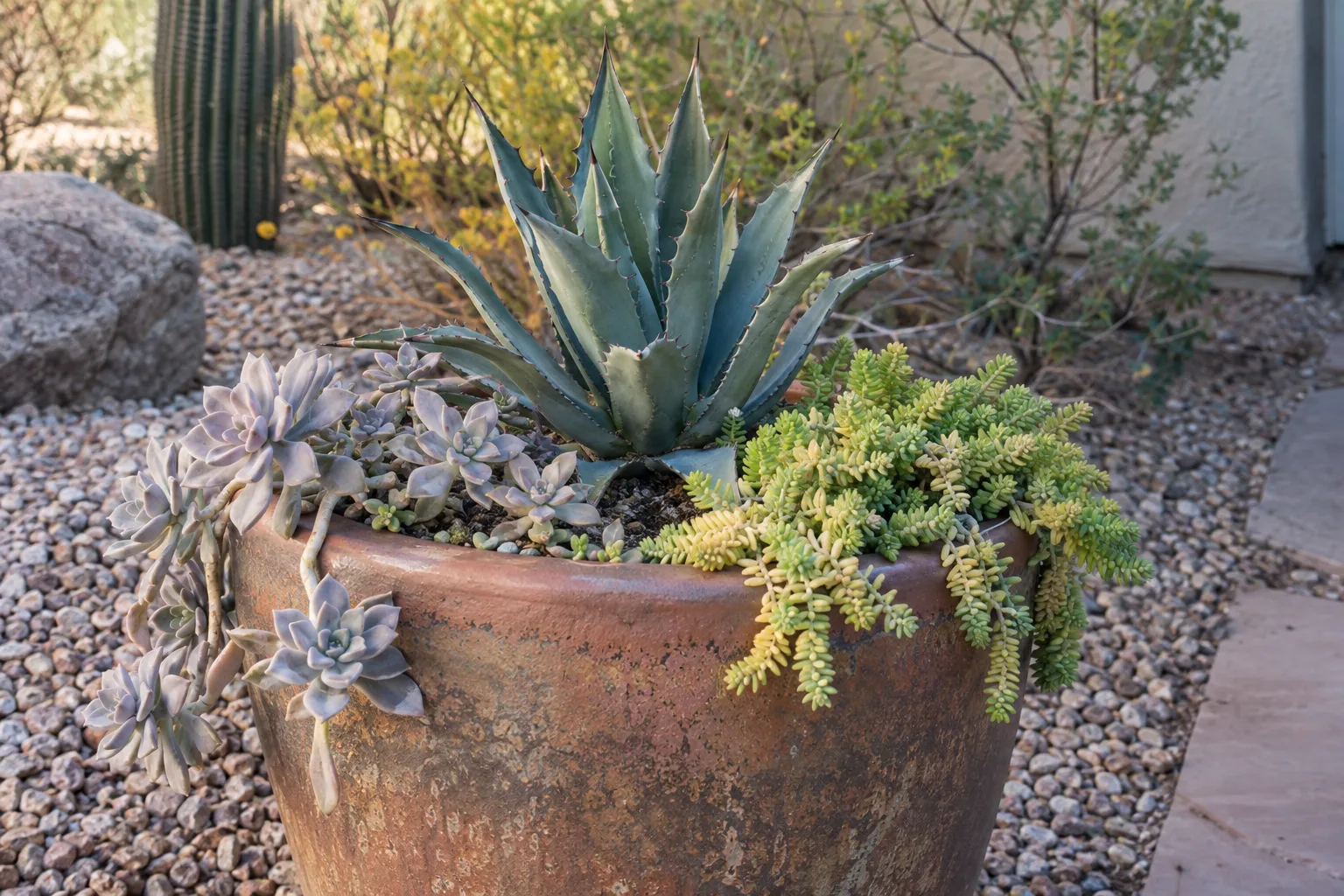
For a sunny spot, try Parry’s agave in the center with ghost plant spilling over the edge. For an east-facing patio, pair aloe vera, jade and a trailing ghost plant. Leave 2 to 3 inches between plants, because tight planting cuts airflow and holds humidity at the soil line, which invites rot in monsoon weather.
Check our gardening calendars for a month-by-month view of what to repot, feed and move. Spring, roughly February through April, is the easiest time to repot root-bound plants and divide overgrown ones, before summer heat arrives. If you want to see more plants that pair well with succulents, look through our plant selection.
Frequently asked questions
Do container succulents need fertilizer?
Yes, a light feeding helps, because regular watering washes nutrients out of pots. Use a balanced fertilizer at half strength once in early spring and once in early fall. Skip it in summer heat and winter dormancy. If new leaves yellow between the veins, hard alkaline water may be limiting iron, and a chelated iron product can help.
Why are my succulent leaves mushy or yellow?
Mushy or yellow leaves, especially near the base, usually signal too much water or poor drainage. Remove the damaged leaves, let the mix dry completely, and hold off watering for 2 to 3 weeks. If the roots look dark and smell sour, trim them, let them air dry for a day or two, and repot in fresh gritty mix.
Can I leave succulents out in monsoon rain?
Most can stay out if the pot drains freely and sits on feet, but a few days of repeated rain can overwhelm a heavy mix. Move prized pots under a patio cover when storms are forecast. Hold off on scheduled watering until the soil dries out afterward, since rain counts as a drink.
Can I use bagged cactus mix?
Yes, bagged cactus and succulent mix is a workable starting point, though many gardeners still add perlite or coarse sand for faster drainage in monsoon humidity. Mix in roughly one part grit to two parts bagged mix and check how quickly water runs through. Fast drainage matters more than the label on the bag.
When should I repot container succulents?
Spring is the best time, since plants are leaving winter dormancy and summer heat is still weeks away. Repot when roots circle the pot or push up through the drainage hole. Move up only one pot size, and wait a few days before watering so any damaged roots can heal.
Are container succulents right for your patio?
They suit anyone who wants color and structure with modest watering, and they work well on patios with morning sun. They are a poor fit if you want lush, fast-growing flowers, or if you will not water at all for a month in summer. Spiny agave and irritating firesticks sap are worth a second thought around small children and pets. Stop by our Queen Creek nursery to look over the succulents and pots in person.