
April is the best month to plant climbing plants in Arizona, with warm soil and about 6 to 8 weeks before triple-digit heat. Bougainvillea, queen’s wreath, passion vine and five other climbers cover fences and trellises best when their roots start before summer.
Key takeaways
- Plant in April, after the last frost, so roots get 6 to 8 weeks of mild weather before highs reach 100°F.
- Dig the hole 2 to 3 times as wide as the root ball and no deeper, with the top of the root ball level with or slightly above the soil.
- Water new vines every 2 to 3 days for the first few weeks, then stretch the interval as fresh growth appears.
- Cat’s claw vine and trumpet vine cling to walls on their own and are very vigorous, so skip them next to stucco you plan to repaint.
- Set up the trellis or wire at planting time, and keep it 4 to 6 inches off the house wall.
Why is April a good month to plant climbing vines in Arizona?
April gives new vines 6 to 8 weeks of mild weather to root before highs reach 100°F. Soil in the East Valley warms through the 60s and 70s°F that month, the range where roots grow fastest, and afternoon highs usually sit in the 80s to low 90s. Frost has mostly passed in Queen Creek by then, though a cold night in a low spot is still possible.
Roots that are established by June can support the burst of top growth that follows monsoon moisture, which arrives roughly July through September. A vine planted in June starts the same job when highs are above 105°F. That is a lot to ask of a transplant. Our gardening calendars list what else to plant each month.
Which climbing plants should I start in April?
Eight vines and trainable shrubs cover most fences, block walls and trellises in the low desert: queen’s wreath, bougainvillea, yellow bells, cat’s claw vine, passion vine, cape honeysuckle, Arizona grape ivy and trumpet vine. These are varieties we commonly carry, and availability changes week to week and season to season, so ask before you plan a whole fence. You can browse the full range on our plants page.
Queen’s wreath (Antigonon leptopus)
Queen’s wreath climbs by tendrils and carries sprays of pink flowers from late spring into fall. It reaches 15 to 30 feet in full sun, so give it chain-link, wire or a pergola post. Once established it needs a deep soaking about every 7 to 10 days in summer. The drawback is that it dies to the ground in a freeze and drops plenty of seed, so expect seedlings the next year.
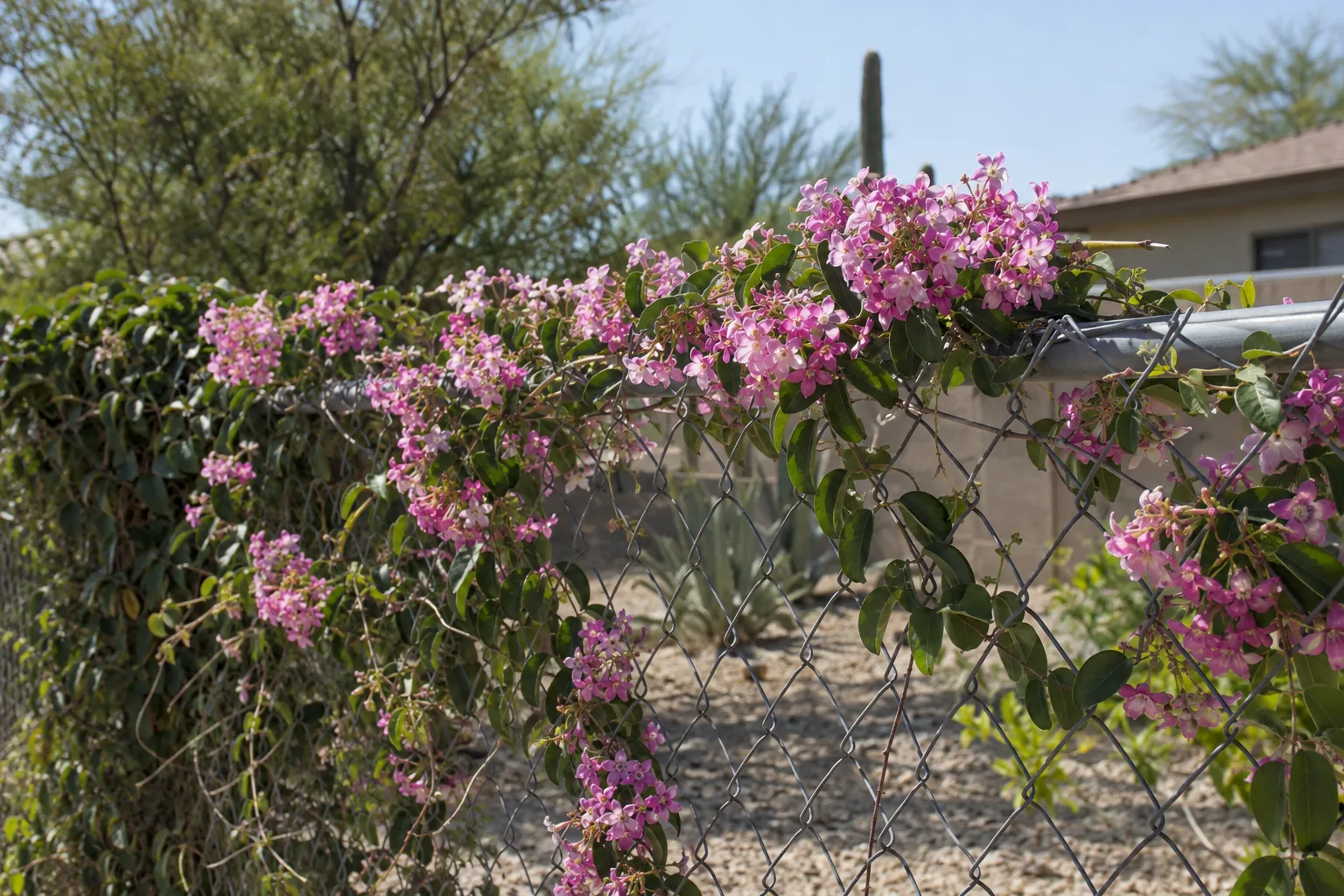
Bougainvillea (Bougainvillea spp.)
Bougainvillea is a thorny, sprawling plant whose colorful bracts cover a south or west wall in full sun. Tied to a support, it spreads 15 to 30 feet. Water deeply and let the soil dry between waterings, because too much water gives you leaves instead of color. The drawback is frost: a hard freeze burns the growth, and the roots dislike disturbance, so slide the plant out of its pot gently.
Yellow bells (Tecoma stans)
Yellow bells is a shrub that grows 6 to 12 feet tall, with yellow trumpet flowers from spring into fall that hummingbirds visit. It will not climb unaided, so tie new shoots to a fence or wire as they grow. It likes full sun and moderate water. Cut it back in late winter once frost danger has passed. The drawback is the constant training, plus seed pods that litter the ground.
Cat’s claw vine (Macfadyena unguis-cati)
Cat’s claw vine grips masonry and wood with hooked tendrils, so it covers a bare block wall faster than almost anything else here. It bears yellow trumpet flowers in spring and reaches 20 to 40 feet in sun or part shade. Water needs are low once it is established. The drawback is serious: it spreads by seed and underground tubers, is very hard to remove, and the hooks can damage stucco and mortar.
Passion vine (Passiflora spp.)
Passion vine climbs by tendrils to 10 to 20 feet and produces intricate flowers from late spring through fall. It grows best in sun with some shade from the hottest afternoon sun. Plan on regular deep watering in summer, more than most vines on this list. The drawback is frost: hardiness varies by species, and the tender ones freeze to the ground. Check the plant tag for the species you are buying.
Cape honeysuckle (Tecoma capensis)
Cape honeysuckle is a sprawling shrub with orange tubular flowers that open mostly from fall through winter, when little else blooms. It grows 6 to 10 feet tall and wider over time, in sun or light afternoon shade, with low to moderate water. Tie it to a fence or trellis, since it will not climb alone. The drawback is cold: hard frost damages it, and you should wait to prune until frost danger has passed.
Arizona grape ivy (Cissus trifoliata)
Arizona grape ivy is a desert-adapted tendril climber that grows 10 to 15 feet on chain-link or wire in sun to part shade. It needs little water once established, though deep summer soakings keep it looking better. Birds visit the small dark berries. The drawback is that it loses its leaves in cold weather and fills in more slowly than queen’s wreath or cat’s claw.
Trumpet vine (Campsis radicans)
Trumpet vine clings with aerial rootlets and produces large orange to red flowers from late spring into early fall that attract hummingbirds. It reaches 20 to 40 feet in full sun and tolerates heat well. Give it a strong support, because mature stems are heavy. The drawback is its spread: it sends up suckers several feet from the main plant and its rootlets can mar stucco, so trim it often.
How do these eight climbing plants compare?
The table below sets the eight side by side on sun, water, climbing method and cold tolerance. Use it to narrow the list before you look at your wall, since a west-facing block wall and a shaded patio post call for different plants.
| Plant | Sun | Water once established | How it climbs | Frost response |
|---|---|---|---|---|
| Queen’s wreath | Full sun | Low to moderate | Tendrils | Dies back, regrows from roots |
| Bougainvillea | Full sun | Low to moderate | Needs ties | Damaged by hard frost |
| Yellow bells | Full sun | Low to moderate | Needs ties | Damaged by hard frost |
| Cat’s claw vine | Sun to part shade | Low | Hooked tendrils cling | May freeze back, regrows |
| Passion vine | Sun to afternoon shade | Moderate | Tendrils | Varies by species |
| Cape honeysuckle | Sun to light shade | Low to moderate | Needs ties | Damaged by hard frost |
| Arizona grape ivy | Sun to part shade | Low | Tendrils | Loses leaves in cold |
| Trumpet vine | Full sun | Low to moderate | Aerial rootlets | Generally cold hardy |
For a west wall that bakes in reflected heat, bougainvillea, cat’s claw vine and trumpet vine cope best. Hummingbird gardens do well with cape honeysuckle, trumpet vine and yellow bells. Low water use points to Arizona grape ivy.
How do I plant a climbing vine in caliche and alkaline soil?
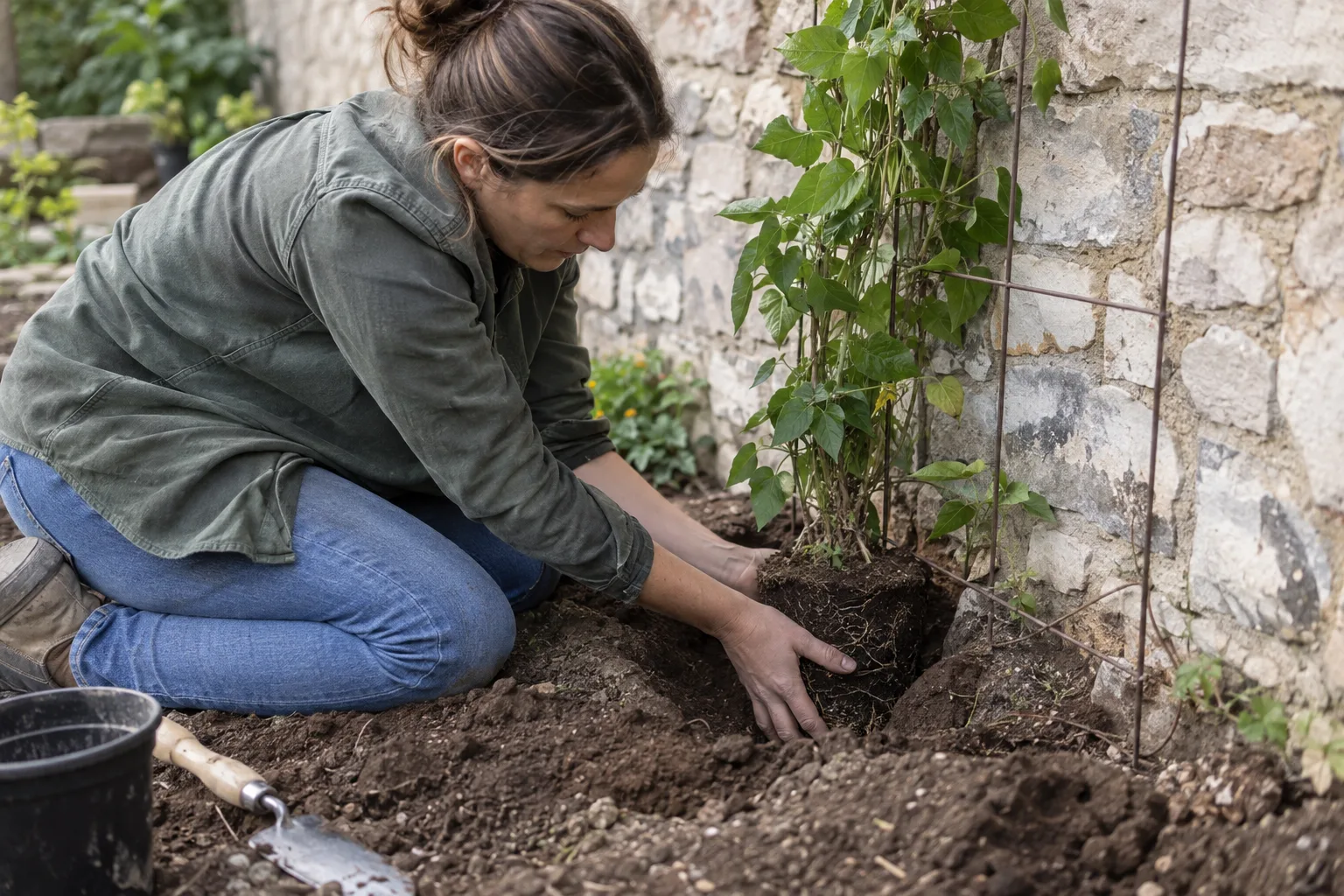
Dig a wide, shallow hole, check that it drains, and set the plant slightly high. Alkaline soil and caliche are common across Queen Creek, and water that pools above a hard layer drowns roots faster than any heat does. Follow these steps for each vine.
- Dig a test hole about 18 inches deep. If you hit a hard, whitish layer, break through it with a digging bar. Fill the hole with water, and if it is still standing a day later, pick another spot or fix the drainage.
- Make the planting hole 2 to 3 times as wide as the root ball and only as deep as the root ball.
- Backfill with the native soil you dug out. If you add compost, keep it to roughly a quarter of the mix and blend it evenly, because a hole filled with fluffy soil can make roots reluctant to grow outward.
- Set the top of the root ball level with or a little above the surrounding soil.
- Water slowly for 20 to 30 minutes to settle the soil and remove air pockets.
- Spread 2 to 4 inches of mulch and keep it a few inches away from the stem.
- Install the trellis, wire or panel now, and tie the first shoots toward it.
- Water every 2 to 3 days for the first few weeks, then spread the waterings further apart as new growth shows that roots are taking hold.
Yellow leaves with green veins point to iron chlorosis, which is common in our alkaline soil. Check drainage first, since roots sitting in saturated soil cannot take up iron even when it is present.
What kind of support does each vine need?
Tendril and twining vines need something thin to grab, such as chain-link, wire or a narrow-grid panel, while shrubs like bougainvillea and cape honeysuckle need ties. Self-clinging vines can hold on to a wall but may damage the surface, so a wire frame is the safer start. Summer sun above 110°F wears out cheap materials in a few seasons.

- Galvanized or stainless wire run between eye bolts, with strands 12 to 18 inches apart, is durable and nearly invisible once the vine fills in.
- Powder-coated steel panels resist sun damage and hold heavy vines like trumpet vine and mature bougainvillea.
- Thin wood trellises dry out, crack and sag in our UV, so use thicker lumber or choose metal.
- Keep any trellis 4 to 6 inches off the house wall so air can move behind it.
What mistakes should I avoid with new climbing vines?
The most common mistakes are planting too deep, overwatering, and putting an aggressive vine where you cannot control it. Each one is easy to avoid with a little planning before the plant goes in the ground.
- Burying the root ball or crown. Planting too deep in slow-draining soil invites rot.
- Watering bougainvillea like a lawn. It blooms best with a dry spell between deep waterings.
- Cutting back frost-damaged growth in February. Wait until new buds show, since the damaged stems protect the plant from the next cold snap.
- Planting cat’s claw or trumpet vine close to a foundation or irrigation line.
- Skipping summer water during the first year. Even drought-tolerant vines need regular deep soaks until they are established.
If you want hands-on help choosing and planting, check our classes and events for upcoming sessions.
Frequently asked questions
Can I plant a climbing vine right against a stucco wall?
Self-clinging vines like cat’s claw and trumpet vine can grip stucco directly, but removing them later can pull off patches of finish. A wire trellis set 4 to 6 inches off the wall gives similar coverage with far less risk. If your stucco is old or cracked, use the trellis and a tendril or twining vine.
Should I fertilize new climbing vines?
Wait 4 to 6 weeks after planting, then use a balanced slow-release fertilizer about every 6 to 8 weeks through September. Bougainvillea blooms better with less nitrogen, so a formula with a higher middle number suits it. Water before and after applying so the roots do not burn in warm soil.
How fast will these vines cover a 6-foot wall?
Fast growers such as queen’s wreath, passion vine, cat’s claw vine and trumpet vine can cover 10 to 20 feet of fence in their first season with regular water. Cape honeysuckle and yellow bells usually take 2 to 3 seasons to fill in. Most growth comes in summer and early fall.
Can I grow a climbing vine in a pot?
Yes, passion vine, bougainvillea and cape honeysuckle all grow in large containers if the pot has drainage holes and a trellis stuck into it. Choose a pot at least 18 to 24 inches wide and expect to water more often in summer. See our pottery and planters for options.
Is it too late to plant a vine in May?
May planting can work if you water consistently, but roots get less time before highs pass 105°F. Mulch well, water more often than you would in April, and hold off on fertilizer until the plant is growing. October is the other good planting window in the low desert, especially for frost-tender vines.
Which climbing plant is right for your fence?
Pick by site and by how much upkeep you will accept. Bougainvillea suits a sunny, warm wall if you can live with occasional frost damage. Queen’s wreath and passion vine fill chain-link quickly, and cape honeysuckle adds winter color. Skip cat’s claw and trumpet vine if you may want to repaint or remove them from stucco later, and skip all of these if you cannot water twice a week through the first summer. Stop by our nursery in Queen Creek and we will help you match a vine to your wall.