
Decorating your yard with fresh evergreens in Arizona works well in December, and cut greens usually last 2 to 3 weeks outdoors. Pick fir, cedar or juniper, soak the stems before arranging, and keep displays out of afternoon sun.
Key takeaways
- Cut fir, incense cedar and juniper usually last 2 to 3 weeks outdoors in December, while pine and spruce often start dropping needles within about 10 days.
- Soak cut stems in cool water for several hours or overnight before you arrange them.
- Place displays where they miss direct afternoon sun, such as under a patio cover or at a north-facing entry.
- Check container water every 2 to 3 days and mist the foliage every 1 to 2 days in our dry winter air.
- Use LED lights, and keep greens at least several feet from fire pits, heaters and candles.

Do fresh evergreens hold up in an Arizona December?
Yes, cut greens last about 2 to 3 weeks outdoors here when you condition them and keep them watered. December days in Queen Creek commonly reach the upper 60s to low 70s°F, and nights often fall into the 30s or 40s. That cool weather helps a great deal.
Humidity is the real challenge. Dry air pulls moisture out of cut needles faster than the damp climate of the Pacific Northwest, where most fir and cedar greens are grown, so a display needs a quick check every few days. Light frost on a cold morning does not hurt cut stems. Afternoon sun does, because it dries foliage far faster than cool air ever will.
Which evergreens last longest outdoors in the low desert?
Incense cedar, Douglas fir and noble fir last longest, usually 2 to 3 weeks outdoors. Pine and spruce are the weakest choices for outdoor use, since needles turn brittle and drop in about a week to 10 days.
| Greens | Typical outdoor life | Best use |
|---|---|---|
| Noble fir (Abies procera) | 2 to 3 weeks | Wreaths, garlands, stiff framework branches |
| Douglas fir (Pseudotsuga menziesii) | 2 to 3 weeks | Garlands, entry pots, soft fragrant fill |
| Incense cedar (Calocedrus decurrens) | 2 to 3 weeks | Flat sprays for mixed arrangements |
| Juniper (Juniperus) | 2 to 3 weeks | Rustic pots, berried accents |
| Eucalyptus (Eucalyptus) | 2 to 4 weeks, dries in place | Silvery texture, dried displays |
| Pine and spruce (Pinus, Picea) | About 1 week to 10 days | Short-term accents only |
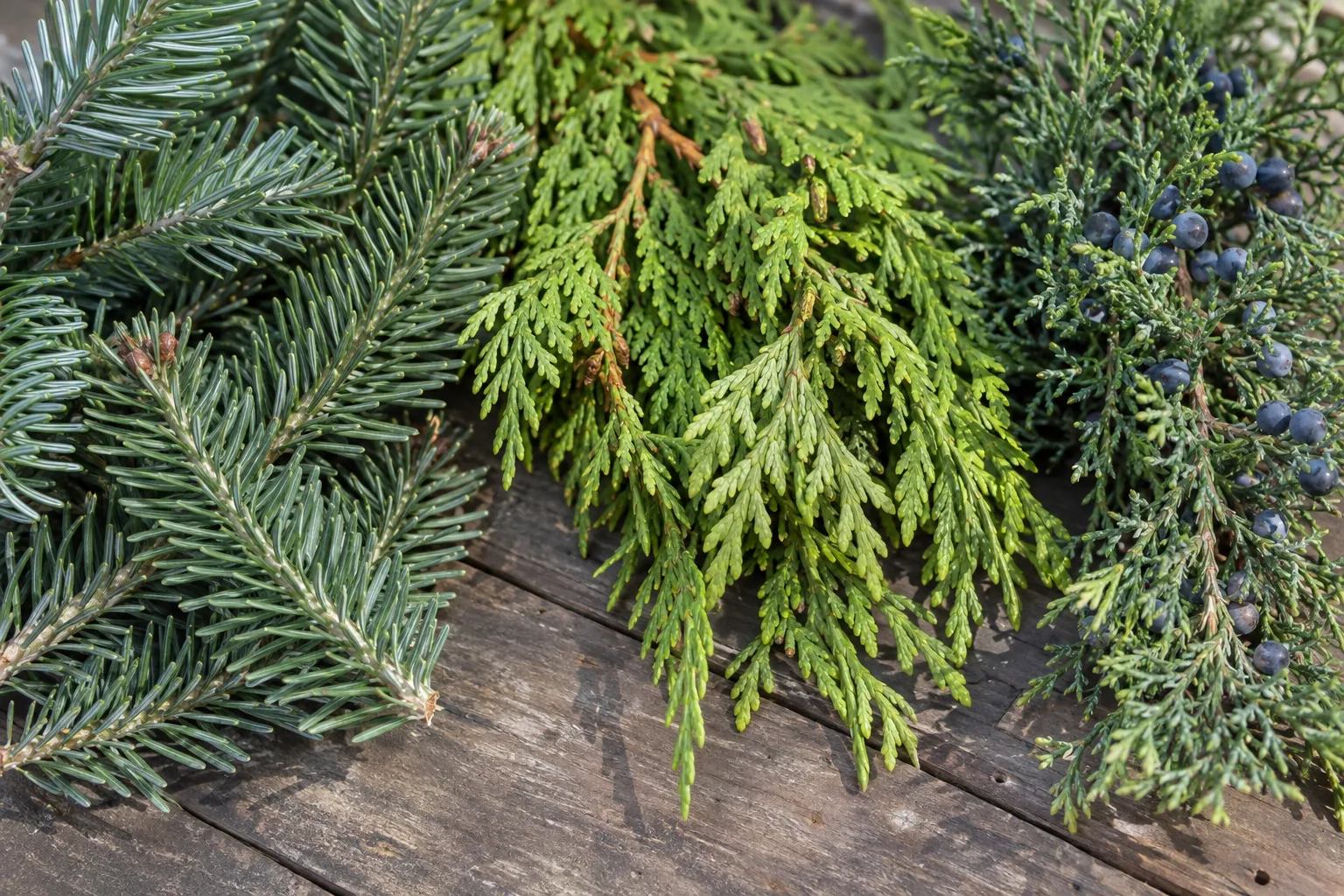
Fir and cedar have stiff branches that hold ornaments without drooping. Juniper gives a blue-green, earthy look that suits a desert yard. If you want something living to cut from in future seasons, our evergreen trees department shows what grows well here, and availability changes week to week and season to season.
Where do I get fresh greens for a yard display?
Buy cut bundles or ready-made garlands from local sellers in late November and early December, then add trimmings from plants you already own. Selection varies from week to week, so ask a seller what is fresh before you plan the design.
When you shop, bend a branch gently. Needles should flex rather than snap, and cut ends should look moist instead of chalky. Skip any bundle that has been baking in the sun.
Your own yard can supply plenty. Rosemary (Salvia rosmarinus), Italian cypress (Cupressus sempervirens), arborvitae, juniper and olive (Olea europaea) all cut well. If you want more rosemary for the yard, browse our herbs, vegetables and berries. Cut no more than about a quarter of any one plant, and harvest in the morning, when stems hold the most water. Put them straight into a bucket of cool water.
What do I need to build an evergreen display?
You need a heavy container, a way to keep stems in water, sharp pruners and a spray bottle. The rest is optional decoration.
- Clean, sharp pruning shears and a large bucket or tub for soaking.
- A heavy container, since a winter wind can tip a light one. Our pottery and planters include sizes that suit entry displays.
- A water-holding liner, bucket or jar to sit inside the pot, plus rocks or gravel for weight.
- Paddle wire if you plan to make garlands or a wreath.
- Battery-powered or low-voltage LED string lights.
- Gloves, and eye protection if you cut anything with milky sap.
How do I build a display step by step?
Condition the stems, build a frame from the largest branches, then layer in texture, accents and lights. The whole project takes an afternoon.
- Pick the spot. A covered patio, walled courtyard or north-facing entry gives shade and wind protection that slow drying.
- Condition the stems. Recut each end at an angle, then soak whole branches in cool water for several hours or overnight.
- Set up the container. Place a water-filled liner inside a heavy pot and weight the base with rocks so wind cannot tip it.
- Build the frame. Push the largest fir or cedar branches in first, varying the angles so the shape looks full rather than flat.
- Add secondary greens. Tuck in cedar sprays, juniper tips or eucalyptus to hide the container rim and any gaps.
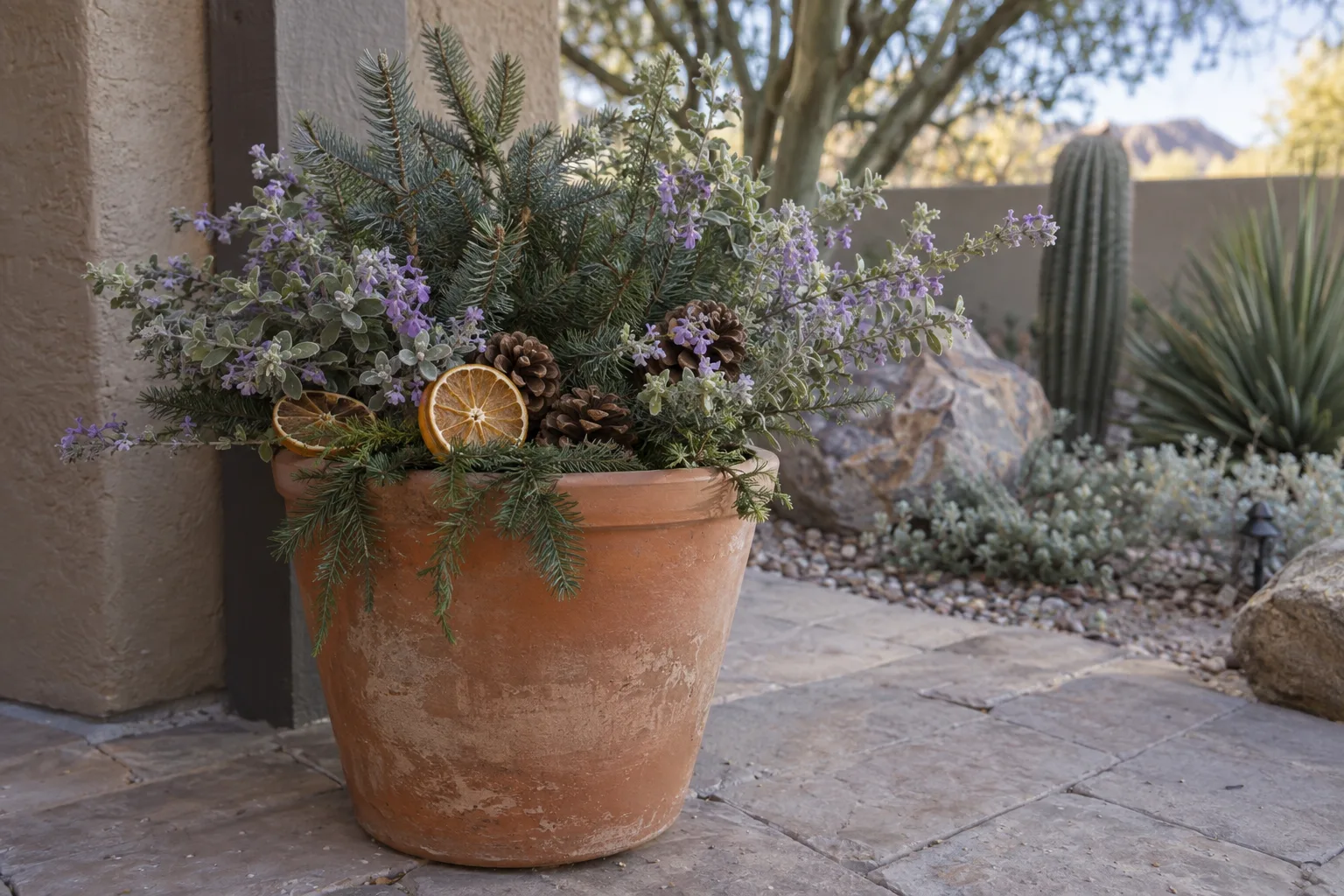
- Add accents. Pinecones, dried citrus slices, ribbon and berried stems go in at different heights.
- Add lights last. Work cords in from the inside so they stay hidden.
- Water and mist. Fill the liner, then mist all the foliage until it is damp.
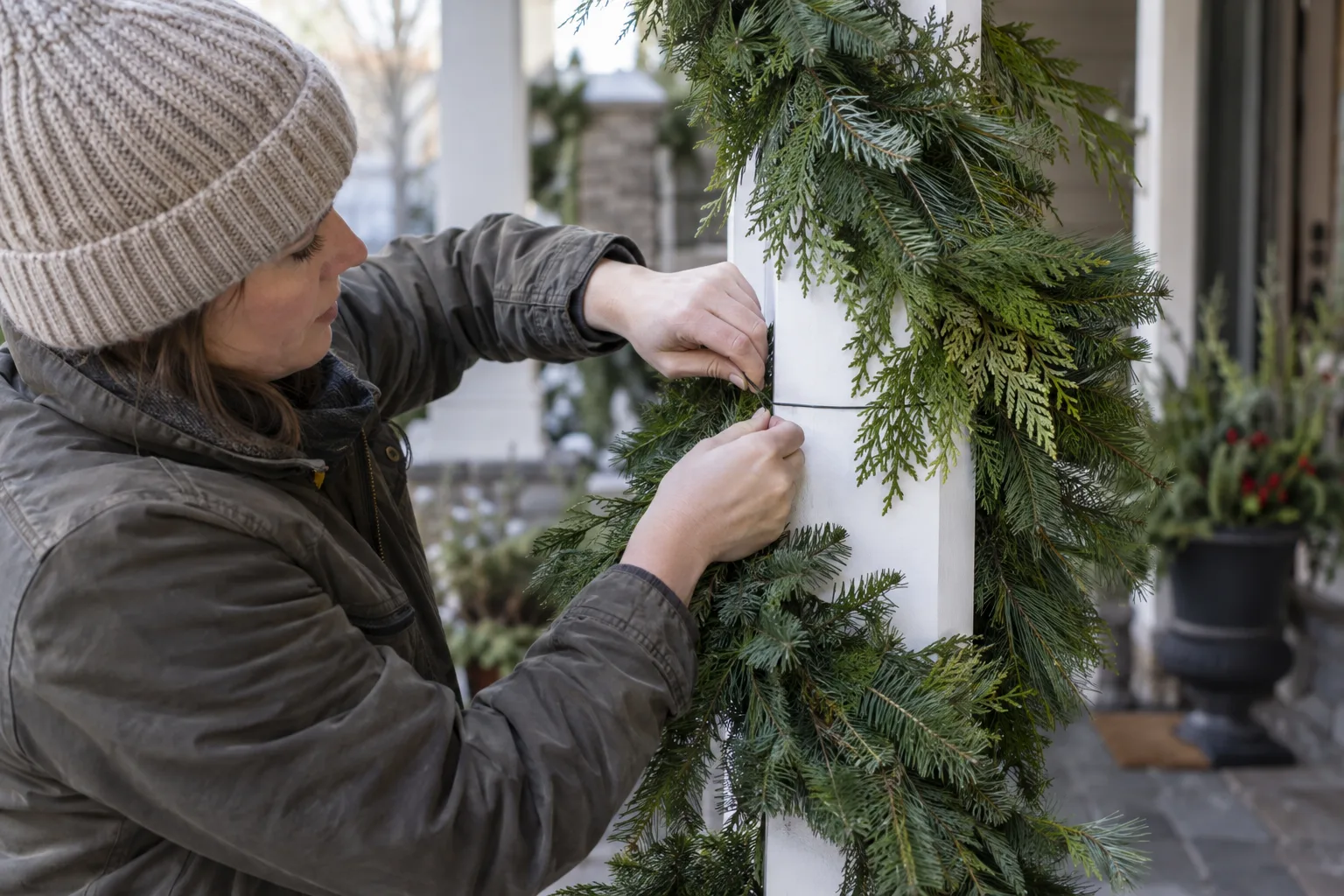
For a garland, wire small bundles of tips, 6 to 8 inches long, onto a rope or a length of wire, overlapping each bundle over the stems of the last. Drape it along a patio beam or wrap it around a support column.
How do I keep cut greens fresh in dry air?
Keep stems in water, keep the display in shade and mist the foliage often. December humidity in the East Valley is commonly low, so cut material loses moisture quickly once it leaves a bucket.
Check the water in the container every 2 to 3 days, since a pot can empty faster than you expect. Mist the foliage every 1 to 2 days. A spot shaded from about 1 to 4 PM can add several days of life compared with a fully exposed one.
Anti-desiccant sprays, sold at garden centers for evergreens, can slow moisture loss from needles. Read the label, test a single branch first, and keep the spray off lights and ornaments. Apply it on a calm, cool morning so it does not drift.
Which plants already in my yard pair well with fresh greens?
Silver-leaved shrubs, rosemary and winter-blooming succulents all pair well with dark green fir and cedar. They add contrast without extra watering.
- Texas sage (Leucophyllum frutescens): Small sprigs of silver-gray foliage look good tucked beside fir branches.
- Rosemary: Upright types can be trimmed into a small cone and wrapped with lights, and the scent mixes well with fir.
- Aloes: Many send up orange or red bloom spikes in winter, so a display placed near one picks up that color.
- Citrus and pomegranate (Punica granatum): Fresh fruit tucked into a pot adds red and orange. Thin citrus slices dried in a 200°F oven for roughly 3 to 4 hours work as ornaments.
To find more silver foliage and winter color for next year, browse our plant selection.
What mistakes shorten a display’s life or create risk?
The most common mistakes are letting containers dry out, placing greens in full afternoon sun and using plants that are unsafe to handle. Each one is easy to avoid.
- Skipping the soak. Unconditioned branches dry out faster in low humidity.
- Using pine for a three-week display outdoors, when needles may drop in about 10 days.
- Placing greens near a fire pit, patio heater or candle. Dry evergreens burn readily.
- Cutting oleander (Nerium oleander) for arrangements. Poison control centers and the ASPCA list it as toxic to people and pets.
- Handling euphorbias bare-handed. Their milky sap irritates skin and eyes, so wear gloves and eye protection.
If pets chew plants, check each material against the ASPCA toxic plant list before hanging it within reach.
Frequently asked questions
What size wreath works for a front door?
An 18 to 20 inch wreath fits most standard front doors. Wire 4 to 6 stems per bundle, each about 6 to 8 inches long, onto a wire frame, overlapping bundles in one direction until the frame is covered. Mist it and let it rest overnight before hanging. Check our classes and events page for what is scheduled.
Can I compost the greens afterward?
Yes, fresh greens compost well once the season ends. Remove wire, ribbon, ornaments and lights first, and cut thick branches into short pieces so they break down faster. Mix them with kitchen scraps or other plant material rather than layering them thickly. Needles from evergreens break down more slowly than leaves, so be patient.
When should I put the display out and take it down?
Put it out in early to mid December so the greens look fresh through the holiday itself. Take it down when needles turn crisp or drop at a light touch. A display that is dry enough to crackle is a fire risk and has no decorative value left.
Is it safe to light fresh greens?
LED string lights are the safer choice, because they produce very little heat compared with older incandescent strings. Use outdoor-rated lights, and keep cords off wet ground. Do not use real candles or open flames in or near fresh greens, and check the display regularly as the foliage dries.
Do I need floral foam?
No, a water-filled liner holds stems well and keeps them hydrated longer than foam. Foam dries out in desert air and leaves crumbs that are hard to clean up. Weight the container with rocks and top off the water every 2 to 3 days.
Are fresh evergreens worth the upkeep in a desert yard?
For most households, yes. A display that needs a quick water check every few days gives you fragrance and texture that artificial greens do not. The cost is a short soak at setup and attention to shade and water. Skip fresh greens if you travel through the holidays, if your entry gets full afternoon sun and has no shaded alternative, or if pets chew plants. Artificial garland is the better choice in those cases. If you want help planning, visit us at the nursery in Queen Creek.