

The Christmas cactus varieties Arizona collectors chase most are Thanksgiving cactus, true Christmas cactus, and white, peach and bicolor hybrids. All live indoors in the low desert, and the best pick depends on bloom timing and how much attention you want to give.
Key takeaways
- Thanksgiving cactus (Schlumbergera truncata) usually blooms first, from late October into November, and has pointed, tooth-like edges on its segments.
- True Christmas cactus (Schlumbergera x buckleyi) blooms later, often December into January, and has smooth, scalloped segment edges.
- Bud set needs 13 to 14 hours of uninterrupted darkness and nights around 50 to 60°F for roughly 4 to 6 weeks, starting in October.
- Keep every type indoors through summer, because highs above 110°F and hot window glass damage these tropical forest plants.
- Use a fast-draining mix and let the top inch dry between waterings, since soggy roots are the most common cause of loss.

What is the difference between a Thanksgiving cactus and a Christmas cactus?
The easiest check is the segment edge. Thanksgiving cactus has pointed, tooth-like projections along each flat segment, while true Christmas cactus has smooth, scalloped edges. Most plants sold as Christmas cactus in stores are Thanksgiving cactus, which flowers about four to six weeks earlier, so your plant’s bloom date is a second clue.
Easter cactus (Hatiora gaertneri) is a third relative, and it flowers in spring.
| Feature | Thanksgiving cactus | True Christmas cactus | Easter cactus |
|---|---|---|---|
| Segment edges | Pointed teeth | Smooth, scalloped | Rounded, with tiny bristles at the tips |
| Usual indoor bloom | Late October to November | December to January | Late winter to spring |
| Flower shape | Angled, often asymmetrical | More symmetrical, tubular | Star-shaped |
Which Christmas cactus varieties do Arizona collectors want most?
Four types make up most of what collectors look for here, and each is a houseplant in the low desert. You can browse the houseplants we sell to see what is on the shelf in a given week. Gardeners often assume a plant with cactus in its name wants desert sun and dry soil, but these four come from humid Brazilian forests and grow on trees.
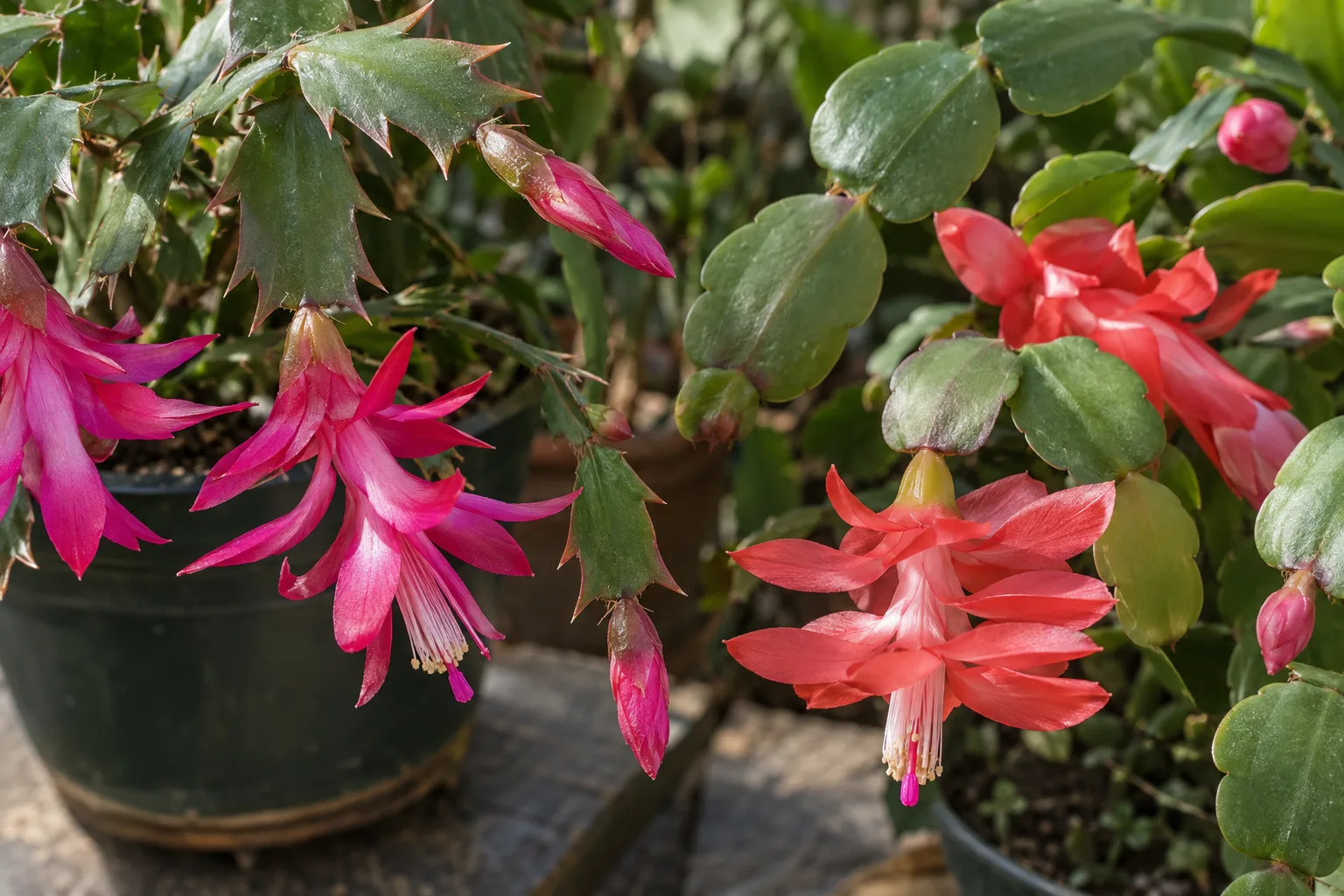
Thanksgiving cactus (Schlumbergera truncata)
This is the easiest one to bloom indoors. Expect a mound about 1 to 2 feet tall and 2 to 3 feet wide in a pot as it ages, in bright indirect light, with water once the top inch of mix dries. The drawback is that the toothed segments snap off when bumped, and buds drop quickly if you move the plant after they form.
True Christmas cactus (Schlumbergera x buckleyi)
Its arching stems and symmetrical flowers arrive closer to the holidays. Size and light match the Thanksgiving type, and it wants the same even watering. The drawback is timing: it responds to cooler nights and longer uninterrupted darkness more strictly, so it is a little harder to bloom on schedule.
Easter cactus (Hatiora gaertneri)
Star-shaped flowers open in late winter to spring, which extends the show past the holidays. It stays smaller, around 8 to 12 inches tall with trailing stems, and likes bright indirect light. Its drawback is a cool, drier winter rest that is easy to get wrong, and it dislikes wet roots.
Rhipsalis (Rhipsalis species)
These thin, trailing epiphytes hang 1 to 3 feet or more, depending on the species, and tolerate lower light than the holiday types. Water when the top inch of mix dries. The drawback is that the flowers and berries are small, so you grow it for its shape and not for a holiday display.
Which flower colors are hardest to find?
Bicolor and clear white forms usually take the most searching. Magenta and pink are the colors you see most often, and they are the easiest to grow well.
Collectors often mention named hybrids such as ‘White Christmas’ for white blooms and ‘Peach Parfait’ for soft peach and salmon tones. Bicolor flowers, such as purple with a white center or red with yellow, tend to be scarce and pass between collectors at plant swaps. The color does not change the care, so a rare cultivar grows exactly like a common one.
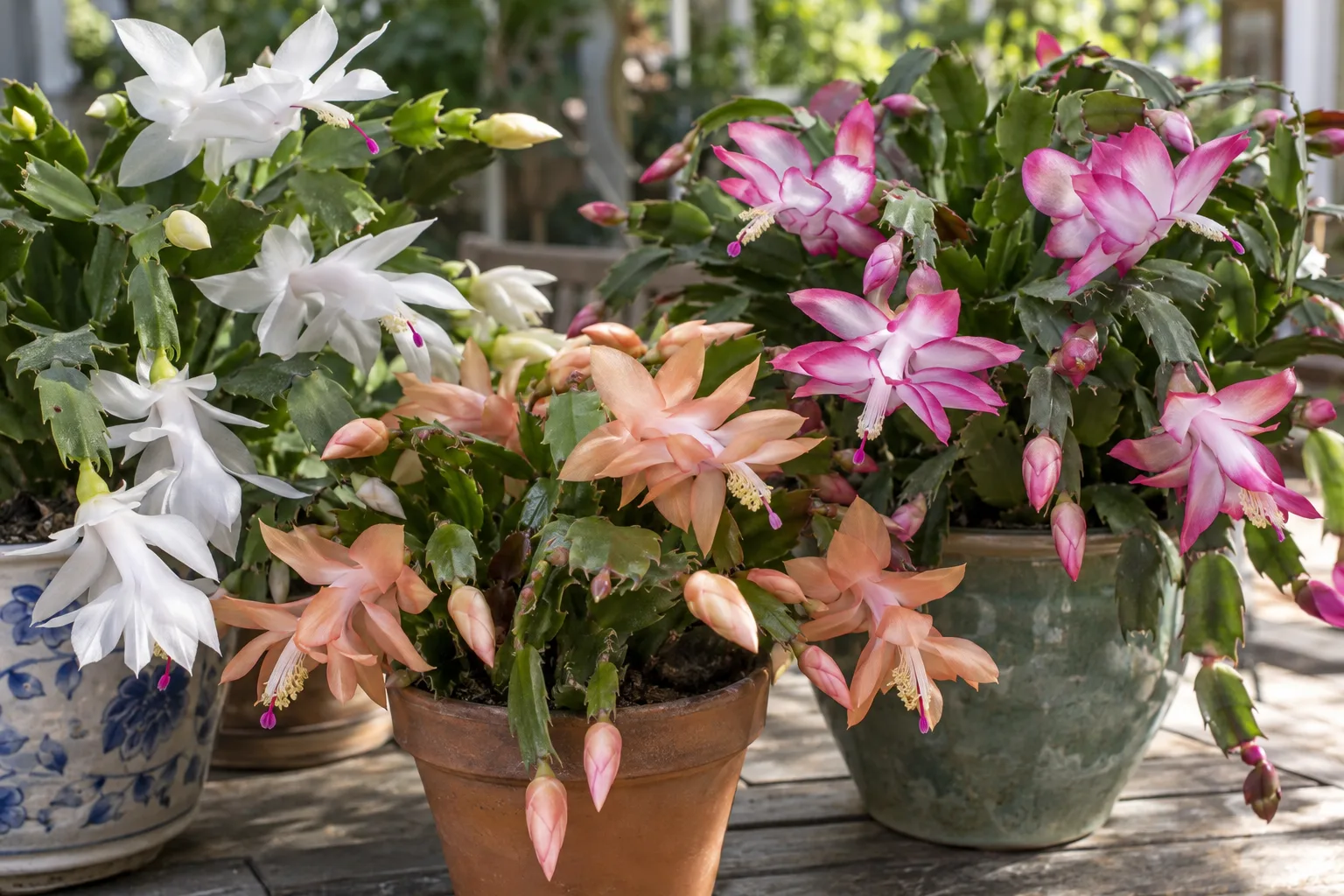
Holiday cactus are among the houseplants we commonly carry in fall, but availability changes week to week and season to season. If you want a particular color, reach us through our contact page before you make the drive.
Where should a Christmas cactus sit in an Arizona home?
Bright, indirect light from an east or north window suits it best. A south or west window can run far hotter than the room behind the glass in summer, and that heat scorches segments and cooks roots.
Summer highs above 110°F rule out outdoor placement from June through September. Indoors, air conditioning keeps the plant comfortable. Fall is the useful season here, because October and November nights cool off right when the plant needs a temperature drop to set buds. Frost damages buds and segments, so bring any plant that spent mild weeks on a shaded porch back inside when the forecast nears 40°F. Winter indoor air is dry, and a tray of wet pebbles under the pot adds a little humidity.
How should you pot and water holiday cactus in the low desert?
Use a loose, fast-draining mix and water only when the top inch feels dry. A blend of roughly equal parts cactus mix and perlite, with a small handful of orchid bark, copies the airy crevices these plants grow in. Skip heavy clay and never use native caliche soil.
Choose a pot with drainage holes. Terra cotta from our pottery and planters dries faster than glazed ceramic, which helps if you tend to overwater.
Our hard, alkaline irrigation water leaves mineral salts behind, often as a white crust on the pot rim. Flush the pot with plain water through the drainage holes every month or two, and use filtered water or rainwater when you have it.
- Summer: water about every 10 to 14 days, letting the top inch dry between drinks.
- Bud setting (October to November): water a little less, keeping the mix barely moist.
- Bloom (December to January): water more often and keep the mix evenly moist.
- After bloom (February to May): ease back and let the plant rest.
How do you get a Christmas cactus to bloom?
Give it long nights, cool temperatures and less water for about 4 to 6 weeks starting in October. The plant forms buds in response to day length and temperature, so the steps below control those two things.
- Stop fertilizing in September, since feeding pushes leaves instead of flowers.
- Starting in early October, water only when the top 1 to 2 inches of mix are dry.
- Give the plant 13 to 14 hours of complete darkness every night, in a room with no lamps, TV glow or porch light coming in.
- Keep nights near 50 to 60°F, such as a spot near an exterior window.
- Watch for small round buds at the segment tips, which usually show within 4 to 6 weeks.
- Once buds appear, return the plant to its bright spot, resume regular watering and leave it where it is.
Mark October on one of our gardening calendars so the start date does not slip. Streetlights and patio lights are the usual reason a plant refuses to bloom here. Covering it with a box overnight is an easy fix.
Why is my Christmas cactus dropping buds?
Bud drop almost always follows a sudden change. Four causes account for most cases: moving the plant after buds form, big temperature swings, soil that dried out completely during bud development, and a draft from an air conditioning vent or heater.
Pick a spot and leave the plant there once buds show. Keep it a few feet from vents, and keep the mix evenly moist but never soggy. Buds already lost will not return, though the plant usually sets a few more if conditions settle quickly. Our classes and events page lists upcoming workshops if you want hands-on help.

Frequently asked questions
How long does a Christmas cactus live?
A well-kept Christmas cactus can live for decades. Plants passed down in families for 20 to 30 years or more are common, and older plants grow wider, branch more and carry more blooms. In the low desert the usual causes of early loss are root rot from soggy soil and summer heat near windows.
Should I repot my Christmas cactus?
Repot only every 2 to 3 years, or when roots crowd the pot. These plants flower well when slightly root-bound. March to May, after bloom ends, is a good window. Go up just one pot size, because a much larger pot holds wet soil longer and invites root rot.
Can I grow new plants from cuttings?
Yes, cuttings of 2 to 3 segments root easily. Twist the piece off, let the cut end dry for about a day, then push it roughly half an inch into barely moist, fast-draining mix. Keep it in bright indirect light and hold off watering for several days. Roots usually form in a few weeks.
Do holiday cactus need fertilizer?
Feed lightly during active growth and pause in early fall. A balanced liquid houseplant fertilizer at half the label strength every 3 to 4 weeks from spring through summer is typical. Fertilizing while buds are setting pushes leafy growth instead of flowers, so stop around September and wait until blooms finish.
Why are the segments limp or shriveled?
Limp segments point to either thirsty roots or rotting ones. Check the soil first. If it is dry 2 inches down, water thoroughly and the segments should firm up within a few days. If the soil is wet and the stems feel soft, the roots are likely rotting, so repot into fresh dry mix and water lightly.
Which Christmas cactus is right for your home?
Start with a Thanksgiving cactus if you want dependable fall color from a forgiving plant. Choose a true Christmas cactus if you have a cool, dark spare room and enjoy managing bloom timing. Pick Easter cactus for spring flowers or Rhipsalis for a trailing look. Skip all of them if you have no bright, indirect spot indoors or tend to water on a fixed schedule whatever the soil feels like. Stop by the nursery in Queen Creek and we will help you choose.