
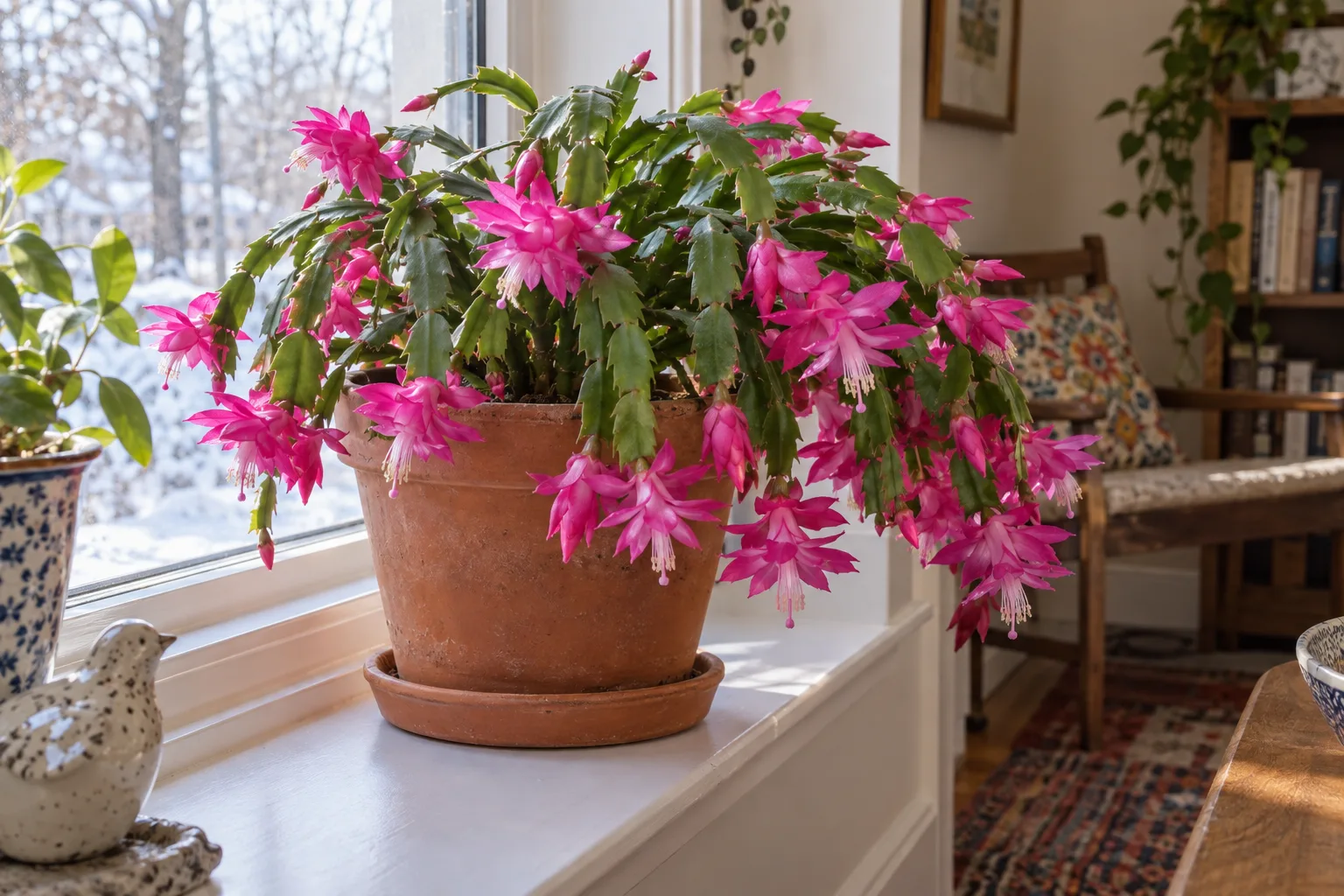
Christmas cactus is a holiday favorite in Arizona homes because it blooms from late November through December, tolerates dry indoor air and lives for many years. Keep it indoors, since low desert summers above 110°F are far too hot for it outside.
Key takeaways
- Buds form when the plant gets 12 to 14 hours of uninterrupted darkness each night and nights of roughly 50 to 60°F, starting around late September to October.
- Bright, indirect light suits it best. An east window, or a spot a few feet back from a bright window, works better than a west window in summer.
- Water when the top inch of mix feels dry, then let the excess drain. Soggy mix rots the roots.
- Once buds appear, leave the pot where it is and keep the mix evenly moist, because moving it or letting it dry out drops buds.
- Treat it as an indoor plant. A shaded patio is fine in the cool months, but summer heat and winter frost both damage it.
What is a Christmas cactus and where does it come from?
It is a trailing plant with flat, jointed stems, in the genus Schlumbergera, native to the coastal mountains of southeastern Brazil, where it grows on tree branches in humid shade. Despite the name, it has no connection to open desert, so it wants bright shade and steady moisture rather than baking sun. That origin explains most of its care.
The green pads are stems that do the work of leaves. True Christmas cactus (Schlumbergera × buckleyi, sometimes still sold as S. bridgesii) has rounded, scalloped segment edges. Thanksgiving cactus (Schlumbergera truncata) has pointed, claw-like teeth and usually opens a few weeks earlier. Both are cared for the same way. Check the segment edges if bloom timing matters to you.
Flowers come in hot pink, red, white, coral, orange, peach and lavender, plus bicolors. These are varieties we commonly carry around the holidays, though availability changes week to week and season to season.
Why does Christmas cactus do so well in East Valley homes?
Indoor temperatures here stay near 65 to 75°F from fall through winter, which suits the plant, and our homes never see the hard freezes that damage it. Dry air is the one thing to manage. The plant evolved in humid forest, so it tolerates our low humidity but looks best with a little help.
Set the pot on a shallow tray of pebbles with water below the pot base, so the roots never sit in water. That raises humidity right around the stems. Keep the plant away from heating vents, which blow hot dry air straight onto the segments.
Our cool October and November nights also help. A covered patio or shaded side yard gives the cool-night conditioning the plant needs to set buds, and then it can come back inside for the holidays. If you are shopping for one, our houseplant department is the place to start.
How much light does a Christmas cactus need in Arizona?
It needs bright, indirect light, such as a spot a few feet back from an east-facing window or beside a north-facing one. A west or south window can scorch the plant from April through September, when the glass radiates heat and outdoor highs pass 110°F.
From November through January the sun sits lower and the air is mild, so a south or west window becomes usable while the plant is blooming. Many gardeners move the pot with the seasons. Pale or yellowish segments mean too much direct sun.
Keep the plant away from doors that stand open on cold evenings. A cold draft, roughly below 50°F, can make buds drop.

How often should I water a Christmas cactus in Arizona?
Water when the top inch of mix feels dry, which for most indoor pots in the low desert falls somewhere between every 7 and 14 days. Pour until water runs out the drainage hole, then empty the saucer. Check the mix with a finger.
Soggy mix rots the fine roots, while a bone-dry pot leaves segments limp and wrinkled. Pull back slightly in early fall while the plant prepares to set buds, then keep the mix evenly moist from the first visible bud until the flowers fade.
Queen Creek tap water is hard, and the salts can leave a white crust on the soil or pot rim. Flush the pot with plain water through the drainage hole every few months to wash them out.
How do I get a Christmas cactus to bloom again?
Give it long nights and cool temperatures in fall. Without 12 to 14 hours of uninterrupted darkness and nights of about 50 to 60°F, a healthy plant will stay green and set no buds. A streetlight through a window or a hallway light switched on at night is enough to interrupt the cycle.
- In late August to early September, stop fertilizing so the plant slows its growth.
- When overnight lows settle into the 50s, move the plant to a covered, shaded patio. Bring it inside if lows are forecast near 45°F.
- Give it 12 to 14 hours of complete darkness every night, in a closet, a spare room or a room where the lights stay off after sundown.
- Water lightly, letting the top inch of mix dry between drinks.
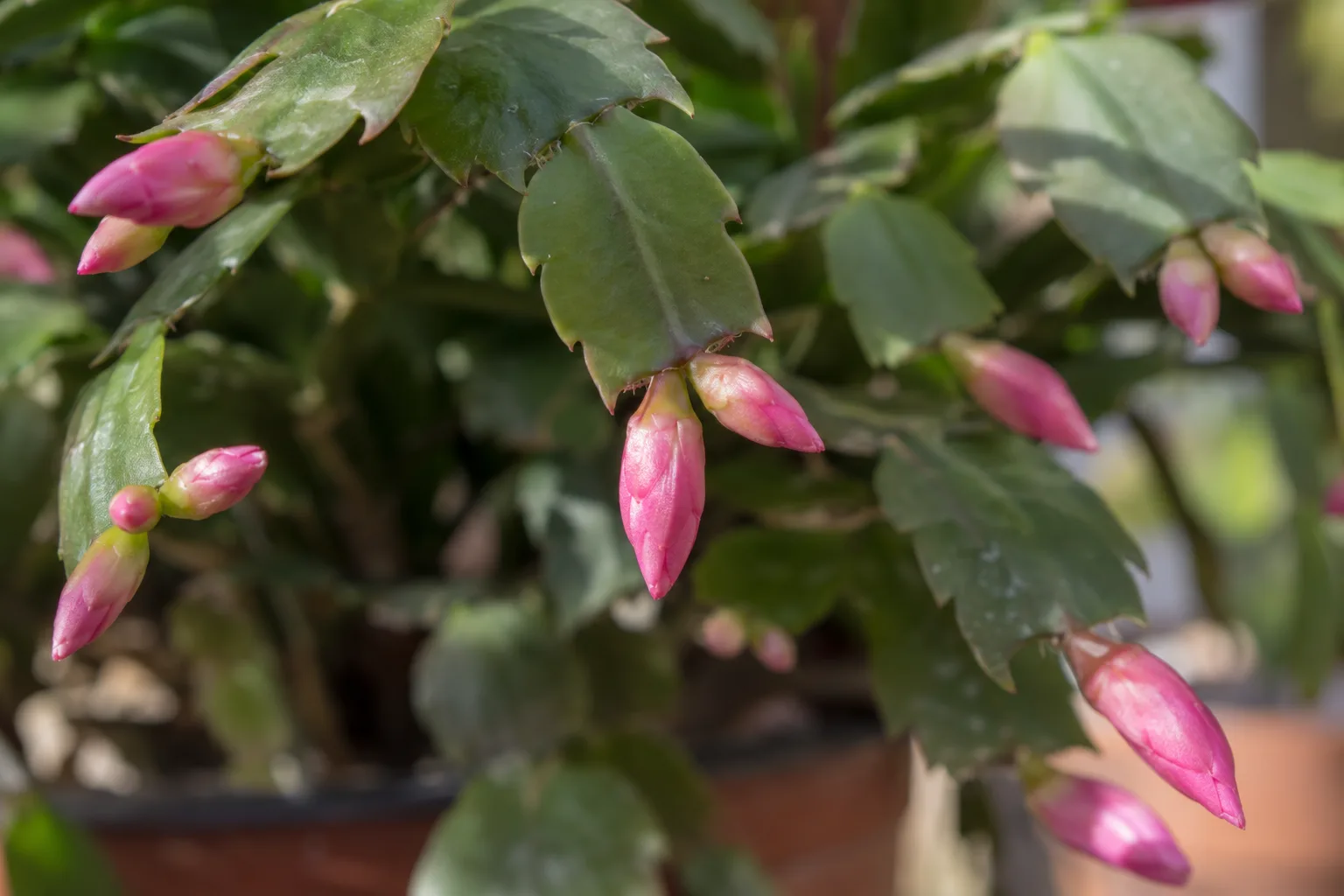
- Look for small round nubs at the segment tips, usually within 4 to 8 weeks.
- When buds show, return the plant to its display spot with bright indirect light, stop the dark treatment and keep the mix evenly moist. Do not move it again until the flowers finish.
- After blooming, rest the plant for 4 to 6 weeks with less water, then resume normal spring care.
Our gardening calendars can help you plan the fall timing around local weather.
What soil and pot work best for Christmas cactus?
Use a well-draining potting mix in a pot with drainage holes. Our native soil is alkaline and often full of caliche, and it packs too tightly for this plant, so it belongs only in the ground and never in the pot. A blend of about one part perlite to three parts potting mix holds a little moisture and still drains fast. A handful of orchid bark improves airflow around the roots.
Terracotta breathes and dries the mix more quickly, which helps if you tend to overwater. Plastic holds moisture longer, so it works well in summer but needs a lighter hand with water in winter. Browse our pottery and planters for a pot with a drainage hole.
Repot only when roots circle the bottom or push out the drainage holes. The plant blooms well when slightly snug. Go up just one size, about 1 to 2 inches wider, and do it in spring after the flowers finish.
What causes bud drop, limp segments and no blooms?
Nearly every problem traces back to water, light or a change in location. Work through the causes below before changing anything else.
Bud drop
Buds fall when the pot is moved after they form, when the mix dries out completely, or when the plant sits near a heating vent or a cold draft. Stabilize the spot and keep the mix evenly moist. Some plants set a second round of buds a few weeks later.
Limp or shriveled segments
Check the mix first. If it is dry and pulling from the pot edge, water thoroughly and the plant should recover within a day or two. If the mix is wet or smells musty, suspect root rot: slide the plant out, trim black or mushy roots, let the root ball air dry for a few hours and repot into fresh mix.
No blooms
A healthy plant that never flowers almost always missed the long nights or cool temperatures in fall. Our evenings can stay warm into October, so outdoor conditioning sometimes has to wait. Indoors, a dark closet at night covers the light side.
- Brown, crispy tips point to dry air or a nearby vent.
- Segments dropping at the joints point to temperature swings or drafts.
If a plant keeps declining, bring a photo to us or check our classes and events page for upcoming workshops.
How do I propagate Christmas cactus from cuttings?
Twist off a piece of 2 to 3 joined segments from a healthy stem, ideally in spring or early summer. Let the cut end dry for 1 to 2 days in the shade so it calluses, which guards against rot in our dry air.
Push the end about halfway into a small pot of barely moist potting mix and keep it in bright, indirect light. Water lightly only when the mix is dry. Roots usually form within 3 to 4 weeks, and a cutting that resists a gentle tug has rooted. Label cuttings by color, because they look identical until they bloom.
Frequently asked questions
Can Christmas cactus live outside in Queen Creek?
It can spend the cool months outdoors, but not the whole year. A deeply shaded, protected patio works from about October until frost threatens. Summer heat, direct sun and winter frost all damage the segments, so plan on bringing it back inside for most of the year.
How long does a Christmas cactus live?
With steady care it can live for decades. Many plants are handed down within families, and gardeners commonly report specimens that are 20 to 30 years old or more. Older plants develop a woody base and a fuller, more cascading shape, which looks best in a hanging basket or on a plant stand.
Is Christmas cactus safe for pets?
The ASPCA lists Christmas cactus as non-toxic to cats and dogs. Eating any plant material can still cause mild stomach upset, and cats often chew the dangling stems. A hanging basket or high shelf protects both the pet and the plant. Call your veterinarian if your pet shows symptoms.
What fertilizer does Christmas cactus need?
A balanced liquid houseplant fertilizer at half the label strength works well. Apply it every 2 to 4 weeks from spring through late summer, then stop in late August to early September so the plant can shift toward setting buds. Resume light feeding after the 4 to 6 week rest that follows blooming.
Can I prune a Christmas cactus?
Yes, and a light trim after flowering encourages branching. Twist off one or two segments at the end of each stem, rather than cutting with shears, so the break occurs at a joint. The plant then produces more tips, and more tips mean more flowers the following season. Root the trimmings as cuttings.
Is a Christmas cactus right for your home?
A Christmas cactus suits you if you have a bright spot out of direct sun, enjoy a small fall routine and want a plant that can last for years. It is a poor match if every window gets hard afternoon sun, if you are away for weeks with nobody to water, or if you want a plant for a sunny patio. The October dark routine takes a few minutes a day. Come visit us at the nursery in Queen Creek and talk it over with our team.