The best birdbath alternatives for Arizona yards sit at ground level or move: a shallow dish in dappled shade, a dripper or small recirculating fountain, or a mister. All keep water cooler and fresher than a pedestal basin in full sun at summer highs above 110°F.
Key takeaways
- A shallow dish on the ground, in dappled shade, stays cooler than a raised basin in full sun. Plan to refill it daily from May through September.
- Water in an exposed pedestal basin can climb well above 100°F on a July afternoon, hotter than most birds will use.
- Moving water from a drip line or small pump gives birds a sound cue and makes a poor breeding site for mosquitoes.
- Place every water source with shrub cover about 6 to 10 feet away so birds have somewhere to retreat.
- Remove hard-water scale with diluted white vinegar (about 1 part vinegar to 3 parts water), then rinse until no vinegar smell remains.
Why does a pedestal birdbath struggle in the low desert?
A pedestal birdbath struggles here because a small volume of water sits in direct sun, heats quickly and evaporates fast. On a July afternoon the water in an exposed basin can climb well above 100°F. Heat is only the first problem.
Hard irrigation water adds a second one. As it evaporates it leaves white calcium scale that builds up on the basin within weeks and needs regular scrubbing. In the dry weeks of June before the monsoon arrives, a shallow basin can empty in a day. Concrete and resin basins can also crack or turn brittle after seasons of UV exposure and big day-to-night temperature swings. Every option below works by keeping water cooler, lower to the ground or moving.
How does a ground-level water dish work in Arizona?
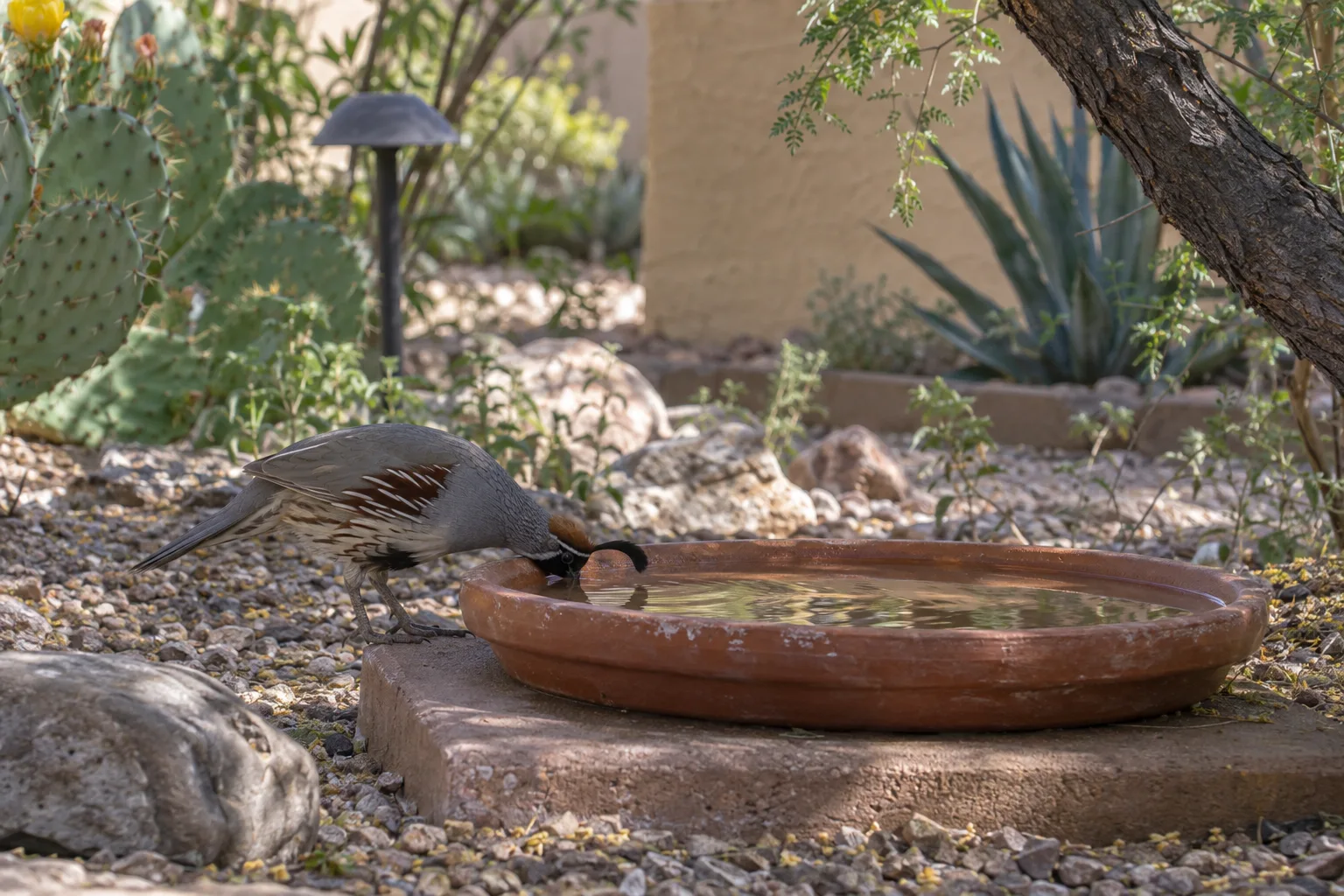
A wide, shallow dish set on the ground gives birds the kind of water they already find in the desert, such as rain pools and the edges of washes. Aim for a dish roughly 18 to 24 inches across, and set it in dappled shade under a desert tree such as a palo verde or mesquite so the water stays cooler longer.
Terra cotta saucers made for large planters are a common choice, since the clay is porous and tends to stay cooler than glazed ceramic. Browse our pottery and planters for wide saucers and bowls, which we commonly carry, though availability changes week to week and season to season. Add two or three flat stones so small birds and insects have a place to stand.

The main drawback is cats. Keep the dish where you can see it from a window, with shrub cover about 6 to 10 feet away so birds can retreat without giving a cat a hiding spot right beside the water.
Is a recirculating fountain worth adding?
A recirculating fountain is worth adding if you want more species, because birds notice the sound of trickling water from a distance. Browse the fountains we commonly carry, from tabletop to boulder styles, keeping in mind that availability changes week to week and season to season. Look for a design with a shallow ledge or basin, since birds will not bathe in deep water.
Solar units need no wiring but run only in daylight, and the flow drops when clouds pass over. Plug-in units give steady flow all day. Either type needs its pump filter cleaned weekly in summer, because warm water grows algae and collects mineral scale quickly. Top the reservoir off daily, since evaporation can drain it faster than you expect and a dry pump can burn out.
Moving water makes a poor breeding site for mosquitoes. A fountain that stalls, or a basin that sits still for several days, can still breed them.

Can a drip line or mister replace a birdbath?
A drip line can replace the daily refilling chore, and a mister can replace bathing for hummingbirds and other small birds. Run a quarter-inch drip line from an irrigation zone to a dish, put it on a short timer, and adjust the run time over a week so the dish tops up without overflowing.
The sound of dripping water draws birds the same way a fountain does, at a much lower cost. Still, a dripper does not replace cleaning. Scale and droppings collect in the dish, so you still need to dump and scrub it every few days in summer.
A fine-mist nozzle on a stake or low branch creates a cloud that small birds, including Anna’s hummingbirds, fly through to cool off. Run it in short cycles during the hottest part of the day, from late morning to mid afternoon. Aim it over a planting bed or gravel so the spray does not soak walls or foundations.
How do I set up a ground-level water station?
Set it up in April or early May so birds find it before the summer heat, though any month works. You need a wide saucer or bowl, a paver or flagstone, a few flat stones, a stiff brush and white vinegar.
- Pick a spot with morning sun and afternoon shade, ideally under a tree canopy. Avoid full western exposure, which heats water quickly after noon.
- Level the ground and set the paver or flagstone down so the dish sits steady and the soil underneath stays dry.
- Place the dish and add flat stones at different heights so some areas are only a shallow film of water.
- Plant or position a low shrub 6 to 10 feet away for cover. Check our gardening calendars for the best months to plant it.
- Connect a drip emitter if you want automatic top-ups, and set the timer to short runs.
- Dump, scrub and refill the dish every 2 to 3 days in summer, and sooner if you see droppings or debris.
Which materials hold up in Arizona heat?
Natural stone and glazed ceramic hold up longest under UV and heat, while lightweight plastic and resin tend to fade and crack first. Each material also handles hard-water scale differently, so match the material to the job.
| Material | Heat and UV | Scale and cleaning | Best use |
|---|---|---|---|
| Terra cotta | Porous, stays a bit cooler, can crack over time | Scale shows as a white film, scrubs off easily | Ground-level saucers |
| Glazed ceramic | Handles heat well, can crack if dropped | Smooth surface wipes clean quickly | Bowls and pot fountains |
| Concrete | Can crack with temperature swings | Rough surface holds scale | Permanent features set in the ground |
| Natural stone | Very durable, heavy | Moderate scale, scrubs well | Boulder fountains, stone basins |
| Resin or plastic | Can turn brittle unless UV-stabilized | Low scale, easy to rinse | Short-term or backup waterers |
If you plan a permanent feature, spend more up front on stone or glazed ceramic. A cheap basin that cracks in two summers costs more in the end.
Which plants make a water station safer for birds?
Low, dense shrubs near the water and a tree overhead make a station safer and cooler. These are varieties we commonly carry, though availability changes week to week and season to season. Browse our desert trees for shade and our full plant selection for shrubs.
- Chilopsis linearis (desert willow): a small desert tree with trumpet-shaped flowers that hummingbirds visit, and light shade for a ground-level dish.
- Calliandra eriophylla (fairy duster): a low, mounding native shrub with fine foliage that gives small birds close cover.
- Salvia greggii (autumn sage): blooms in spring and fall and draws hummingbirds to the mister area.
- Celtis pallida (desert hackberry): a dense, thorny native shrub with small berries that offers sheltered perches.
- Leucophyllum frutescens (Texas ranger): a silver-leaved shrub that tolerates alkaline soil and reflected heat, useful as a backdrop behind a fountain.

Check mature size before you plant. Several of these shrubs reach 4 to 8 feet wide, and a shrub planted too close to the dish drops leaves into the water and gives cats a hiding spot.
What mistakes should I avoid with bird water?
The most common mistakes are full afternoon sun, chemical additives and letting the dish run dry. Each is easy to correct.
- Putting the dish in full western sun, where water heats quickly after noon.
- Adding algaecides, chlorine tablets or other treatments. Scrub the basin instead and rinse it well.
- Leaving vinegar residue behind. Rinse until the smell is gone before you refill.
- Skipping refills during a heat wave. Birds that come to rely on a source find an empty dish at the worst time.
Frequently asked questions
How deep should bird water be?
Most small birds prefer water about 1 to 2 inches deep at the bathing area. Larger birds such as doves and quail tolerate a little more, while hummingbirds and verdins favor very shallow edges. If your basin is deeper, add a sloped rock or flat stones to make a gradual entry, since birds avoid water when they cannot judge the depth by sight.
Will cats make a ground-level dish unsafe for birds?
They can, which is why placement matters. Put the dish in an open spot you can see from a window, with shrub cover roughly 6 to 10 feet away rather than right beside the water. A second source at a higher level, such as a fountain or mister, gives birds a choice if a cat visits.
Do I need mosquito control during the monsoon?
Standing water from July through September can breed mosquitoes in a few days, so empty and rinse still dishes at least every 2 to 3 days. Moving water from a drip line or pump helps. If you add Bti mosquito dunks, follow the product label and confirm it states the product is safe around birds and wildlife.
How do I remove white mineral scale?
A soak in diluted white vinegar removes most hard-water scale. Mix roughly 1 part vinegar to 3 parts water, soak the basin for about 30 minutes, scrub with a stiff brush and rinse until no vinegar smell remains before refilling. Terra cotta and stone scrub easily, while smooth glazed surfaces usually wipe clean faster.
Should bird water go near a seed feeder?
Keep water at least 10 feet from seed feeders if you can. Seed hulls and droppings foul nearby water quickly, which raises the cleaning load and can spread disease among birds. If space is tight, put the dish on the opposite side of the yard from the feeder and empty it more often.
Is a pedestal birdbath still worth keeping?
Keep a pedestal birdbath only if it sits in afternoon shade and you will empty and scrub it every day or two in summer. For most Queen Creek yards, a shallow ground-level dish with a drip line gives birds cooler water for less work, and a mister or fountain adds variety. If you travel often in summer and cannot refill anything, skip bird water until you have an automated setup. Stop by the nursery in Queen Creek and we will help you pick a setup that fits your yard.