
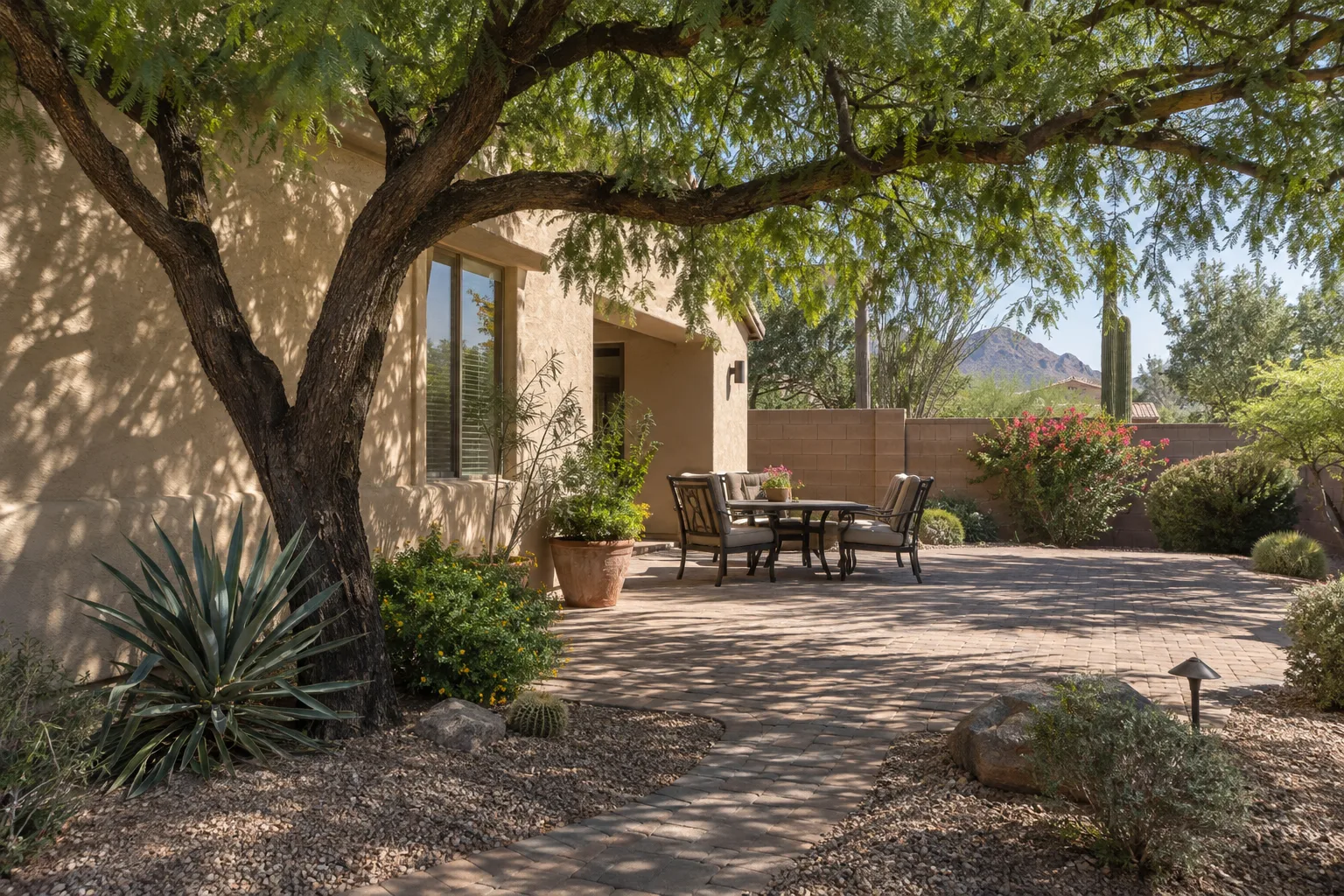
The best shade trees for an Arizona backyard are native and desert-adapted species such as blue palo verde, velvet mesquite, desert willow, Texas ebony, tipu and Shamel ash. Match the tree to your yard size, pool location and water budget, and plant in fall.
Key takeaways
- Plant from mid-September through November, or February through April, so roots establish before summer highs above 110°F.
- Put large trees on the west and southwest sides of the house, roughly 15 to 20 feet from the wall, to block afternoon sun.
- Dig the hole 2 to 3 times wider than the root ball but no deeper, and backfill with the native soil.
- Water deeply and infrequently so moisture reaches 2 to 3 feet down, rather than sprinkling a little every day.
- Start structural pruning in the first 3 to 5 years, never top a tree, and finish pruning before the monsoon starts in July.
Which shade trees do best in Queen Creek and the East Valley?
Native and desert-adapted trees do best here because they tolerate alkaline soil, caliche, low humidity and summer highs above 110°F. Our desert trees are the place to start, and the six below are varieties we commonly carry. Availability changes week to week and season to season, so ask before you plan around one.
Blue palo verde (Parkinsonia florida)
Blue palo verde grows 20 to 30 feet tall and about as wide, with a light, open canopy and green bark. It wants full sun and very little water once established. Yellow flowers cover it in April and May. The drawback is litter: it drops small leaves, blossoms and seed pods, so keep it back from pools and gutters.

Velvet mesquite (Prosopis velutina)
Velvet mesquite reaches roughly 25 to 30 feet tall with a broad, umbrella-shaped canopy of fine foliage. It takes full sun and needs little water after the first couple of years. Bees visit the spring bloom. The drawback is thorns and seed pods, and seedlings pop up in nearby beds, so it suits a corner of the yard better than a play area.
Desert willow (Chilopsis linearis)
Desert willow belongs to the trumpet creeper family, and it grows 15 to 25 feet tall, often with several trunks. It wants full sun and low water once established. Pink, purple or white trumpet flowers appear from late spring into summer. It is deciduous, so the shade is gone in winter, and it can turn leggy without early pruning. Browse our flowering trees for similar options.
Texas ebony (Ebenopsis ebano)
Texas ebony is an evergreen that grows slowly to about 20 to 30 feet, with dark, dense foliage that casts deep shade. It takes full sun and low water after establishment. Growth is slow, often a foot or two per year, and it has thorns. Young trees can be damaged by a hard winter frost, so give them a protected spot. See our evergreen trees for other year-round shade.
Tipu tree (Tipuana tipu)
Tipu grows 25 to 40 feet tall with a wide, flat-topped canopy that gives soft, dappled shade. It takes full sun and does best with regular deep watering in summer. Apricot-yellow flowers open in late spring. The wood is brittle, so early structural pruning matters before monsoon winds arrive. It also drops flowers and pods, and young trees can suffer frost damage.
Shamel ash (Fraxinus uhdei)
Shamel ash is a fast grower that can reach 40 to 60 feet, which makes it the right pick only for a large lot. It wants full sun and moderate to high water, so it suits a yard on a steady irrigation schedule. It is semi-evergreen in mild winters. The drawback is weak branch structure without pruning, and pollen that bothers people with allergies.
| Tree | Mature height | Water once established | Leaf habit | Main drawback |
|---|---|---|---|---|
| Blue palo verde | 20 to 30 feet | Very low | Deciduous, green bark | Constant litter |
| Velvet mesquite | 25 to 30 feet | Low | Deciduous | Thorns and pods |
| Desert willow | 15 to 25 feet | Low | Deciduous | Bare in winter |
| Texas ebony | 20 to 30 feet | Low | Evergreen | Slow, thorny |
| Tipu tree | 25 to 40 feet | Low to moderate | Semi-evergreen | Brittle wood |
| Shamel ash | 40 to 60 feet | Moderate to high | Semi-evergreen | Pollen, size |
Where should I plant a shade tree for the most cooling?
Plant it on the west and southwest sides of the house, because summer sun comes from that direction from about 2 PM until sunset. A large tree set 15 to 20 feet from the wall shades the stucco and windows during the hottest hours. South walls are the next priority.
East-side trees cool a morning patio but do less for your home. Shade over concrete driveways and patios helps too, since paving stores heat and releases it well into the evening. Keep large trees at least 10 to 15 feet from pools, plumbing and block walls so roots and debris stay manageable.
When is the best time to plant a shade tree in the low desert?
Mid-September through November is the best window, with February through April a close second. Fall planting gives roots the whole cool season to spread before summer heat arrives. Planting in June through August is possible but means very frequent watering and a real risk of leaf scorch.
Frost-sensitive trees such as tipu and Texas ebony do better planted in spring, after the last frost danger has passed. Our gardening calendars show how the planting seasons line up month by month.
How do I plant a shade tree in caliche soil?
Check for caliche first, then dig a wide, shallow hole and break through any hardpan layer so water can drain. Caliche is a cement-like layer of calcium carbonate that can sit a few inches to several feet below the surface. Water pooling in the hole after a day means it needs to be broken up.
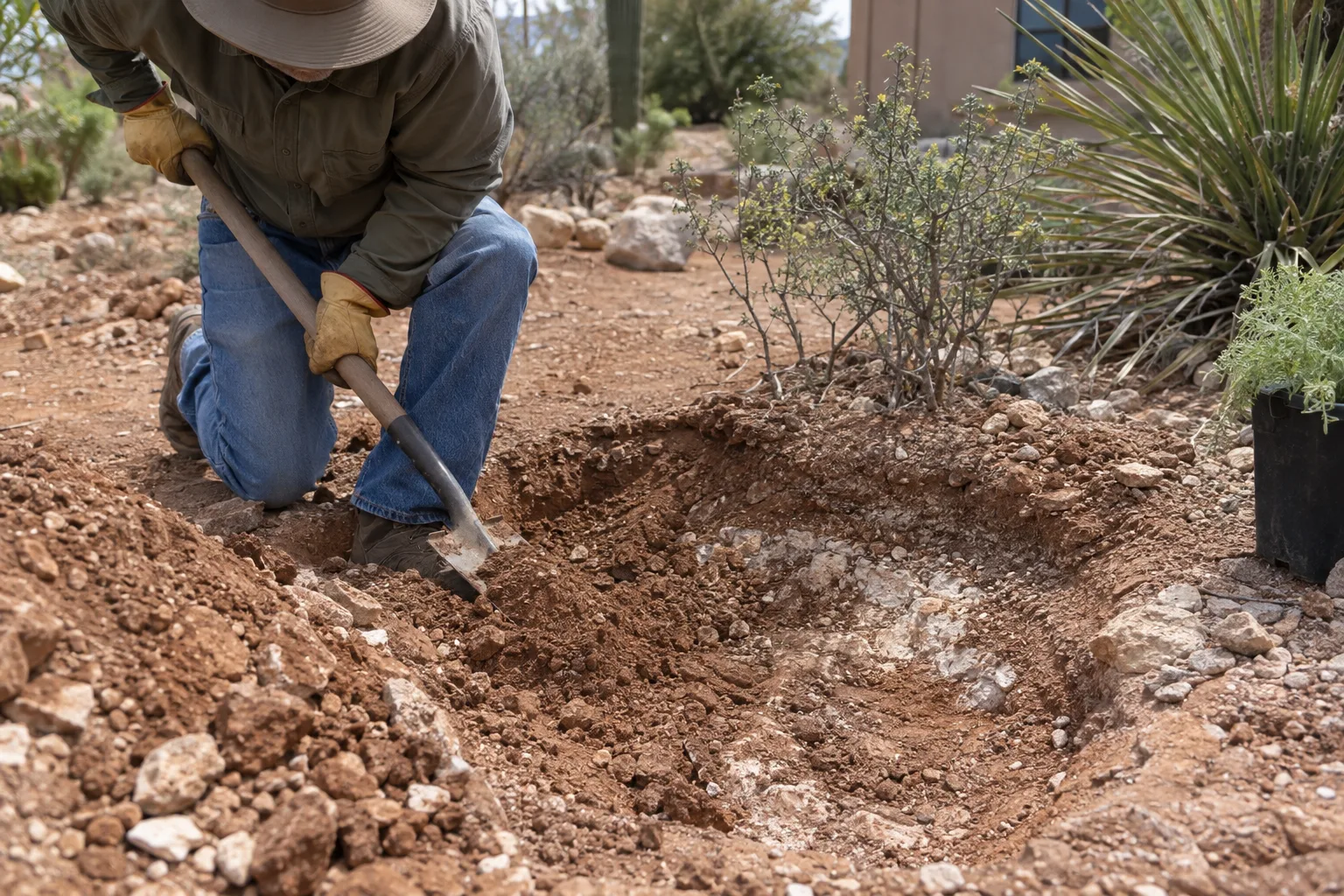
- Fill the hole with water and watch it. If it is still standing after 24 hours, drill or chip through the caliche at the bottom.
- Dig the hole 2 to 3 times wider than the root ball and no deeper than its height.
- Set the top of the root ball 1 to 2 inches above the surrounding soil.
- Backfill with the soil you dug out, since unamended soil encourages roots to spread outward instead of circling the hole.
- Build a berm of soil 4 to 6 inches tall around the canopy edge to hold water.
- Spread 3 to 4 inches of mulch, keeping it 4 to 6 inches from the trunk.
- Water deeply at planting and again two days later.
The common mistakes are planting too deep, leaving stakes on for years and piling mulch against the bark. If you want to see a planting done, check our classes and events page for what is scheduled.
How often should I water a new shade tree?
Water deeply and let the soil dry between sessions, so roots follow moisture down instead of staying near the surface. For the first few weeks, a new tree in warm weather may need water every 2 to 3 days, and you then stretch the interval as roots establish. Check the soil rather than the calendar.
Established natives such as palo verde and mesquite usually do well with a deep soak every 7 to 10 days in summer. Shamel ash and tipu may need one every 5 to 7 days. In winter, every 30 to 45 days is often enough, since cool soil holds moisture longer. Place drip emitters at the canopy edge, not at the trunk. Hard water leaves salts behind, and a deep soak helps flush them below the root zone.
How do I prune a shade tree before monsoon season?
Thin the canopy and fix weak structure in early summer, before the monsoon begins around July. Wind events can reach 50 to 70 mph, and a dense canopy acts like a sail. Well-spaced branches let wind pass through.

- In the first 3 to 5 years, remove crossing branches and competing leaders so one strong trunk carries the tree.
- Raise the lowest limbs gradually to about 6 to 8 feet above the ground.
- Thin by removing whole branches back to where they start.
- Never top a tree. Cutting main branches to stubs produces weak, fast regrowth that breaks easily.
For mature trees or work near power lines, hire an arborist certified by the International Society of Arboriculture.
Frequently asked questions
Can I plant a shade tree near a pool?
Yes, but choose a low-litter tree and keep it 10 to 15 feet back. Texas ebony and a well-pruned tipu or desert willow drop less debris than palo verde or mesquite. Semi-evergreen and evergreen trees also avoid one big leaf drop. Pods and flowers will still reach the water, so plan on skimming.
What is the best shade tree for a small yard?
Desert willow is a good fit, since it stays around 15 to 25 feet and can be trained to a single trunk. Texas ebony is another option because it grows slowly and densely, so it needs little size control. Avoid Shamel ash on a small lot, where it will outgrow the space.
Do shade trees need fertilizer?
Native trees like palo verde and mesquite usually need none, and extra nitrogen can push soft growth that breaks in wind. Desert-adapted trees may benefit from a slow-release, low-nitrogen feeding in late winter. Yellow leaves with green veins point to iron chlorosis, common in alkaline soil, and chelated iron applied in spring can help.
How fast do shade trees grow here?
Growth varies widely by species and watering. Shamel ash is the fastest and can add several feet per year when young and irrigated well. Palo verde, desert willow and tipu are moderate, while Texas ebony may add only 1 to 2 feet a year. Consistent deep watering in the first two summers speeds up every species.
Which shade tree is the right one for your yard?
Blue palo verde, velvet mesquite and desert willow are the lowest-effort choices if you can live with some litter. Texas ebony suits patient gardeners who want dense evergreen shade. Tipu and Shamel ash give faster canopy but need steady water and regular pruning, so skip them if you prefer a hands-off yard. Small lots should avoid anything that reaches 40 feet. Stop by our Queen Creek nursery and we will help you match a tree to your space.