Never plant these eight Arizona trees near your home: Arizona ash, fruitless mulberry, Fremont cottonwood, eucalyptus, Chinese elm, tamarisk, tree-form oleander and Indian laurel fig. Their roots, brittle limbs, pollen or toxicity cause costly problems beside a foundation, pool or sewer line.
Key takeaways
- Large, fast-growing shade trees can send roots 1 to 2 times as far as their canopy spreads, so give them at least 20 to 30 feet from the house, pool and sewer line.
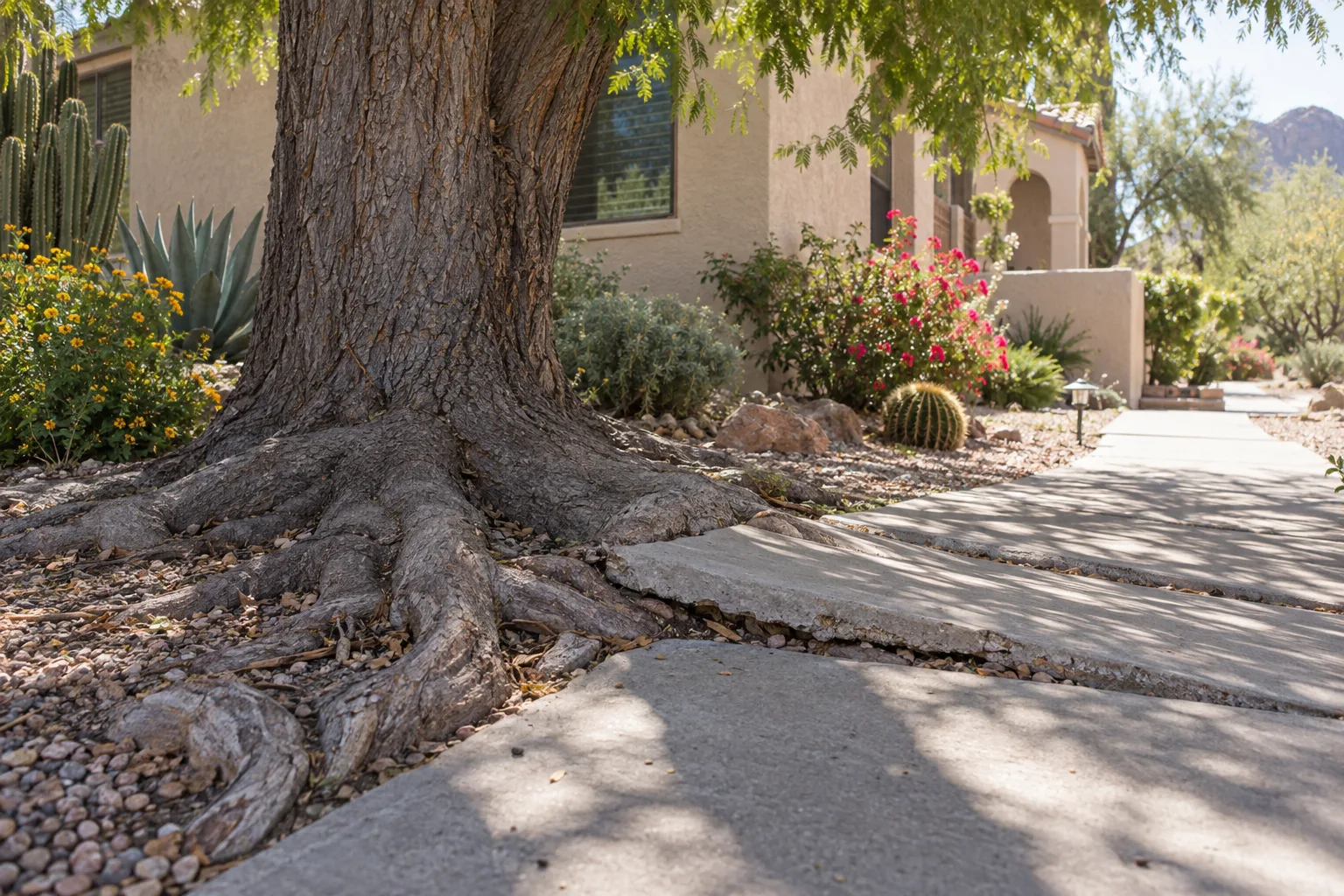
- Caliche often sits 1 to 3 feet below the surface, which keeps roots shallow and pushes them sideways under sidewalks and patios.
- Fruitless mulberry and Arizona ash are well-known sources of late winter and spring pollen in the East Valley.
- Tree-form oleander is poisonous in every part, and tamarisk appears on Arizona’s noxious weed list.
- Call 811 before you dig any planting hole, and allow a few working days for utility lines to be marked.
Why does tree placement matter so much in Queen Creek?
Placement matters because our soil and water push roots sideways and toward leaks. Caliche, a cement-like mineral layer, often sits 1 to 3 feet below the surface, and roots that cannot grow down spread out near the top, where they meet pavers, drip lines and shallow pipes.
Summer highs above 110°F make a big canopy tempting, and fast growers deliver shade quickly. The same speed produces soft, brittle wood. Monsoon winds from roughly July through September snap weak limbs and topple shallow-rooted trees onto roofs, walls and cars.
The trees below cause trouble through size, roots, pollen or toxicity. Our trees department is a good place to compare better-behaved options before you choose a spot.
Which eight trees should you keep away from your house?
These eight cause the most regret close to homes in the East Valley. Sizes are typical mature ranges and shift with water and care, so treat them as a planning guide and not a promise for any one tree.
Arizona ash (Fraxinus velutina)
Arizona ash grows fast to about 30 to 50 feet tall and wide, wants full sun and takes regular deep watering. The drawback is brittle wood. Limbs break in monsoon winds, and surface roots lift pavers and sidewalks in compacted soil. Spring pollen adds to the list, so give it open ground far from structures.
Fruitless mulberry (Morus alba)
Fruitless mulberry reaches 30 to 50 feet with a broad canopy, takes full sun and wants regular water. Its drawback is pollen. The male trees sold as fruitless shed heavy pollen in late winter and spring, and their thirsty, shallow roots are known for invading irrigation and sewer lines. Some Arizona cities have restricted mulberry, so check local rules first.
Fremont cottonwood (Populus fremontii)
Fremont cottonwood is a handsome native along rivers and washes, reaching 40 to 80 feet in full sun with very high water use. The drawback is its roots, which travel far in search of moisture and find sewer, pool and irrigation lines. Female trees also release cottony seed fluff in spring that clogs pool filters and screens. It belongs along a wash.
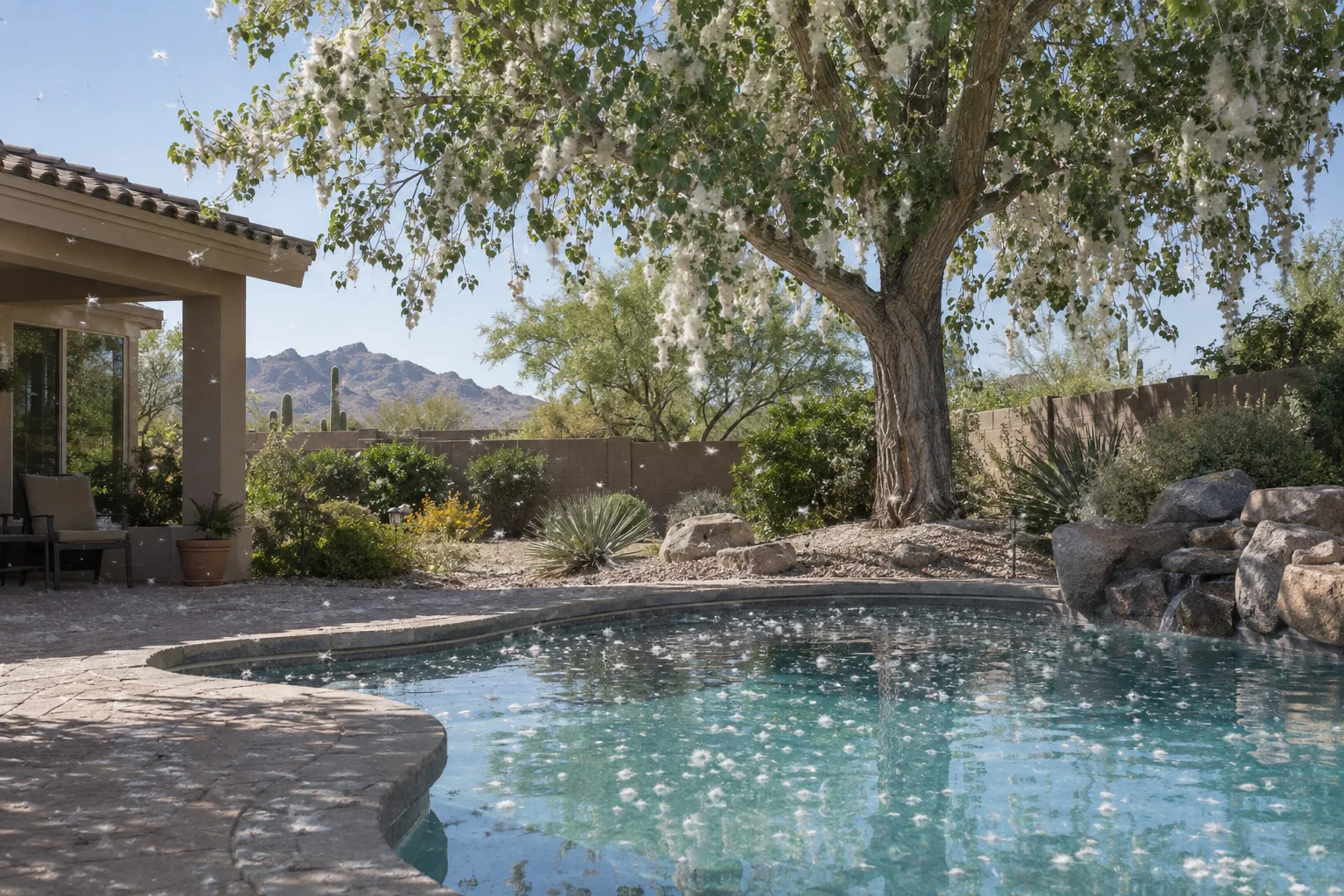
Eucalyptus (Eucalyptus camaldulensis and relatives)
Red gum and other large eucalyptus species grow 40 to 100 feet tall in full sun and handle low water once established. The drawback is sheer size. They drop bark, leaves and large limbs, their roots range widely, and whole trees can fall in storms. Most residential lots in Queen Creek are too small for them.
Chinese elm (Ulmus parvifolia)
Chinese elm grows 40 to 50 feet tall and wide in full sun with regular water. It tolerates our heat well. The drawback is shallow surface roots in alkaline, compacted soil, plus heavy seedling sprouts in rock and planting beds and branch unions that can split in wind. Keep it well away from driveways and walls.
Tamarisk (Tamarix spp.)
Tamarisk, also called salt cedar, grows 15 to 30 feet in full sun and sends deep roots after water. The drawback is that it is invasive. It uses large amounts of water, leaves salt in the soil beneath it, and resprouts from cut stumps. It appears on the Arizona noxious weed list, and we recommend leaving it out of your yard entirely.
Oleander in tree form (Nerium oleander)
Trained into a tree, oleander reaches about 12 to 20 feet in full sun and needs little water once established. The drawback is toxicity. Every part is poisonous to people, dogs, cats and horses, so it does not belong over a patio, pool or play area. Multiple trunks can also split under a heavy canopy. If a child or pet chews on it, call Poison Help or your vet right away.
Indian laurel fig (Ficus microcarpa)
Indian laurel fig grows 30 to 50 feet tall in sun to part shade with regular water. The drawback is aggressive, shallow roots that lift sidewalks and push into pipes. Thrips can curl and drop its leaves, and hard winter frost can burn the foliage. Skip it near a house.
How far from the house should a large shade tree go?
Give large shade trees at least 20 to 30 feet from the foundation, pool and underground lines, and more for the biggest species. Roots often reach as far as the canopy spreads or beyond. Roots rarely stop at the dripline.
| Tree | Typical mature height | Main concern near a house |
|---|---|---|
| Arizona ash | 30 to 50 ft | Brittle limbs, surface roots, pollen |
| Fruitless mulberry | 30 to 50 ft | Heavy pollen, invasive roots |
| Fremont cottonwood | 40 to 80 ft | Water-seeking roots, seed fluff |
| Eucalyptus | 40 to 100 ft | Size, limb drop, wide roots |
| Chinese elm | 40 to 50 ft | Shallow roots, seedlings |
| Tamarisk | 15 to 30 ft | Invasive, salt buildup, water use |
| Oleander (tree form) | 12 to 20 ft | Poisonous in every part |
| Indian laurel fig | 30 to 50 ft | Shallow roots, thrips, frost damage |
How do you check a planting site before you buy a tree?
Walk the site with a tape measure, call 811 and look up before you choose a tree. The whole check takes about 30 minutes.
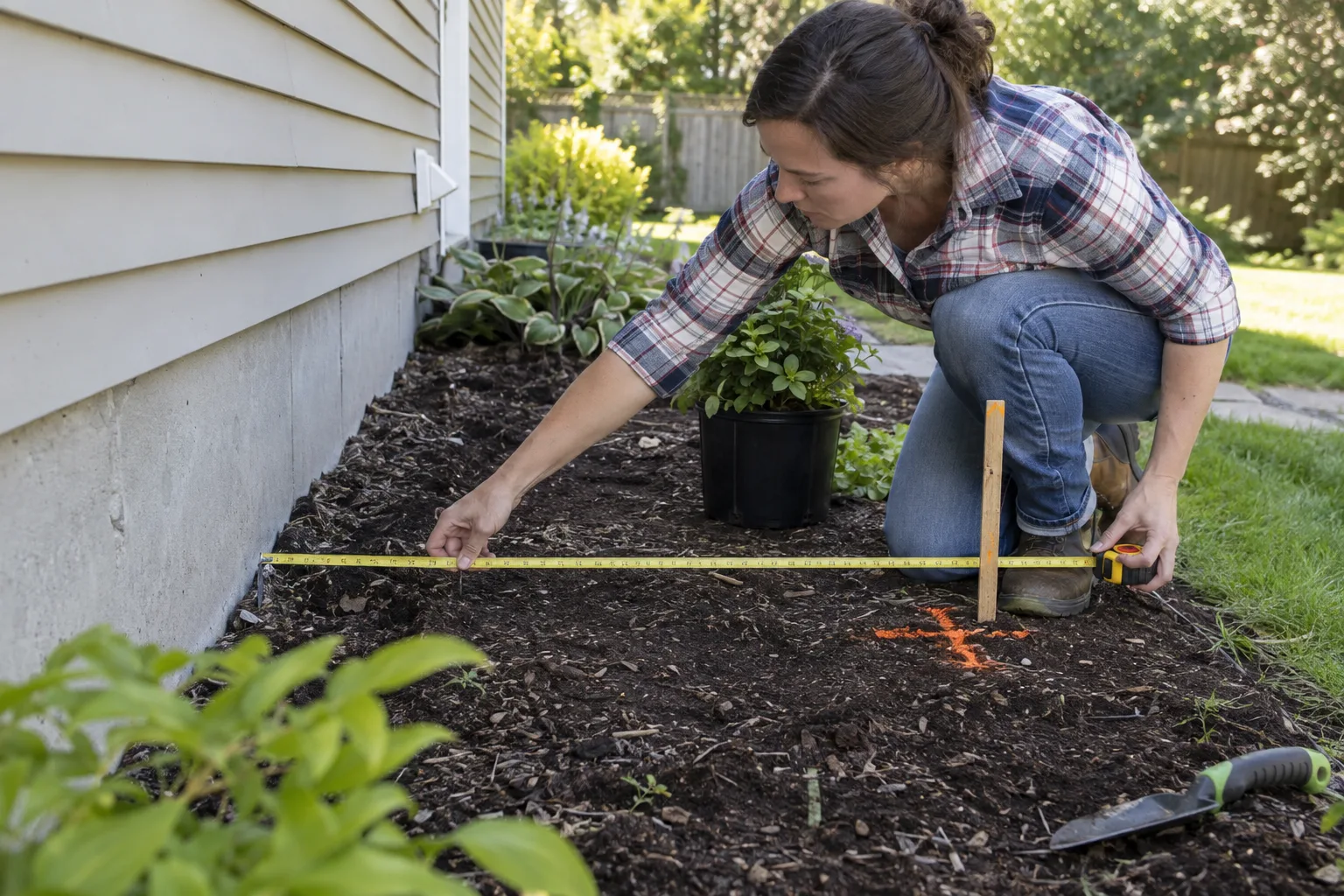
- Call 811 and wait for utility lines to be marked before you dig.
- Measure from the planting spot to the foundation, patio, pool equipment, block wall and property line.
- Look up the tree’s mature height and spread, and ignore its size in the pot.
- Dig a test hole to see how deep you get before hitting caliche, then fill it with water and watch whether it drains overnight.
- Look overhead for power lines and roof eaves that will force constant pruning.
- Note where drip lines, hose bibs and sewer cleanouts sit, because roots head for leaks.
- Choose a tree whose mature size fits the space you measured.
The usual mistake is planting for the size a tree is today. A 5-foot sapling beside a wall becomes a 40-foot problem within about a decade.
Which shade trees are better choices near a house?
Desert-adapted trees that stay under about 30 feet and take modest water cause far fewer problems close to a house. These are varieties we commonly carry, though availability changes week to week and season to season. Placement still matters. Browse our desert trees and flowering trees for ideas.
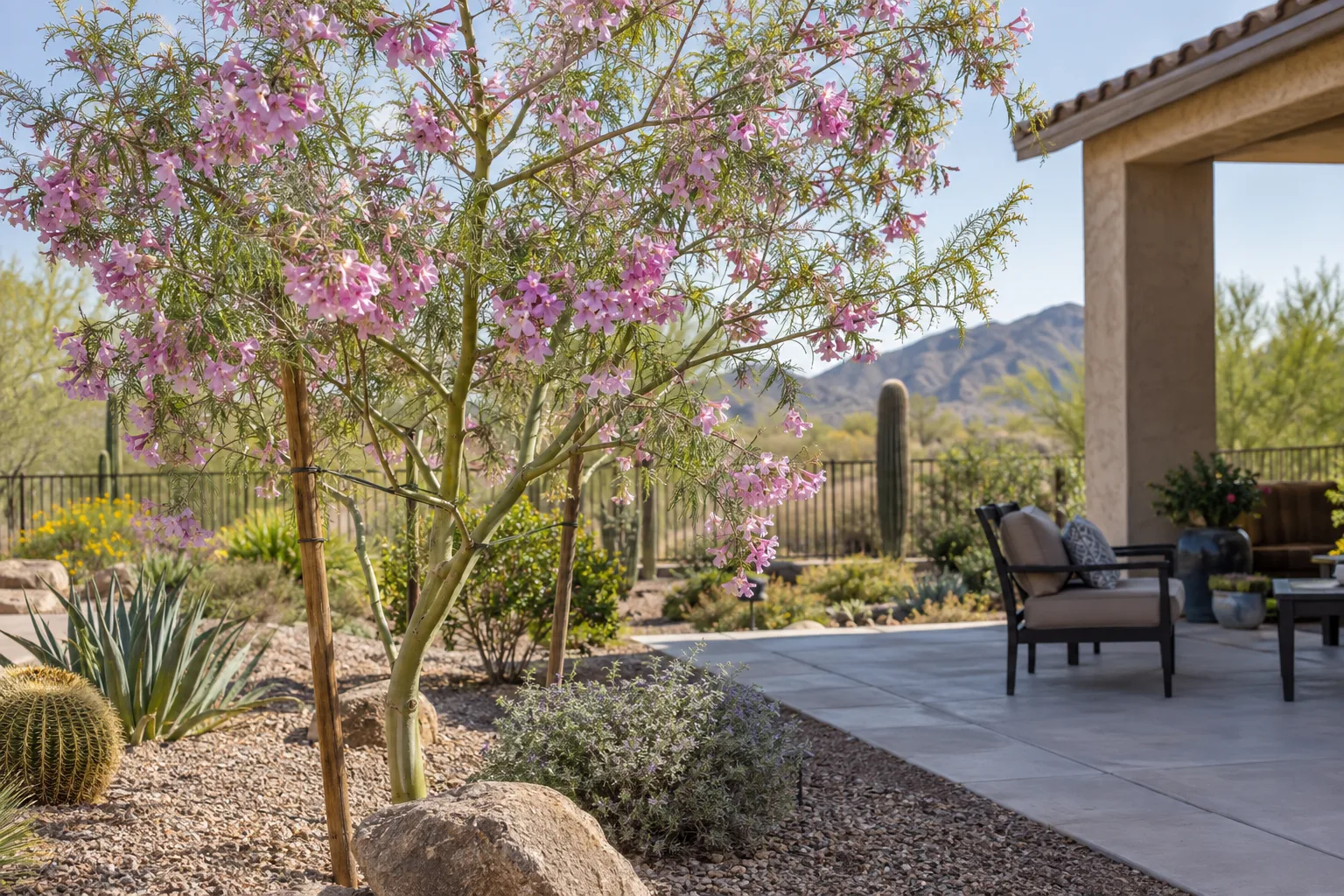
- Desert willow (Chilopsis linearis): 15 to 25 feet, airy canopy, flowers through summer.
- Desert Museum palo verde (Parkinsonia ‘Desert Museum’): 20 to 30 feet, yellow spring bloom, low water once established.
- Chitalpa (x Chitalpa tashkentensis): 20 to 30 feet, pink or white summer flowers.
- Velvet mesquite (Prosopis velutina): 25 to 40 feet, filtered shade, best with 20 feet or more of clearance and deep, infrequent watering.
What should you do if one of these trees is already in your yard?
Start with an inspection by a certified arborist, because removal is not always necessary. An arborist can judge limb structure, thin weight from heavy branches and tell you how close roots are to the house.
Water deeply but away from the trunk and foundation so roots do not concentrate near the wall. Keep irrigation lines and sewer cleanouts clear of the root zone. Tamarisk stumps resprout, so ask a licensed professional how to treat them. Wear gloves around oleander and never burn its clippings.
Frequently asked questions
Can I keep a mature mulberry already growing in my yard?
Yes, if it stands well away from the house, pool and pipes and nobody in the household reacts to its pollen. Have a certified arborist check its structure, keep the canopy trimmed back from the roof, and avoid watering near the foundation. Remove it if roots show up in sewer or irrigation lines.
How can I tell if roots are damaging my pipes or foundation?
Watch for slow drains, soggy patches outside your irrigation zones, water bills that climb without explanation, and new cracks in walls or paving. Each of these can have other causes. A licensed plumber can run a camera through the sewer line, and a structural engineer can evaluate wall cracks, so call them before guessing.
Does a root barrier let me plant a big tree closer?
A root barrier helps redirect roots but does not make an aggressive species safe next to a house. Roots can grow under or around a panel, and a short barrier does little against thirsty species such as ficus or cottonwood. Distance and species choice protect your home better, so treat a barrier as a backup.
What if my neighbor’s tree roots reach my yard?
Start by photographing the damage and talking with your neighbor, since many cases end there. Rules about cutting roots and branches across a property line vary, and cutting can weaken or kill a tree. Ask your city, your HOA or an attorney before you cut, and have a plumber or arborist document damage in writing.
When is the best time to plant a replacement shade tree?
Fall is generally the best time in the low desert, because cooler air and warm soil let roots establish before summer. Early spring also works. Avoid planting during the hottest months, from about June through August, when new roots struggle to keep up with water loss. Check the University of Arizona Cooperative Extension for timing on specific trees.
Should you plant any of these eight trees near your home?
No. Keep all eight at least 20 to 30 feet from a house, pool or sewer line, and skip tamarisk and tree-form oleander entirely. Cottonwood, eucalyptus and Arizona ash only suit properties with real room for dropped limbs. Anyone with a small lot, young children, pets or pollen allergies should choose a smaller desert tree instead. If you already own one, an arborist visit is money well spent. Stop by our nursery in Queen Creek and talk through your yard with us.