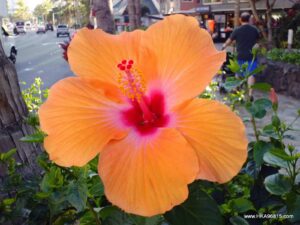

Make your spring containers last into summer in Arizona by moving them into larger, light-colored pots by mid-April, refreshing the soil, and swapping cool-season annuals for heat lovers by early May. Then water deeply every morning.
Key takeaways
- Swap cool-season annuals for heat-tolerant plants between mid-April and early May, before highs settle above 100°F.
- Choose light-colored containers of 10 to 15 gallons or more, since small dark pots can overheat roots even when the soil is wet.
- Mix perlite or pumice into potting soil so it drains freely and does not shrink into a dry, water-repelling block.
- Water deeply in the early morning, daily from May on and sometimes twice a day in June, and confirm by touching the soil.
- Give pots morning sun and shade from roughly 2 to 5 p.m., when afternoon heat is strongest.

When should I swap spring plants for summer plants?
Swap between mid-April and early May, as soon as cool-season annuals start to fade and before daytime highs settle above 100°F.
Petunias, pansies, snapdragons and calibrachoa are built for mild weather, and no amount of extra water or fertilizer will raise their heat ceiling once the days climb past 100°F. Do not wait for them to die. Leggy stems, fewer blooms, yellowing lower leaves and midday wilting in moist soil all point to a plant at its limit.
Planting in late May or June is possible, but new roots struggle when the soil in a pot runs far hotter than the air. An early swap gives summer plants a few weeks to settle in before July. Our gardening calendars list what to plant month by month.
What container holds up best in summer heat?
A large, light-colored container holds up best, because it heats slowly and holds a bigger reserve of water. Dark plastic and metal soak up sunlight and can push root-zone temperatures well above the air temperature, and roots in soil that hot stop taking up water even when the mix is wet. Watering more only adds to the problem.
These materials are worth a look in our pottery and planters department:
- Light-colored fiberglass or resin reflects heat and stays cooler than dark plastic in the same spot.
- Glazed ceramic loses less moisture through its walls than bare terra cotta, so lighter glazes are the better choice.
- Double-walled pots have an air gap that insulates roots from sun on the outer wall.
- Bare terra cotta wicks water through its walls and dries fast, so it suits fall and winter better than July.
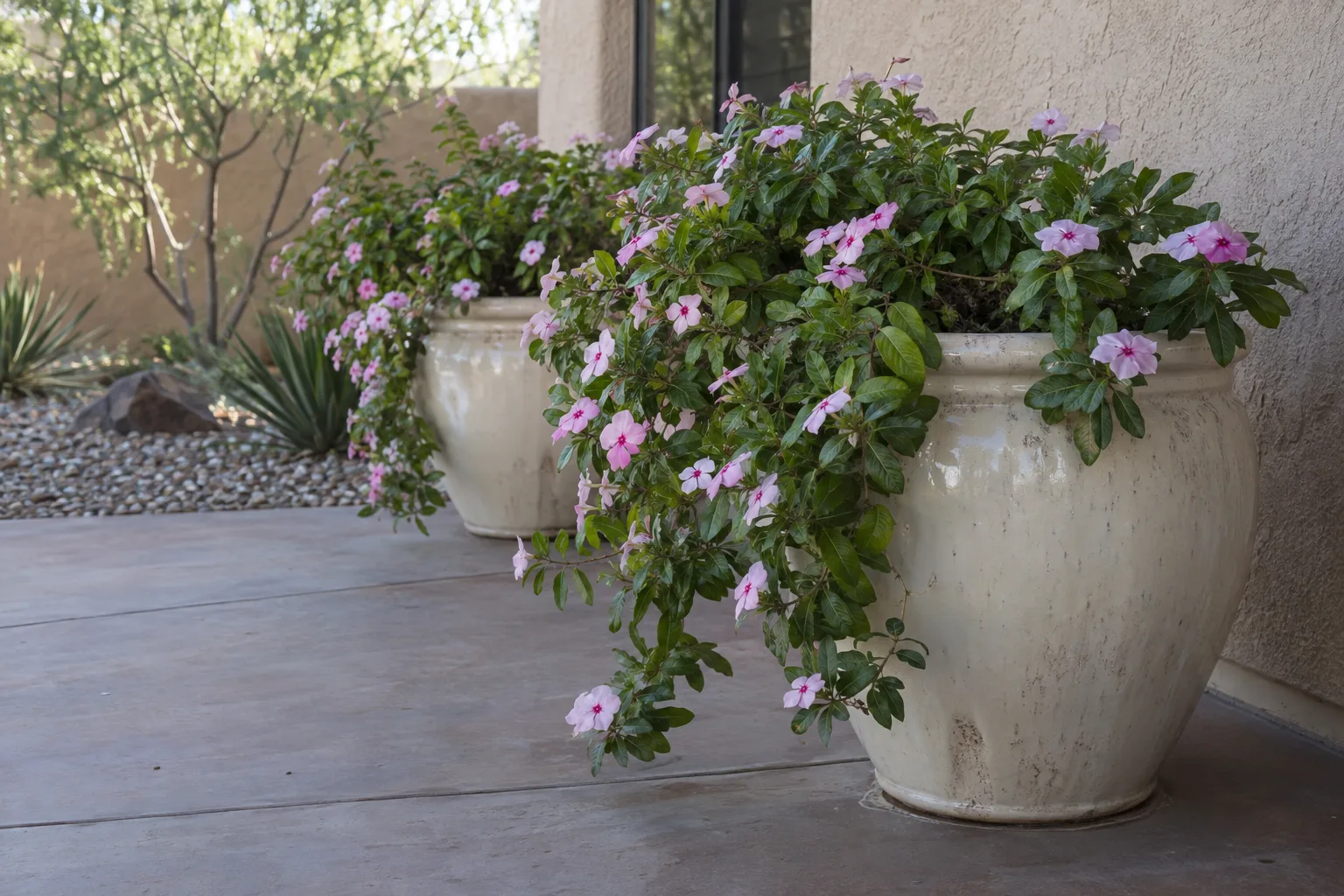
For size, 10 to 15 gallons is a practical minimum for a display pot in full sun. A 5-gallon pot can need water twice a day in June, while a larger pot buffers both heat and moisture. Mixed plantings with several plants belong at the bigger end of that range.
What soil mix works for summer containers?
A free-draining mix with perlite or pumice blended into quality potting soil works best. Straight peat-based mixes dry out quickly, can repel water once they are completely dry, and shrink and compact over a season of heat and watering.
A reasonable starting point is about half quality potting mix, with the rest made up of perlite, pumice and a little coconut coir to hold moisture. Water-retention crystals can help in small amounts, but too many leave roots sitting in soggy soil.
A 1 inch layer of fine gravel or crushed granite on top slows evaporation and keeps the surface cooler. Our hard irrigation water also leaves mineral salts behind, so refresh the mix at least once a year rather than topping it off for several seasons.
Which plants hold up in summer containers?
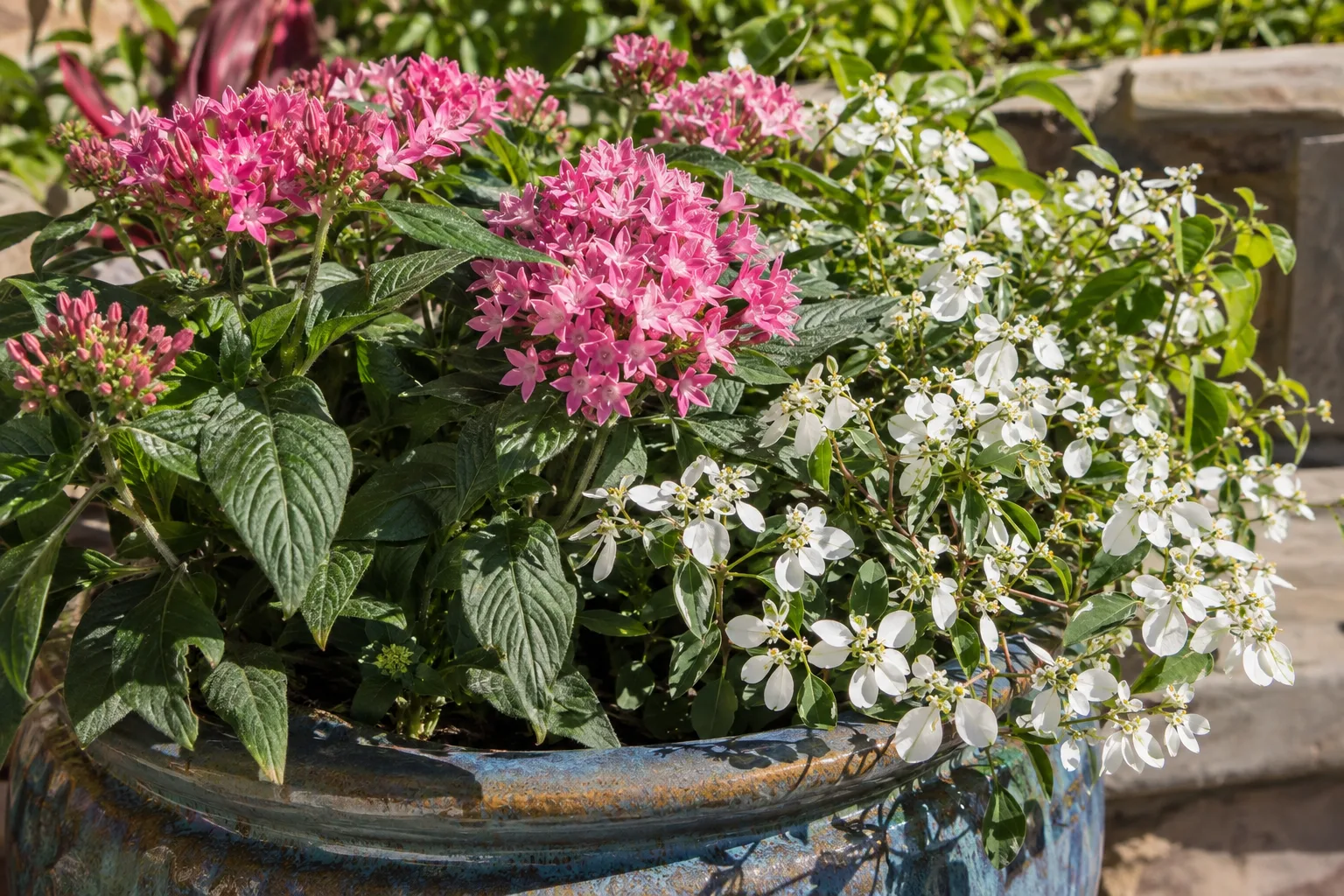
Heat-loving annuals and tender perennials such as vinca, portulaca, pentas and angelonia handle summer pots in the low desert. These are varieties we commonly carry, though availability changes week to week and season to season. You can browse what is in the annual flowers and foliage department.
Vinca (Catharanthus roseus)
Vinca grows 1 to 2 feet tall in full sun to light afternoon shade and needs moderate water. It keeps blooming through 110°F days. The drawback is that it sulks in wet, cool soil, so overwatering and poor drainage cause trouble.
Portulaca (Portulaca grandiflora)
Portulaca stays 4 to 8 inches tall and spreads into a low mat, with succulent leaves that store water. It wants full sun and sharp drainage. Its flowers close on cloudy days and in shade, so it disappoints on a covered patio.
Pentas (Pentas lanceolata)
Pentas reaches 2 to 3 feet tall and blooms steadily through summer, with clusters that hummingbirds and butterflies visit. It likes morning sun and some afternoon shade in the hottest months. The drawback is that it wilts fast if the pot dries out.
Angelonia (Angelonia angustifolia)
Angelonia, sometimes called summer snapdragon, grows 1 to 2 feet tall with upright flower spikes in purple, pink and white. It takes full sun and regular water. It can stretch and flop in too much shade.
Diamond Frost euphorbia (Euphorbia hypericifolia)
This euphorbia forms a loose, airy mound 1 to 2 feet across with tiny white flowers that fill gaps between bolder plants. It likes sun with a break from the harshest afternoon rays. Its delicate look can fade in the hottest weeks if the pot sits against a hot wall.
How often should I water containers as the heat builds?
Check every pot daily from May on, because most containers in full sun need water every day by June and some need it twice. Use the table as a starting point for a 10-gallon pot in full sun, then adjust by pushing a finger 2 to 3 inches into the soil.
| Month | Typical daily highs | Watering check |
|---|---|---|
| March | 70s to low 80s | Every 2 to 3 days |
| April | High 80s to 90s | Every 1 to 2 days |
| May | High 90s to 100s | Daily |
| June | 100 to 110°F or more | Daily, sometimes twice |
| July to August | 100 to 110°F or more | Daily, less after monsoon storms |
Water slowly until it runs out of the drainage holes, so roots grow deeper instead of staying near the hot surface. Morning is best, ideally before 7 a.m. A drip emitter on a timer takes the guesswork out of June.
Feed with a liquid fertilizer at about half the label rate, a little more often than you would in spring. Fertilizer salts can burn stressed roots, and every few weeks a thorough flush with plain water helps wash out the salts that our hard water and fertilizer leave behind.
Where should I put containers in summer and monsoon season?
Place pots where they get morning sun and shade from roughly 2 to 5 p.m. Reflected heat from a stucco wall or pavers can add a lot to a pot’s temperature, so pull containers a foot or two away from south and west walls in May.
If you cannot move them, a shade sail or shade cloth that blocks about 30 to 40 percent of the light takes the edge off. Heavier shade cuts blooming on sun-loving plants like portulaca and angelonia.
The monsoon runs roughly July through September. Higher humidity eases plant stress, but a single storm can soak pots for an hour. Clear the drainage holes, lift pots on feet, and empty saucers after storms. Water the soil rather than the leaves, since humid weather encourages leaf spots.
How do I switch spring pots to summer, step by step?
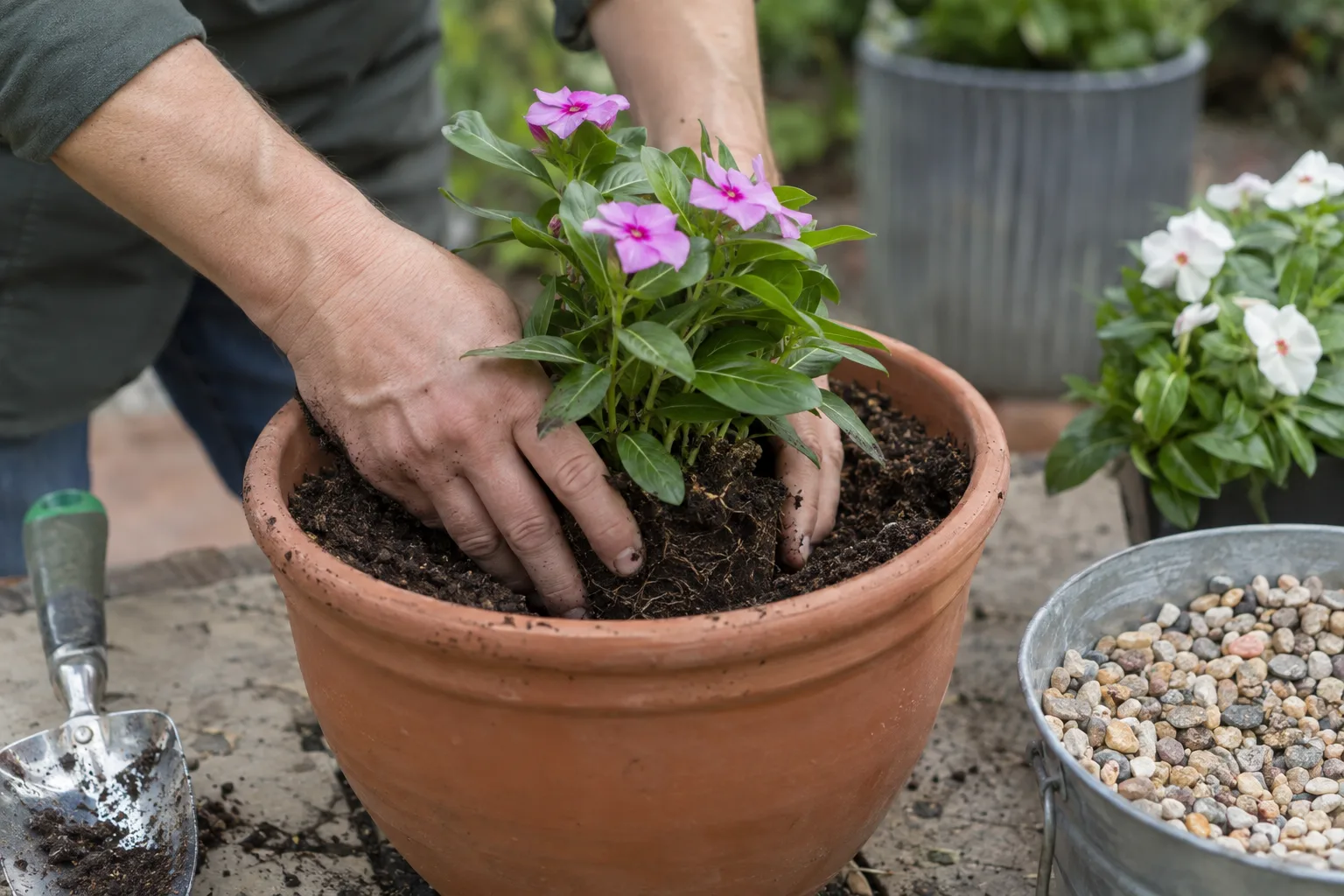
You can switch a pot in under an hour on a cool morning. Gather fresh potting mix, perlite or pumice, summer transplants, fine gravel and a larger container if the old one is small or dark.
- Start early in the morning, when the pot and the plants are coolest.
- Pull out the cool-season plants and shake loose as much old root mass as you can.
- Scoop out the tired top few inches of soil, or replace it all if it has shrunk or turned hard.
- Blend fresh potting mix with perlite or pumice and refill the pot, leaving 1 to 2 inches below the rim.
- Check that the drainage holes are open.
- Set the transplants at the same depth they sat in their nursery pots, leaving room for them to fill out.
- Water until it runs freely from the bottom, then add a 1 inch layer of gravel.
- Move the pot to a spot with morning sun and afternoon shade, and check the soil each morning through September.
What mistakes shorten a container’s summer?
Most losses come from a handful of habits. Small dark pots in all-day sun cook roots no matter how often you water. Waiting until June to swap plants forces transplants into soil that is already very hot.
- Shallow sips of water leave the lower root zone dry and keep roots near the hot surface.
- Evening watering in humid monsoon weather keeps leaves wet overnight and invites fungus.
- Heavy fertilizer doses burn heat-stressed roots.
- Saucers full of standing water drown roots after a storm.
- Old, compacted soil sheds water down the sides of the pot instead of soaking in.
If you would like to learn this in person, our classes and events page lists what is coming up.
Frequently asked questions
Can I keep petunias alive past May in Arizona?
Rarely, so plan to replace them by early May. Petunias slow down and stop blooming once highs stay above roughly 95 to 100°F. Morning-only sun, daily watering and a hard shearing can buy a few weeks, but they seldom recover once 105°F days arrive. Use the pot for heat-tolerant annuals instead.
How can I tell heat stress from thirst?
Check the soil first. Push a finger 2 to 3 inches down. If it is dry, water deeply. If it is damp and the plant still wilts in the afternoon, heat is the likely cause, so add shade and wait. Do not water wet soil, since that invites root rot. Plants that perk up by evening were heat-stressed.
Are self-watering containers a good idea for summer?
They can help if the reservoir is large and you refill it often. A reservoir keeps the soil from drying out completely, which prevents the water-repelling problem in peat mixes. In June a small reservoir may empty in a day, and the water inside can warm up. Check the level every morning at first.
Do pots do better under a patio cover?
Yes, if the spot still gets 3 to 4 hours of direct morning sun. Covered patios cut afternoon heat and slow evaporation. Deep shade leads to leggy plants and few flowers, so the edge of a ramada or patio cover usually works best. Keep pots away from hot south and west walls.
How often should I replace container soil?
Refresh it at least once a year and replace it fully every year or two. Heat breaks down organic matter quickly, so the mix shrinks, compacts and drains poorly. If water runs down the sides without soaking in, or the soil sits well below the rim, it is overdue for fresh mix.
Are summer containers worth the effort in the low desert?
Yes, if you can check your pots every morning and swap plants on schedule. A few large pots of vinca or pentas give months of color for modest work. If you travel for weeks in summer with no one to water, or you want a pot you can ignore, skip annuals and plant a single drought-tolerant shrub or succulent instead. Stop by our Queen Creek nursery and we will help you pick pots and plants for your patio.