
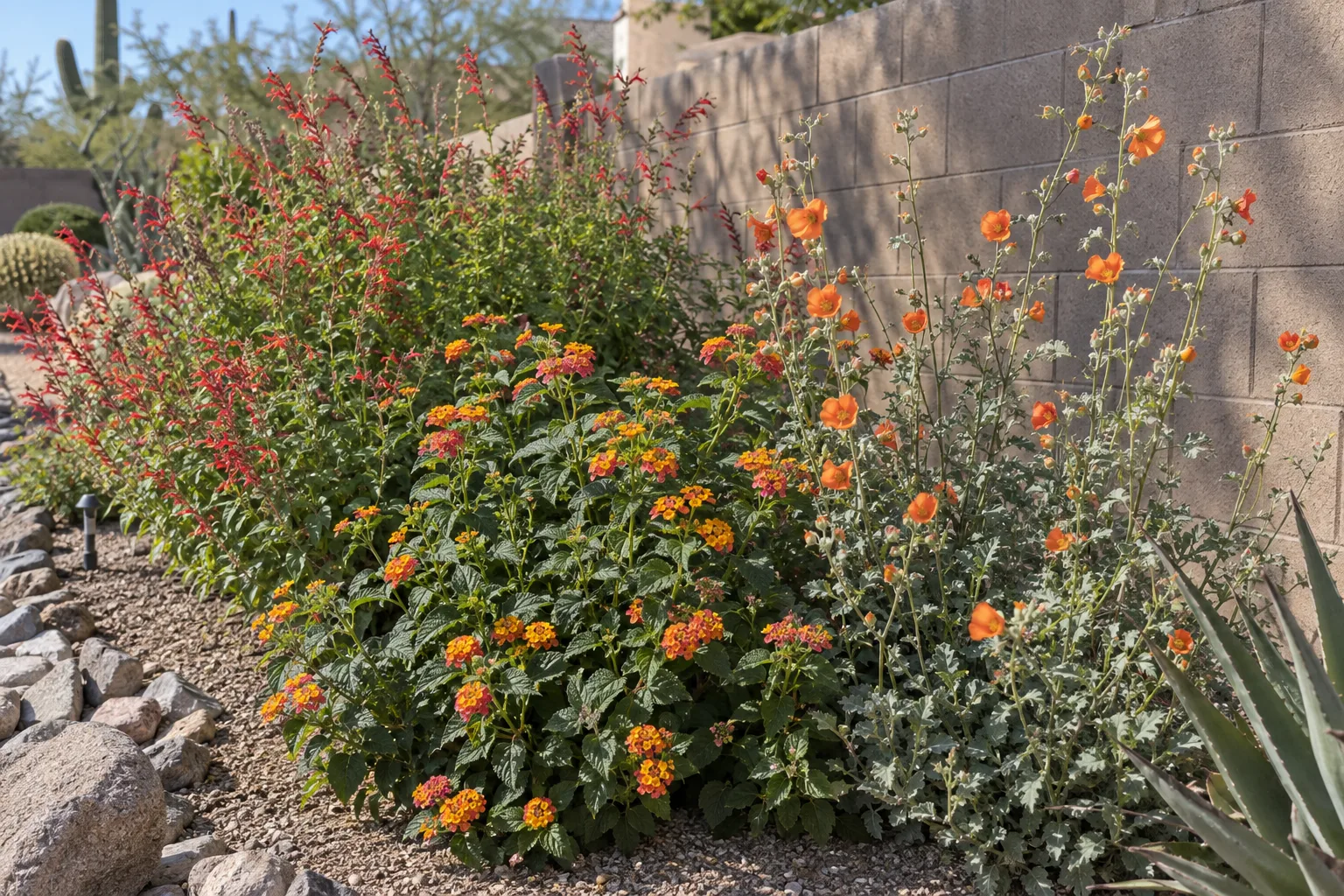
Arizona perennials such as autumn sage, lantana, red bird of paradise, desert marigold, blackfoot daisy and globe mallow end the replanting cycle once their roots are established. Plant them in fall, water deeply through the first year, and they need far less from you afterward.
Key takeaways
- Plant perennials from late September through October, when soil is still warm and air temperatures are falling, so roots get a full cool season to grow before summer.
- Dig the hole 2 to 3 times as wide as the root ball but no deeper, and set the crown about an inch above the surrounding soil.
- Water new plants every few days at first, then stretch to a deep soak every 7 to 14 days in summer once they have been in the ground a year.
- Cut back shrubby perennials like autumn sage and lantana by about a third to a half in late February or March, after frost risk has passed.
- Hold off on fertilizer for the first 6 to 8 weeks and skip it during summer heat above 110°F.
Why do perennials save money in the low desert?
A perennial is bought once and kept for years, while an annual is bought again every season. Annuals planted in fall usually fade by late May as highs climb, so a bed of them means replanting at least once or twice a year.
A perennial spends its first season building roots that go down and outward. By the second summer those roots reach cooler, steadier soil, and the plant needs less water and less attention than it did as a new purchase. You pay for the plant, the soil prep and the first year of care, then the work shifts to light pruning.
What makes the low desert hard on garden plants?
Four conditions do most of the damage: extreme heat, alkaline soil, caliche and a monsoon that swings between flood and drought. A plant has to handle all of them, and the ones listed below were chosen because they do.
Summer highs in Queen Creek and the rest of the East Valley regularly pass 110°F, and the soil surface and reflected heat from block walls and pavement run well above the air temperature. Our soil is alkaline, and many yards have a hard calcium layer called caliche a foot or so down that slows drainage and blocks roots. Hard irrigation water adds salts over time.
The monsoon, roughly July through September, can drop heavy rain in one afternoon and then leave weeks of dry heat. Plants that rot in soggy soil struggle in that pattern. Frost is occasional in winter, and it is enough to cut back the more tender perennials.
Which perennials hold up best in the low desert?
These six come back reliably in our conditions and bloom for long stretches. They are varieties we commonly carry, though availability changes week to week and season to season. You can browse what is currently on the shelves in our plant department.

Autumn sage (Salvia greggii)
Autumn sage grows 2 to 3 feet tall and wide in full sun or light afternoon shade. It needs low water once established. Flowers come in red, pink, coral and white from spring into fall, with a slowdown in the hottest weeks, and hummingbirds visit them. The drawback is that it turns woody and sparse if you skip the yearly cutback.
Desert marigold (Baileya multiradiata)
Desert marigold stays around 1 to 2 feet tall and wide, wants full sun and needs very little water. Yellow flowers rise on slender stems from spring into fall. Individual plants tend to be short-lived, so it relies on self-seeding to keep going, and it can look ragged between flushes of bloom.
Lantana (Lantana montevidensis and Lantana camara)
Trailing lantana runs 1 to 2 feet tall and spreads 3 to 6 feet, which suits slopes and wall edges. Shrubby types reach 3 to 5 feet. Both want full sun and low to moderate water, and both bloom from spring until frost. A cold night burns the foliage, and the plant looks rough until spring regrowth fills in.
Red bird of paradise (Caesalpinia pulcherrima)
Red bird of paradise grows 6 to 10 feet tall and wide in full sun with low water once established. Its orange-red flower clusters bloom through much of the summer, when many plants stall. It needs real space, and a hard freeze can cut it to the ground, though it usually resprouts from the base in spring.
Blackfoot daisy (Melampodium leucanthum)
Blackfoot daisy forms a low mound 6 to 12 inches tall and 12 to 18 inches wide in full sun with low water. White daisy flowers with yellow centers appear in late winter through spring and again in fall. Drainage is the drawback: wet soil kills it faster than heat, so plant it in a mound or in gravelly ground.
Globe mallow (Sphaeralcea ambigua)
Globe mallow is a native that reaches 2 to 3 feet tall and wide in full sun with low water. Coral to orange blooms peak in spring and often return after monsoon rains. It handles poor, rocky soil well. It also grows rangy without a cutback, so plan on trimming it to keep it tidy.
When is the best time to plant perennials in Arizona?
Late September through October is the best window, with February and March as a second choice. Fall planting gives roots a full cool season to spread before the first summer, and spring planting gives them only a few months before highs pass 100°F.
Our gardening calendars lay out the month-by-month tasks for the East Valley. This table gives the short version for perennials.
| Months | What to do |
|---|---|
| Late September to October | Main planting window. Water new plants every few days. |
| November to January | Water less often. Cover tender plants on frost nights. |
| February to March | Prune shrubby perennials. Second planting window. |
| April to May | Add mulch. Increase watering as temperatures climb. |
| June to September | Water deeply and less often. Skip a watering after heavy monsoon rain. |
How do I plant a perennial in alkaline, caliche soil?
Dig a wide hole, test how fast it drains, and plant the crown slightly high in mostly native soil. Wide matters more than deep, because most roots spread sideways in the top foot or two.
- Choose a spot that matches the plant’s sun needs, and keep in mind that a south or west block wall adds reflected heat.
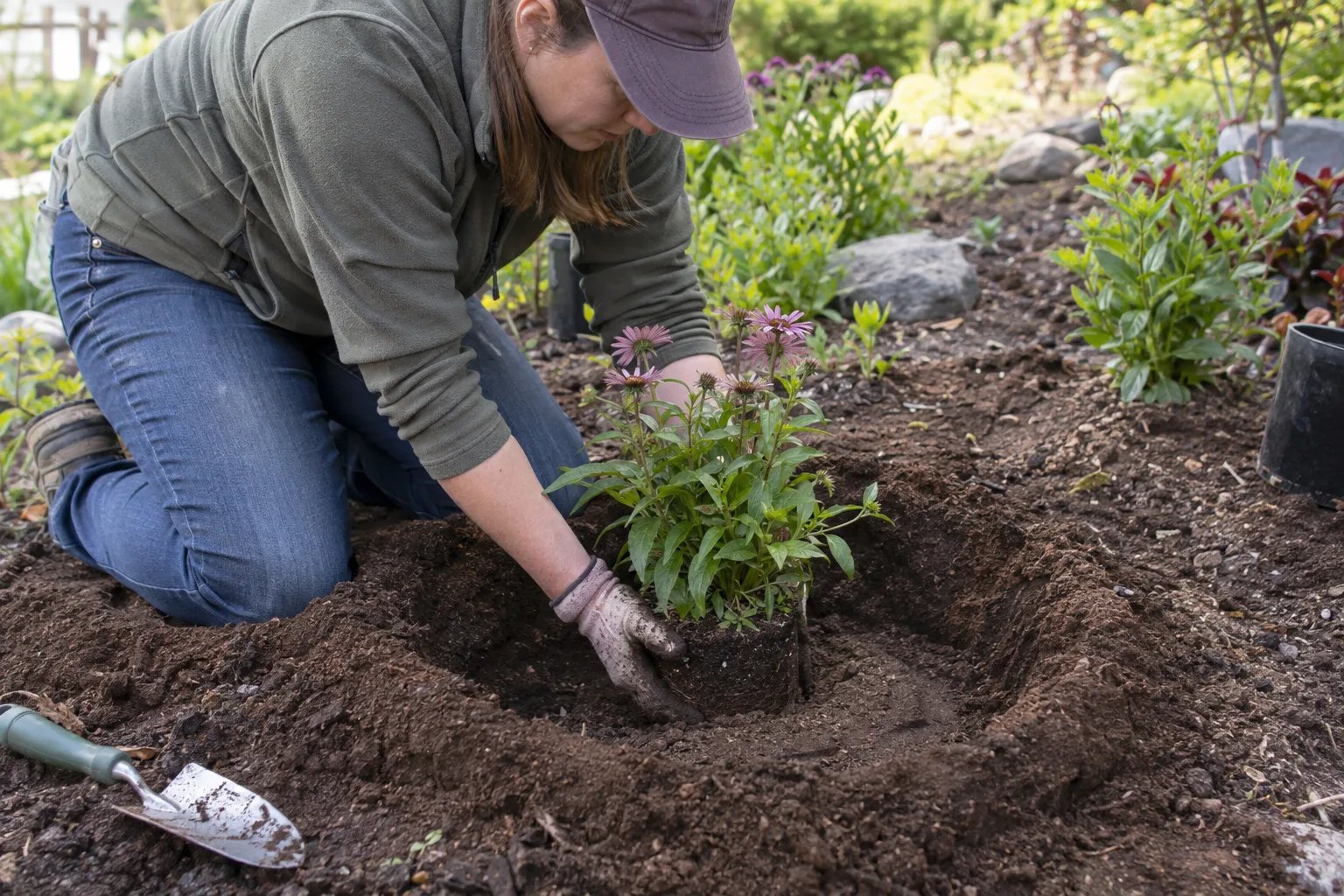
- Dig the hole 2 to 3 times as wide as the root ball and only as deep as the root ball.
- Fill the hole with water. If it is still standing after a full day, caliche is blocking drainage, so break through the layer with a digging bar or plant in a raised mound instead.
- Loosen circling roots gently with your fingers.
- Set the plant so the crown sits about an inch above the surrounding soil, because soil settles and a buried crown can rot.
- Backfill mostly with the native soil you removed. A modest amount of compost is fine, but a rich, heavily amended hole can hold water and drain differently from the soil around it.
- Build a low soil rim around the plant and soak it slowly.
- Spread 2 to 3 inches of mulch over the root zone, pulled back from the crown and stems.
Avoid fertilizing for the first 6 to 8 weeks. New roots need time to settle before you push top growth.
How often should I water established perennials?
Once a perennial has been in the ground about a year, most of these plants do well with a deep soak every 7 to 14 days in summer and every 3 to 4 weeks in winter. Treat those numbers as a starting point, since soil type and exposure change the answer.
Deep watering matters more than frequency. A drip system that runs long enough to wet the soil 18 to 24 inches down pushes roots into cooler ground, while frequent shallow watering keeps roots near the hot surface. After a heavy monsoon rain, skip the next watering and let the soil dry down. Overwatering, especially in July and August, is a common reason established perennials decline.
Drip emitters beat overhead spray for these plants. They put water at the roots and keep foliage dry.
When should I prune perennials in the low desert?
Prune shrubby perennials in late February or March, once frost risk has passed and before spring growth takes off. Cut autumn sage, lantana and globe mallow back by about a third to a half to keep them full instead of leggy.

Leave frost-damaged growth on until then, because the dead foliage insulates the crown during cold nights. Red bird of paradise can be cut to within a foot or so of the ground if frost hit it hard, and it usually resprouts by late spring. Deadhead desert marigold and blackfoot daisy every week or two during bloom to keep them tidy.
If you want hands-on practice, check our classes and events page to see what is scheduled.
What mistakes shorten a perennial’s life here?
Most losses trace back to planting time, drainage and watering. Each of these is easy to avoid once you know it.
- Planting in summer. Young roots cannot supply enough water when highs run 105°F to 115°F, so wait for fall.
- Skipping the drainage test. A hole that holds water turns into a bathtub in monsoon season.
- Planting too deep. A buried crown stays wet and rots, which is why we set it an inch high.
- Overwatering after the first year. Rot from soggy soil looks a lot like drought stress, with wilted, yellowing leaves.
- Fertilizing in summer heat. New growth on a stressed plant adds demand it cannot meet, so feed in early spring or fall.
- Ignoring reflected heat. A spot against a west-facing wall can run far hotter than open ground, so match the plant to the spot.
Frequently asked questions
Can I grow these perennials in pots?
Yes, though pots heat up quickly and dry out fast in summer. Lantana, autumn sage and blackfoot daisy are reasonable container choices. Pick a large, light-colored pot with drainage holes and place it where it gets afternoon shade. Browse our pottery and planters for options, and plan on watering more often than in-ground plants.
Will frost kill these perennials?
Frost usually damages the top growth of lantana and red bird of paradise but rarely kills established roots. Autumn sage, desert marigold, blackfoot daisy and globe mallow tolerate most East Valley winters with little harm. Wait until spring to prune frost-burned growth, and cover young plants on nights forecast near freezing.
How long until a perennial is established?
Most perennials planted in fall take about 12 months to establish, and some need a second summer to look fully settled. During that first summer a plant may drop leaves or slow down, which is common. Keep up deep watering and resist the urge to replace it too early, because many recover in October.
Do perennials need fertilizer?
Native and desert-adapted perennials need little fertilizer. A light feeding in early spring, after the first 6 to 8 weeks in the ground, is plenty for most. Heavy feeding pushes soft, leafy growth that burns in summer heat and attracts more watering demands. If leaves yellow between the veins, check drainage and watering before reaching for a product.
Can I mix perennials with annual color?
Yes, and it works well. Perennials give the beds their structure and long bloom, and annuals fill gaps with seasonal color in cool months. Keep annuals near the front where they are easy to replace. Our annual flowers and foliage department is a good place to find companions for the perennials above.
Are perennials the right choice for your yard?
For most sunny East Valley yards, yes. If you have a spot with full sun, drainage you have tested and a willingness to prune once a year, these plants will save you money and replanting within two seasons. They are a poor match for deep shade, and they will not give a manicured, uniform look like a clipped hedge or a lawn. Come see them in person and we will help you match plants to your spot, so visit us in Queen Creek.