Fertilizing your Arizona lawn too early feeds winter weeds instead of grass, because Bermuda stays dormant until soil 4 inches down holds near 65°F. In Queen Creek that usually happens between late March and April, so trust a soil thermometer over the calendar.
Key takeaways
- Bermuda wakes up when soil 4 inches deep holds near 65°F for several mornings in a row, usually late March to April in the East Valley.
- Nitrogen put down on dormant Bermuda mostly feeds winter weeds and can wash below shallow roots.
- Yellow or tan grass in February usually means dormancy, cold soil or low iron, and nitrogen will not fix any of those.
- Established Bermuda lawns typically get three to four slow-release feedings between April and September.
- Water fertilizer in with 15 to 20 minutes of irrigation, then return to your normal schedule the next day.

Why does early fertilizer backfire on a dormant lawn?
Dormant grass cannot use nitrogen, so the fertilizer goes to whatever is growing, mostly winter weeds, or it moves down with irrigation water past roots that are not active. Bermuda, the most common lawn grass in Queen Creek and across the East Valley, slows down and turns tan once soil cools, typically from about November into March.
Weeds such as oxalis keep growing through mild winter weeks and take up the nitrogen first. You end up with a thicker weed patch and the same tan lawn. Unused nitrogen can also travel below the shallow root zone with rain or irrigation, where the lawn cannot reach it once it wakes up. Waiting costs nothing.
How do I know when the soil is warm enough to fertilize?
Push a soil thermometer 4 inches into the ground and fertilize Bermuda once the reading holds near 65°F on three mornings in a row. A single warm afternoon can spike the surface temperature while the root zone stays cold, so morning readings are the more reliable guide.
Check two or three spots, because a lawn along a block wall or a driveway warms earlier than a shaded strip on the north side of the house. Green-up is another signal. When the lawn starts turning green on its own across most of the yard, the soil has usually warmed enough for roots to work.

Use the reading together with a month-by-month schedule. Our gardening calendars give general timing for the low desert, and your thermometer tells you how your own yard compares. Cold springs run late, and warm ones run early.
What problems does fertilizing too early cause?
Early feeding causes weeds, weak roots, wasted product and, if the rate is too high, burned leaf tips. Each one costs you money or a good part of the growing season, and some are slow to show up until the first stretch of 110°F days arrives.
- More weeds: Nitrogen feeds every plant in the lawn, and winter weeds are the ones awake to use it.
- Weak roots: Fertilizer can push leaf growth before roots are working, and a lawn with lush blades over shallow roots struggles in summer heat.
- Wasted nitrogen: Product that the grass cannot take up leaches below the root zone with irrigation.
- Salt stress: Our irrigation water is hard and our soil is alkaline, so heavy fertilizer on a lawn that is not growing adds to salts already present.
- Leaf burn: Applying more than the label rate, especially on dry turf, can scorch grass blades.
Why does my lawn look yellow in late winter?
A yellow or tan lawn in February is most often dormant Bermuda, cold-stressed ryegrass, or grass short on iron. None of these respond to a nitrogen feeding, and each has a different fix.
Dormant Bermuda is normal and needs only patience until soil warms. Overseeded ryegrass that yellows during a cold snap usually recovers on its own as days warm. Iron shortage shows up as yellowing between the veins of the blade, and it is common here because alkaline soil, often pH 7.5 to 8.5, makes iron harder for roots to absorb. A chelated iron product applied at the label rate addresses that.

When should I fertilize each type of lawn?
Feed Bermuda and St. Augustine after spring warm-up, and feed overseeded ryegrass in the cool months when it is growing. The table below lays out a general low desert schedule.
| Period | Bermuda | Overseeded ryegrass | St. Augustine |
|---|---|---|---|
| October | None | Light starter feeding at overseeding | None |
| November to February | None, dormant | Slow-release balanced feeding about once | None |
| Late March to April | First feeding once soil holds 65°F | None, heading toward spring transition | First feeding once soil is warm |
| May to June | Second feeding | None | Second feeding |
| July to August | Light feeding if growth is strong | None | Light feeding if needed |
| September | Optional light feeding early in the month | Prepare for overseeding | Optional light feeding |
Ryegrass needs a gentle hand. Heavy nitrogen in February pushes fast, soft growth that struggles once highs pass 100°F in May. St. Augustine is the shade option in some yards, and it tends to burn more easily than Bermuda in alkaline soil, so go lighter on rate.
How do I fertilize once the soil is ready?
Check the soil, mow, apply a slow-release nitrogen product at the label rate, and water it in. The steps below cover a typical first spring feeding on Bermuda.
- Confirm that 4-inch soil readings hold near 65°F on three mornings in a row.
- Mow two or three days before, so granules reach the soil instead of catching on tall blades.
- Choose a slow-release nitrogen product with a low or zero middle number, and read the label for the rate per 1,000 square feet.
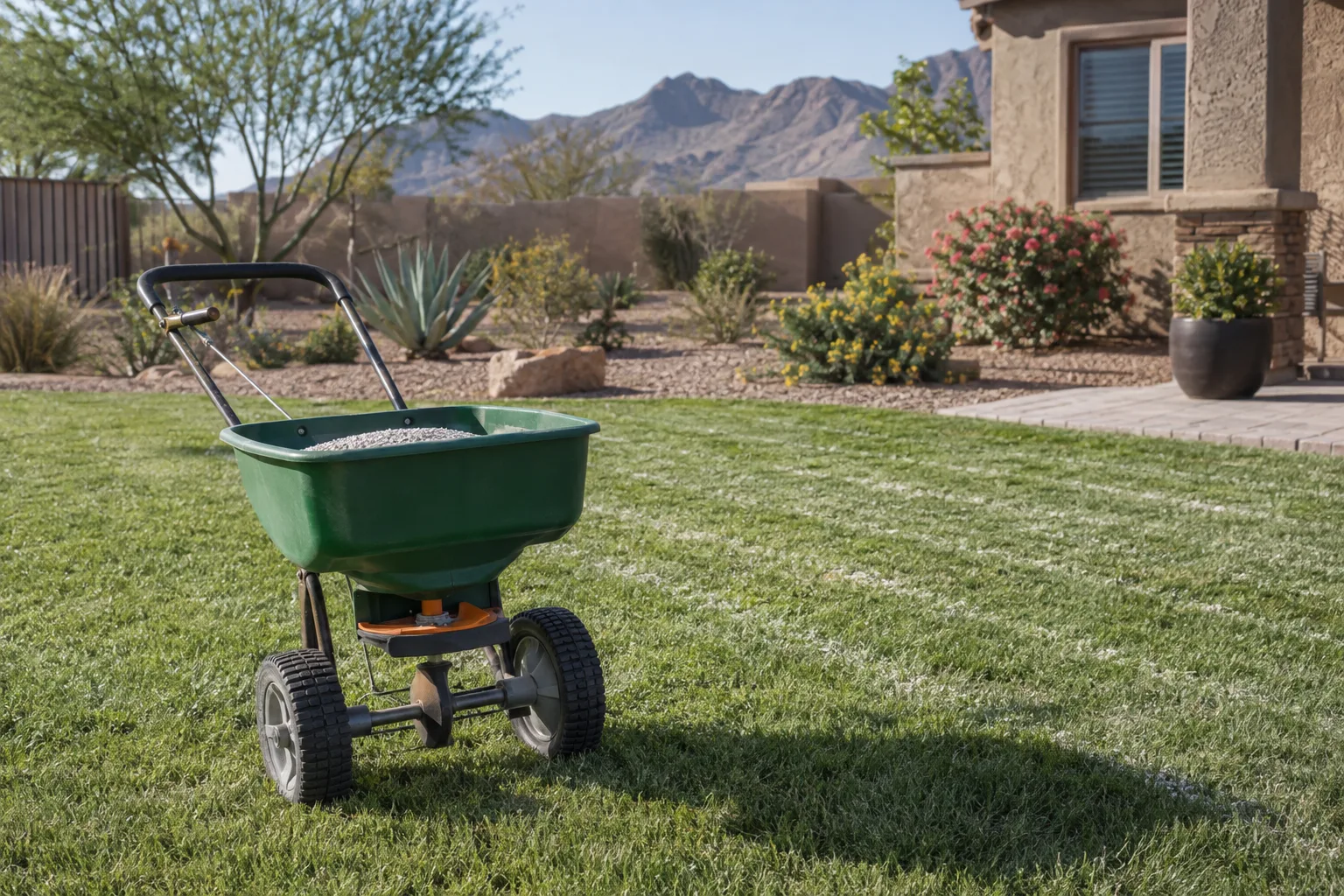
- Set the spreader to the label rate. Err slightly low on the first pass, because you can add more later but you cannot remove product.
- Walk the lawn in two directions at half the rate each, which prevents stripes.
- Run irrigation for 15 to 20 minutes to rinse granules off the blades and into the soil, and keep traffic off for a day.
Two mistakes are worth avoiding. Feeding just before the monsoon, roughly July through September, risks heavy storms flushing nitrogen out of the root zone within days. And increasing irrigation after fertilizing keeps the soil soggy; return to your regular schedule the next day and adjust only as temperatures climb.
What should I look for in a lawn fertilizer for Queen Creek soil?
Look for a slow-release nitrogen source, a low phosphorus number, and iron in the blend or as a separate product. The three numbers on the bag are nitrogen, phosphorus and potassium, in that order.
Nitrogen drives green growth and is the number to time carefully. Phosphorus is often already present in our alkaline soils, so skip high-phosphorus blends unless a soil test shows a shortage. Potassium supports heat and drought tolerance, which helps going into summer. Iron addresses the yellowing that alkaline soil causes, and it is often the missing piece when a lawn looks pale.
If you are unsure what your lawn needs, contact us with a description or a photo of what you see. Matching a product to a soil test result is easier than guessing at a bag.
Frequently asked questions
How many times a year should I fertilize Bermuda?
Most established Bermuda lawns do well with three to four feedings between April and September. Start at spring green-up, feed again in late May or June, add a light one in midsummer if growth is strong, and treat September as optional. Total yearly nitrogen commonly falls around 3 to 6 pounds per 1,000 square feet, depending on the product and the lawn.
Can I fertilize right after overseeding with ryegrass?
Yes, with a light starter fertilizer at overseeding in October. Wait until the ryegrass has sprouted and been mowed a couple of times before a fuller feeding. Heavy nitrogen in November creates soft, shallow-rooted growth that can struggle through the spring transition, so keep the rate modest and the product slow-release.
Is it too late to fertilize Bermuda in September?
A light feeding early in September is fine, but late heavy nitrogen is a risk. It can keep Bermuda growing when it should be slowing for dormancy, which leaves tender growth exposed to the first frost. By October, skip nitrogen on Bermuda and put your effort into overseeding preparation if you plan to do it.
Do I need a soil test before fertilizing?
A soil test is worth it if your lawn stays pale after feedings, or if you are thinking about adding phosphorus. It shows pH and nutrient levels, so you stop guessing at deficiencies. For a routine, healthy Bermuda lawn, label-rate nitrogen on schedule plus occasional iron often covers it. See our classes and events page for current offerings.
Is there a way to reduce how much lawn I have to feed?
Yes, shrinking the lawn cuts fertilizer, water and mowing together. Many East Valley gardeners keep a smaller lawn area and replace the rest with low-water shrubs, groundcovers and flowering plants. Browse our plant selection for ideas that suit full sun, reflected heat and alkaline soil.
Is it worth waiting for warm soil before you fertilize?
Yes. Waiting until soil holds near 65°F costs you a few weeks of tan grass and saves you weeds, wasted product and a lawn that sulks in July. The only people who can skip all this are those whose lawn is coming out soon or who already live with a gravel or desert landscape. For everyone else, a five-dollar thermometer is the best fertilizer tool you can own. Stop by our nursery in Queen Creek and tell us what your lawn looks like.