

Arizona grapevines in April need deep watering, light feeding, shoot tying and leaf shade over the clusters. Bloom and fruit set happen this month in the low desert, so the care you give now shapes the harvest that ripens from June through August.
Key takeaways
- Water deeply enough to wet the soil 18 to 24 inches down, and shorten the interval by 1 to 2 days as highs climb from the 80s into the mid-90s.
- Hold back on heavy nitrogen during bloom and fruit set, because it pushes leaves instead of fruit.
- Apply sprays and foliar feeds only in the early morning, while temperatures are still below about 90°F.
- Tie shoots to the trellis once they reach 6 to 8 inches, and keep leaves over the clusters on the west side.
- Mulch 3 to 4 inches deep, and keep the mulch 4 to 6 inches away from the trunk.

What stage are grapevines in during April in the low desert?
Most table grapes (Vitis vinifera) in the East Valley are in bloom or early fruit set in April. Flower clusters that opened in March self-pollinate, and the tiny berries start to swell. Shoots can grow several inches a day in warm weather. The crop is set this month.
Stress at this stage, from drought, heat spikes or heavy feeding, can cause berries to drop (a problem called shatter) and leave you with loose, thin clusters at harvest. Spring here runs from 80°F afternoons toward the mid-90s within a few weeks, so the care schedule shifts as the month goes on. If you are shopping for vines or other backyard fruit, start with our fruit trees department and ask us what is available.
How often should I water grapevines in April?
Established vines usually need a deep soak every 5 to 7 days in April, and vines in their first or second year need water every 3 to 4 days. Aim to wet the soil 18 to 24 inches deep, then let the top 4 to 6 inches dry before the next soak. A long screwdriver or soil probe pushed into the ground shows how far the water went.
Put drip emitters near the edge of the canopy rather than at the trunk, so roots grow outward. Run a catch-can test to learn how many gallons your emitters deliver, then set run times from that number. As highs climb from the low 80s to the mid-90s, shorten the interval by a day or two. Wilting leaves are a late signal. Check the soil first.
Should I fertilize grapevines in April?
Feed lightly, and hold back on nitrogen during bloom and fruit set. Heavy nitrogen pushes leafy shoots that shade the clusters and compete with them for energy. An established vine in decent soil often needs little more than compost and a modest, label-rate application of a balanced fertilizer.
The bigger issue in our alkaline soil (often pH 7.5 to 8.5) is iron. Yellow new leaves with green veins point to iron chlorosis, because the iron is in the soil but the roots cannot take it up. An EDDHA iron chelate applied as a soil drench holds up better than other forms at high pH. Zinc shortages can also affect fruit set. A soil or tissue test every two to three years, through a lab or University of Arizona Cooperative Extension, shows what your vine needs. Test before you buy.
If you use a foliar feed, apply it in the early morning while the temperature is below about 90°F. Spraying in midday heat can burn leaves and young clusters.
How do I train and thin shoots in April?
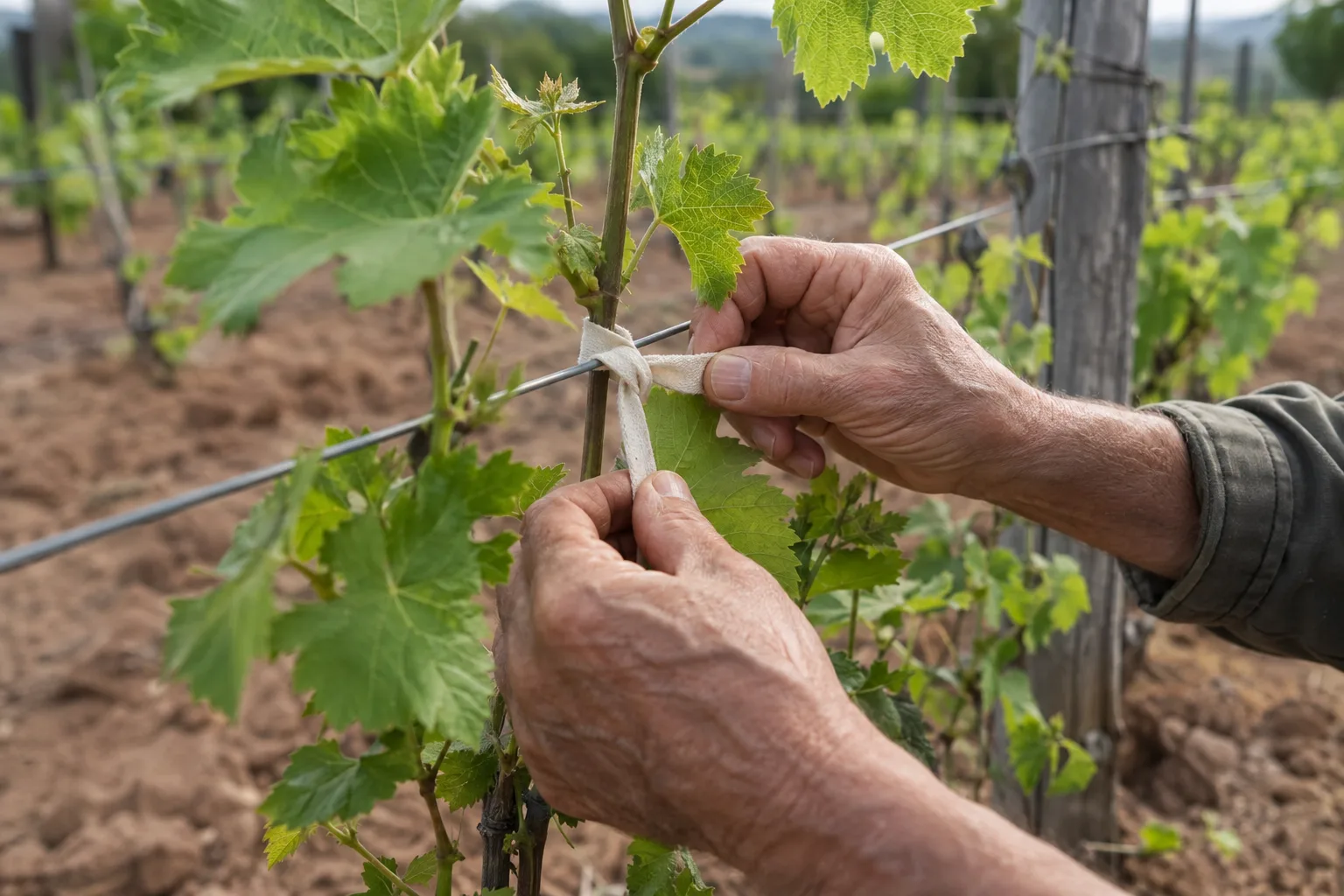
Tie fruiting shoots to the trellis once they reach 6 to 8 inches, and remove suckers from the base of the trunk and from below the graft union. Use soft ties or cloth strips, since wire can cut into canes as they thicken. Tying a little each week is easier than untangling brittle shoots in May.
Keep the shoots that carry clusters and thin the ones that cross or crowd the center. An open canopy lets air move through the vine, which helps against powdery mildew. Leave enough leaves over the clusters, especially on the west and southwest side, because direct afternoon sun in July and August can leave berries with brown, leathery sunburn patches. Do not strip leaves away from the fruit.
What should I do about caliche and alkaline soil?
Caliche blocks drainage, so break through it at planting, and accept that alkaline soil changes slowly. A hardened layer can sit anywhere from a few inches to a few feet down in East Valley yards. Water that pools above it leaves roots short of oxygen, and no fertilizer fixes that.
Organic matter does more for these soils than any quick fix. Spread 2 to 3 inches of compost on the surface each spring, then cover it with 3 to 4 inches of wood chip mulch. Sulfur lowers pH slowly and has limited effect in soil with a lot of free lime, so do not expect it to change a yard in one season. Our hard irrigation water also leaves salts behind, and an occasional extra-long soak helps move them below the root zone.
- Keep mulch 4 to 6 inches off the trunk to prevent rot.
- Mix coarse sand into clay only with plenty of compost, since sand alone can make soil denser.
- Check drainage by filling a test hole with water and timing how long it takes to empty.

What pests and diseases show up on grapevines in April?
Powdery mildew and leafhoppers are the two to watch. Mildew shows as a white, powdery film on young leaves and shoot tips, and it favors dense canopies and mild spring weather. Sulfur and potassium bicarbonate are the products most often used against it, but read the label for your crop, its rates and its temperature limits, because sulfur can burn leaves in heat.
Leafhoppers feed on leaf undersides and leave a pale, stippled look on the top surface. Insecticidal soap sprayed on the undersides in the early morning reaches the nymphs. Skip broad-spectrum insecticides while the vine is in bloom, since bees visit the flowers. Bring a photo or a leaf sample if you are unsure what you are seeing, or contact our team with questions. Stunted growth or rolled leaves are worth showing us.
Can I plant a new grapevine in April?
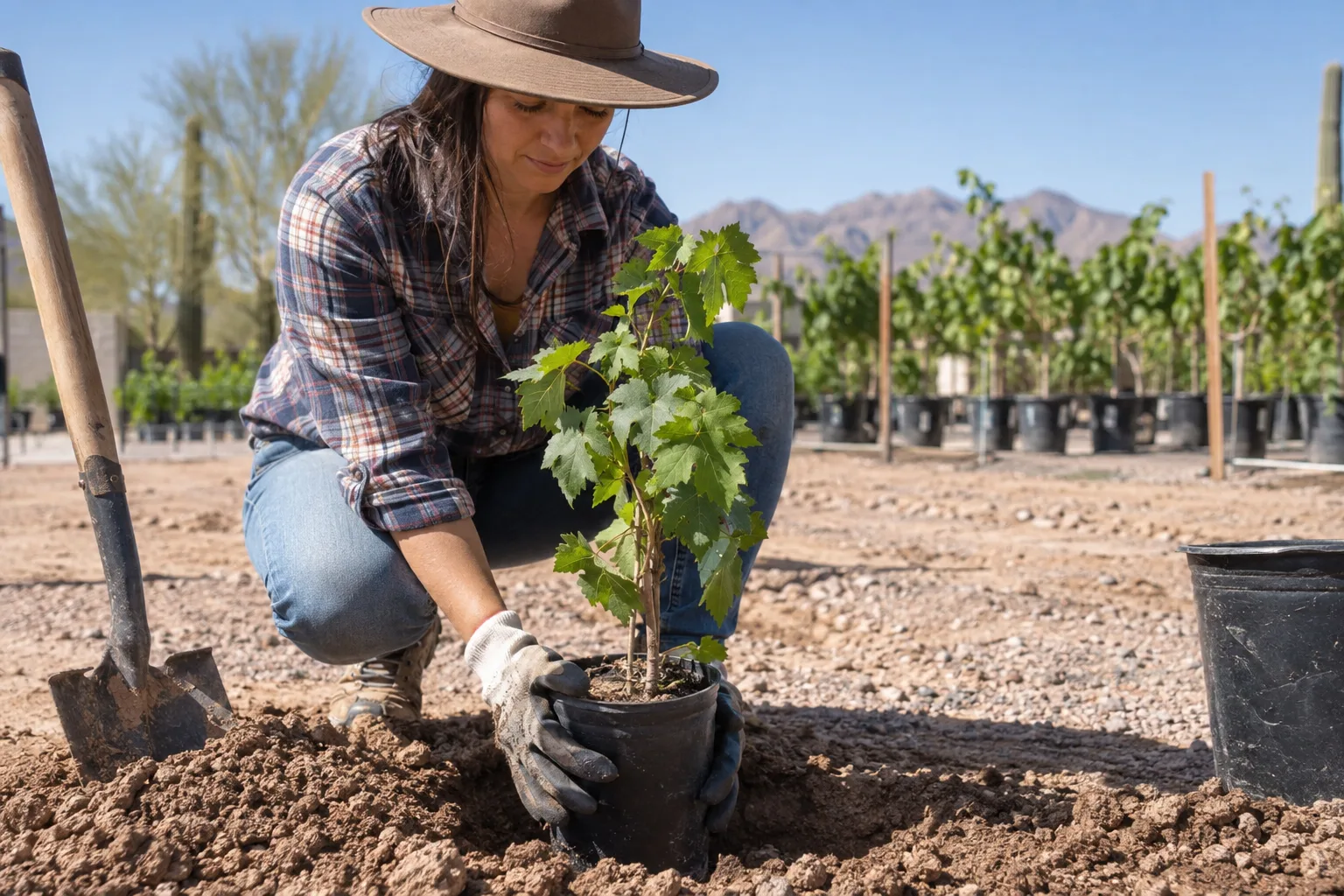
You can in early April, but the window is closing. February and March give a new vine more time to root before summer, and October is a good second chance. An April vine needs afternoon shade during its first summer and water every 3 to 4 days while the roots establish.
Table grape varieties we commonly carry include Thompson Seedless, Flame Seedless and Perlette, though availability changes week to week and season to season. Perlette ripens early, which suits our heat, while Thompson and Flame are widely grown across the low desert. Ask us which varieties are in right now, and match the vine to your trellis and the sunniest spot you have.
What should I do each week in April?
Spread the work across the month so nothing piles up. For other months, see our gardening calendars, and check our classes and events page for any upcoming gardening classes.
| Week | Tasks |
|---|---|
| Week 1 | Check soil moisture at 12 and 24 inches, test emitters, remove trunk suckers, and drench with chelated iron if new leaves are yellow. |
| Week 2 | Start tying shoots, feed lightly if the vine needs it, and scout for powdery mildew. |
| Week 3 | Thin crossing shoots and check that leaves still shade the clusters. |
| Week 4 | Refresh mulch, shorten the watering interval by 1 to 2 days, and note cluster counts for next winter’s pruning. |
Frequently asked questions
Can I still prune grapevines in April?
Light corrective pruning is fine in April. Remove dead wood, crossing canes and trunk suckers, but leave the fruiting shoots alone. Heavy pruning on a growing, flowering vine removes the wood carrying this year’s clusters and pushes a flush of leafy growth. Save structural cuts for winter dormancy, when the vine is leafless and the framework is easy to see.
Why are berries dropping off my grapevine?
Berry drop during bloom is usually shatter, caused by stress at fruit set. Common triggers are uneven watering, a sudden heat spike, heavy nitrogen and sometimes a zinc shortage. Some loss is normal, since vines set more flowers than they can ripen. If whole clusters fall or the vine looks wilted, check root zone moisture and drainage first.
Do grapevines need bees to set fruit?
Most table grape varieties are self-fertile, so they set fruit without a pollinator. Wind and the movement of the shoots carry pollen within each flower cluster. Bees still visit the blooms, and protecting them is a good reason to avoid broad-spectrum insecticides during flowering. Check the variety tag, since a few grapes have flowers that need a nearby pollinizer.
Should I let a young grapevine fruit in its first year?
Many growers remove the clusters on a first-year vine so it can put energy into roots and trunk. A second-year vine can often carry a light crop, and a third-year vine a fuller one. Vigor differs by variety, so ask us about yours. Letting a weak vine fruit early can slow its establishment.
How much sun do grapevines need in the low desert?
Grapevines grow best with 8 or more hours of sun a day, but the fruit does better with some leaf cover in afternoon heat. A first-summer vine benefits from a little afternoon relief. Sunburned berries show brown, leathery patches and ripen poorly. A trellis on an east or south exposure with leaves over the clusters works well.
Is a grapevine right for your yard?
A grapevine suits you if you have a sunny spot with a sturdy trellis or arbor, drip irrigation, and 15 minutes a week in April to tie shoots. You get shade, fruit and a long-lived plant. It does not suit a dark corner, a small pot with no room for roots, or a gardener who wants a plant with no pruning at all. Stop by Desert Horizon Nursery in Queen Creek and we will help you choose a spot.