Six Arizona desert shrubs take a March pruning well: lantana, autumn sage, brittlebush, desert ruellia, yellow bells and red bird of paradise, once frost risk has passed. Three others, penstemon, desert marigold and hummingbird bush, should be left alone while they bloom.
Key takeaways
- Prune frost-tender shrubs such as lantana, yellow bells and red bird of paradise in March, after you see green shoots, because a cold night can still reach Queen Creek in early March.
- Lantana usually takes the deepest cut, down to roughly 6 to 12 inches above the ground on woody plants.
- Autumn sage and yellow bells do best with a cut of about one-third to one-half, made just above a leaf pair or side branch.
- Skip penstemon, desert marigold and hummingbird bush until bloom ends, typically late April to May.
- Water after pruning, but hold off on fertilizer for 3 to 4 weeks.

Why is March the right month to prune desert shrubs?
March sits between the last frosts and the first stretch of real heat, so fresh cuts have mild weather to heal. Cold air settles over open ground in Queen Creek, and a frost in early March is possible, so check the forecast before you cut anything frost-tender.
New growth is the guide. Wait until you see green buds or shoots, then cut back to just above them. Pruning in January or February can expose tender regrowth to a late cold night, and pruning in late spring puts open wounds into days above 100°F. The rule for flowering shrubs is to prune after they bloom, and that rule decides every plant on the skip list below.
Which six desert shrubs should I prune in March?
Lantana, autumn sage, brittlebush, desert ruellia, yellow bells and red bird of paradise all respond to a March cut. You can browse shrubs in our plant department to see what we commonly carry, though availability changes week to week and season to season.
Lantana (Lantana camara)
Lantana blooms on new growth, so a hard cut in March sets up flowers for the warm months. Cut woody, frost-browned stems back by one-half to two-thirds, down to about 6 to 12 inches if the base is bare and tired. Wear gloves and long sleeves while you work.
Autumn sage (Salvia greggii)
Autumn sage gets woody and open if it is never cut. Reduce it by one-third to one-half, cutting just above a pair of leaves, and it fills in within a few weeks. Mexican bush sage (Salvia leucantha) is more frost-tender, so wait until frost-burned tops are brown and then cut it back harder, by half or more.
Brittlebush (Encelia farinosa)
Brittlebush needs only light shaping, and only after the yellow flowers fade, usually late March into April. Trim back about one-third of the stem length to keep it compact. It is a short-lived shrub that often fails when cut into bare wood, so always leave leafy growth below the cut.
Desert ruellia (Ruellia peninsularis)
Desert ruellia is a rounded shrub with blue-purple flowers, and it benefits from a trim once frost danger is past. Remove dead or frost-damaged stems and cut the rest back by up to one-half to restore its shape. Cut just above a node.
Yellow bells (Tecoma stans)
Yellow bells grows fast, often reaching 6 to 8 feet tall, and it blooms on new wood. In March, remove frost-damaged tips and shorten the rest by about one-third to keep the center from flopping open. Cutting back this way sets up a full flush of trumpet flowers later in spring and summer.
Red bird of paradise (Caesalpinia pulcherrima)
Red bird of paradise often dies back after a cold winter, and March is when you find out how far. Wait for new shoots, then cut dead stems to live wood, or nearly to the ground if the top is gone. Roots often resprout even when the top looks lifeless.

Which three shrubs should I skip in March?
Skip penstemon, desert marigold and hummingbird bush, because all three are in bloom or building buds in March. Cutting them now removes flowers and delays the show. Wait until the flowers fade, then shape lightly.
Parry’s penstemon (Penstemon parryi)
Parry’s penstemon sends up tall pink flower spikes in March and April. Cut the spent stalks at the base once bloom ends, typically late April to May, and leave the leaf rosette alone.
Desert marigold (Baileya multiradiata)
Desert marigold is a short-lived perennial with yellow daisy-like flowers that peak in spring. Pinch off spent flowers as you go, and shear it lightly after the main bloom if it looks ragged. A hard cutback in March only removes buds.
Hummingbird bush (Justicia californica)
Hummingbird bush, or chuparosa, carries red tubular flowers from late winter through spring. It has a loose, open habit and looks best with minimal cutting. If it needs shaping, wait until the spring bloom winds down, usually around late May, and remove only dead or crossing stems.
How do I prune a desert shrub step by step?
Plan your cuts first, remove dead wood second, and shape last. Rushing the shape before you see the plant’s real structure is how shrubs end up lopsided or over-cut.
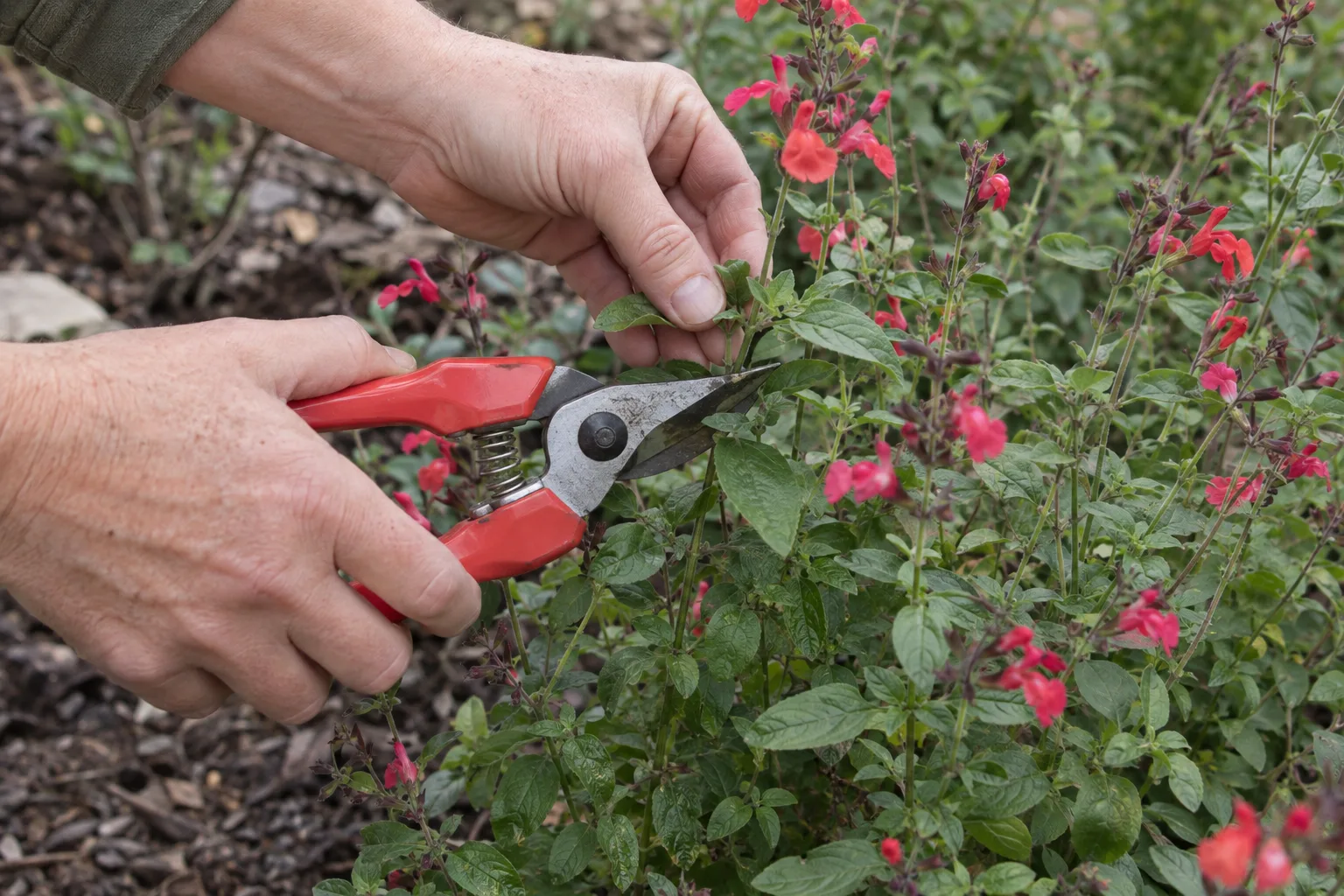
- Walk around the shrub and note dead, crossing and frost-damaged stems before cutting.
- Sharpen bypass pruners and wipe the blades with rubbing alcohol between plants.
- Cut dead stems back to green tissue. A thumbnail scratch on the bark shows green and moist wood if the stem is alive.
- Shape from the outside in, setting the outline first and then opening the center.
- Cut just above a bud, leaf pair or side branch, and never leave a stub.
- Step back every few minutes to check the shape.
- Rake up and discard the trimmings the same day.
Bypass pruners handle small stems, loppers handle thicker ones, and a pruning saw takes care of old wood on larger shrubs like yellow bells.
What should I do after pruning desert shrubs?
Water deeply, then wait before you fertilize. A slow soak that wets the soil 12 to 18 inches down encourages roots to grow deeper, which helps the plant handle the heat that arrives in April and May.
Fertilizer pushes soft, fast growth that suffers in a heat spike. Wait 3 to 4 weeks after pruning before feeding, and skip it for native shrubs that already look healthy. Our soil is alkaline, and hard irrigation water adds to that, so a slow-release product made for desert plants is a safer choice than a quick-release one.
Afternoon wilting on a warm day is normal for a few days. If a shrub shows no new growth after 4 to 6 weeks, send us photos through our contact page and we can help work out why.
What pruning mistakes hurt desert shrubs?
The most damaging mistakes are cutting at the wrong time and cutting too deep. Plants forgive a messy cut more easily than a badly timed one.
- Shearing shrubs into flat boxes. This strips the natural shape and forces weak regrowth.
- Cutting into bare wood. Many desert shrubs will not resprout from stems with no leaves or buds.
- Pruning spring-flowering plants during bloom. You lose the flowers for that season.
- Using a tropical or northern schedule. Our frost dates and summer heat differ, so timing from other regions can be off by weeks.
Desert shrub pruning calendar
| Shrub | Prune in March? | How much | Notes |
|---|---|---|---|
| Lantana | Yes | One-half to two-thirds | Wait for new shoots |
| Autumn sage | Yes | One-third to one-half | Cut above a leaf pair |
| Brittlebush | After bloom | About one-third | Keep leafy growth |
| Desert ruellia | Yes | Up to one-half | Remove frost damage |
| Yellow bells | Yes | About one-third | Blooms on new wood |
| Red bird of paradise | Yes | Dead wood only, or to the ground | Wait for green shoots |
| Parry’s penstemon | No | Spent stalks only | Late April to May |
| Desert marigold | No | Deadhead, light shear later | Peaks in spring |
| Hummingbird bush | No | Light shaping only | After bloom, around late May |
What can I plant in March while I am working in the yard?
March soil is warm enough for roots to establish before summer. Tough, low-water shrubs and perennials such as damianita (Chrysactinia mexicana), blackfoot daisy (Melampodium leucanthum) and globe mallow (Sphaeralcea ambigua) are varieties we commonly carry, though availability changes week to week and season to season.
Newly planted shrubs need regular water through their first summer. Our gardening calendars lay out what to do month by month, and our classes and events page lists current offerings.

Frequently asked questions
How can I tell if a branch is dead or dormant?
Scratch the bark with a thumbnail; green, moist tissue underneath means the branch is alive. Brown and dry all the way through means it is dead. On frost-damaged shrubs such as red bird of paradise, you may need to scratch several inches down a stem before you find green. Cut back to that point.
Do I need to seal pruning cuts on desert shrubs?
No, pruning sealants are not needed on desert shrubs. Clean cuts from sharp tools close on their own, and sealants can trap moisture against the wound. Make each cut just above a bud or side branch, leave no stubs, and let the dry air do the rest. Sanitize blades between plants if you are cutting out diseased wood.
Can I prune hard if a shrub looks overgrown?
Most of the six shrubs above tolerate a hard cut in March if live foliage or buds remain below the cut. Never cut into bare wood with no green on it. If a shrub looks sick from drought, pests or disease, do only light cleanup first and wait for healthy growth before a deeper cutback in April or May.
Why did my lantana not come back after a hard cut?
A hard cut in late spring or roots sitting in wet soil are the usual causes. Lantana cut in April or May has less time to regrow before summer heat, and heavy clay or caliche that drains slowly can rot roots over winter. Plant in well-drained soil, and make the big cut in March.
What tools do I need to prune desert shrubs?
Bypass hand pruners, loppers and a pruning saw cover nearly every cut on these shrubs. Use pruners for stems up to about 1/2 inch, loppers up to about 1 inch, and a saw beyond that. Bypass blades slice cleanly, while anvil pruners crush stems. Wear gloves and eye protection, because dry stems snap and some shrubs have thorns.
Is March pruning worth it for your yard?
Yes, if you have lantana, sage, yellow bells or red bird of paradise that looks woody or frost-burned, because a March cut sets up the growth that follows. Brittlebush and ruellia need only light shaping. If a shrub is in bloom, newly planted or already stressed, wait or remove only dead wood. A mostly native planting may need just one light trim a year. Stop by the nursery in Queen Creek and we will help you decide what to cut.