

The best time to plant these eight desert plants is April, while the soil is warm and highs stay below 100°F. Desert willow, palo verde, lantana and five others get about 6 to 8 weeks to root before 110°F heat arrives in the low desert.
Key takeaways
- April planting gives roots roughly 6 to 8 weeks to establish before daytime highs pass 110°F, usually by June.
- Set the top of the root ball 1 to 2 inches above the surrounding soil so water drains away from the crown.
- Fill each hole with water first. If it still stands after 1 hour, break through the caliche or move the plant.
- Water new plants deeply every 2 to 4 days for the first month, then stretch the interval as heat builds.
- Hold off on fertilizer for the first 60 days, because soft new growth burns in May and June heat.
Why is April a good time to plant in the Arizona low desert?
April gives new roots warm soil and moderate air, the combination they need to grow before summer. Across the Phoenix metro and the East Valley, soil is usually in the 70s by mid-month and daytime highs sit in the 80s to low 90s, well under the 110°F days that arrive by June.
Timing matters. Roots set in April have about 6 to 8 weeks to spread before the first extreme heat, while a plant set out in June spends that same stretch just trying to survive. The monsoon, roughly July through September, then adds rainfall to plants already rooting into the surrounding soil. Our gardening calendars show what else goes in the ground each month.
Which desert plants can go in the ground in April?
Eight tough choices are below, from trees to shrubs to a succulent. They are varieties we commonly carry, though availability changes week to week and season to season. You can browse our current plant selection before you visit.
Desert willow (Chilopsis linearis)
This native tree reaches 15 to 25 feet tall and 15 to 20 feet wide, wants full sun, and needs only occasional deep water once established. Trumpet-shaped flowers in pink, lavender or burgundy open from about May into September and draw hummingbirds. The drawback is litter, since it drops flowers and long seed pods and stands bare through winter. Give it room away from pools.

Palo verde (Parkinsonia species and hybrids)
Palo verdes grow 20 to 30 feet tall with a similar spread, take full sun, and need very little water after the first year or two. Bright yellow flowers cover the canopy in spring, and the green bark photosynthesizes year-round. The drawbacks are spring flower litter, thorns on some types, and a tendency to blow over in monsoon wind if overwatered into fast, shallow growth. See our desert trees for more shade options.
Texas sage (Leucophyllum frutescens)
Texas sage grows 5 to 8 feet tall and wide in full sun, with silver-gray leaves and purple flowers that often follow humid monsoon weather. Water needs are very low once established. Its drawback is sensitivity to wet soil. Overwatering causes root rot, and shearing it into a tight ball cuts down the flowers.
Red bird of paradise (Caesalpinia pulcherrima)
This shrub reaches 6 to 10 feet, likes full sun and good drainage, and carries orange-red flowers from late spring into fall. Water needs are low once the roots settle. In a cold winter it can freeze back to the ground, and it is slow to leaf out again in spring. Plant it where you will not mind a bare patch for a few weeks.
Lantana (Lantana camara and Lantana montevidensis)
Lantana runs from 1 to 4 feet tall and 3 to 6 feet wide depending on the type, blooms from spring into fall, and takes full sun with low to moderate water. Butterflies visit the flower clusters. The drawback is frost damage, and the plant turns woody and leggy unless you cut it back in late winter.
Bougainvillea (Bougainvillea hybrids)
Grown as a shrub it reaches 6 to 10 feet, and as a vine on a wall or trellis it climbs 15 to 30 feet. It takes full sun and reflected heat, and needs low water once established. Too much water or nitrogen gives you leaves instead of colorful bracts. Frost tender, thorny and fussy about root disturbance, so handle the root ball gently.
Baja ruellia (Ruellia peninsularis)
Baja ruellia grows 3 to 4 feet tall and wide, with purple tubular flowers from spring into fall. It takes full sun, though a spot with light afternoon shade keeps it looking better in the hottest exposures, and it needs low to moderate water. It can look scruffy without regular trimming. Frost will burn the tips.
Agave (Agave species)
Sizes range from compact types around 1 to 2 feet to large species 6 to 10 feet wide, so check the mature spread of the exact variety. Agaves take full sun to light shade and need very little water. The spines are sharp, so keep them away from walkways. Most species bloom once and then die, leaving pups behind.
How do I deal with caliche and alkaline soil before planting?
Test drainage first and leave the native soil mostly unamended. Fill your planting hole with water. If it has not drained within about 1 hour, a layer of caliche, the rock-hard calcium carbonate that sits anywhere from a few inches to several feet down, is probably holding water in the hole.
Break through it with a digging bar or move the plant to a better spot. Standing water rots roots fast, even on desert natives. Local soil is alkaline and our irrigation water is hard, and the plants above are adapted to both. Heavy compost in the hole can create a bathtub effect where water pools at the edge of the amended soil.
How do I plant a desert tree or shrub in April?
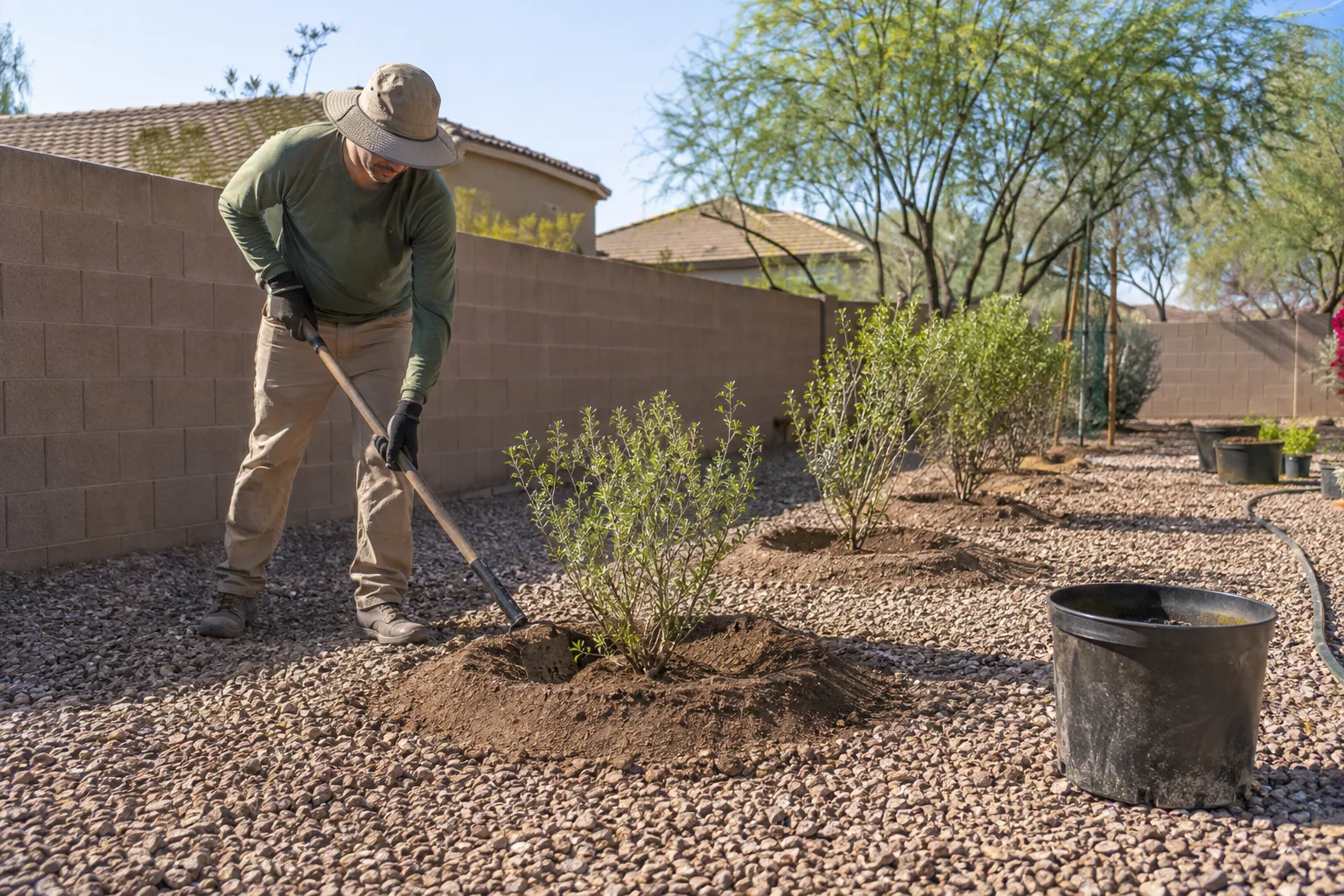
Dig wide, plant high, and backfill with the soil you took out. Follow these steps for any plant on this list.
- Dig the hole 2 to 3 times wider than the root ball and no deeper than the root ball is tall.
- Slide the plant out of its pot and loosen circling roots with your fingers. Treat bougainvillea gently and disturb its roots as little as possible.
- Set the root ball so its top sits 1 to 2 inches above the surrounding soil.
- Backfill with native soil, firming it lightly with your hands.
- Build a soil berm 4 to 6 inches tall around the planting area to hold water over the roots.
- Fill the basin with water twice on planting day so moisture soaks 12 inches or more down.
- Spread 2 to 3 inches of decomposed granite or gravel over the root zone, keeping it a few inches off the trunk or crown.
- Stake trees only if they rock in the wind, using loose ties, and remove the stakes after one growing season.

If you would like to watch planting done by hand, check our classes and events for upcoming sessions.
How often should I water new desert plants?
Water deeply and fairly often at first, then less often as roots spread. For the first 4 weeks, soak the basin every 2 to 4 days. From May into early June, stretch that to every 3 to 5 days as the soil dries more slowly at depth than at the surface.
By midsummer, shrubs and perennials usually want a deep soak every 3 to 5 days, and trees can go a little longer between soaks. Water before 8 AM to cut evaporation. During monsoon weeks with a good soaking rain, skip a watering, but do not stop altogether because storms are patchy.

Check before each watering. Push a long screwdriver or soil probe 4 to 6 inches into the soil near the root ball, and if it comes out damp, wait another day. Drip emitters work well, and a deep soak every so often helps flush salts that hard water leaves behind. Exact intervals vary with soil, exposure and plant size.
What should I hold off on in April?
Hold off on fertilizer, heavy pruning and any planting in low spots. New plants put their energy into roots first. Nitrogen in the first 60 days pushes soft leaves that wilt in May heat, so wait until fall if you feed at all.
Skip pruning beyond removing damaged growth, because bare branches expose bark to strong sun. Avoid planting agave, Texas sage or red bird of paradise where runoff collects after a storm. Wet crowns are a bigger threat to these plants than dry weather.
Frequently asked questions
How far apart should I space these plants?
Space them by mature width, not by the size of the pot. Trees like desert willow and palo verde want 15 to 20 feet from structures and each other. Texas sage, red bird of paradise and Baja ruellia need roughly 4 to 6 feet. Lantana can sit 3 to 4 feet apart.
Can I still plant these in May?
Yes, but your margin shrinks as temperatures climb past 100°F. Water more often, mulch well, and cover new plants with 30 to 40 percent shade cloth for the first 2 to 3 weeks. Agave and Texas sage handle late planting better than most because they need so little water once settled.
Will a late frost hurt April plantings?
A frost in April is uncommon here, but a cold night near 32°F can still happen in Queen Creek. Bougainvillea, red bird of paradise and lantana are the most tender on this list. Drape frost cloth over them if the forecast calls for freezing lows, and remove it in the morning.
How can I tell whether a new plant is stressed or just adjusting?
Drooping in the first 1 to 2 weeks usually points to a watering problem, so check the soil 4 to 6 inches down. Healthy transplants typically show new growth within 3 to 4 weeks. If the soil is wet and the plant still declines after 3 weeks, suspect poor drainage or root rot.
Which of these plants attract hummingbirds and butterflies?
Desert willow and red bird of paradise are the best hummingbird picks here, and lantana is a reliable butterfly nectar source. Baja ruellia draws bees and hummingbirds as well. Agave flowers feed pollinators when the plant blooms, though it usually dies afterward. Palo verde flowers feed bees in spring.
Which of these eight plants fits your yard?
Choose by space and by how much work you want to do. Desert willow and palo verde need 20 feet or more of open room, so skip them in a small yard. Bougainvillea and red bird of paradise suit warm spots, but plan to cover them in a freeze. Agave and Texas sage ask for the least water. Stop by our Queen Creek nursery and we will help you match a plant to your spot.
