

Young agaves rot more often in winter because cold soil stays wet for days or weeks while their roots work slowly. Summer heat dries the ground fast. In the Arizona low desert, agave rot peaks from December through February, and most of it is preventable.
Key takeaways
- Soil below about 55°F slows agave roots, so they take up water and fight off rot fungi more slowly from December through February.
- Rain that dries out in a few days during July can sit in cold winter soil for a week or longer.
- Turn off irrigation to in-ground agaves from November through February, because winter rain is usually enough.
- Set the crown at or slightly above soil level, and mound the planting spot 4 to 6 inches where drainage is slow.
- Plant in March through April or September through October, and avoid planting in the cold months from November through January.
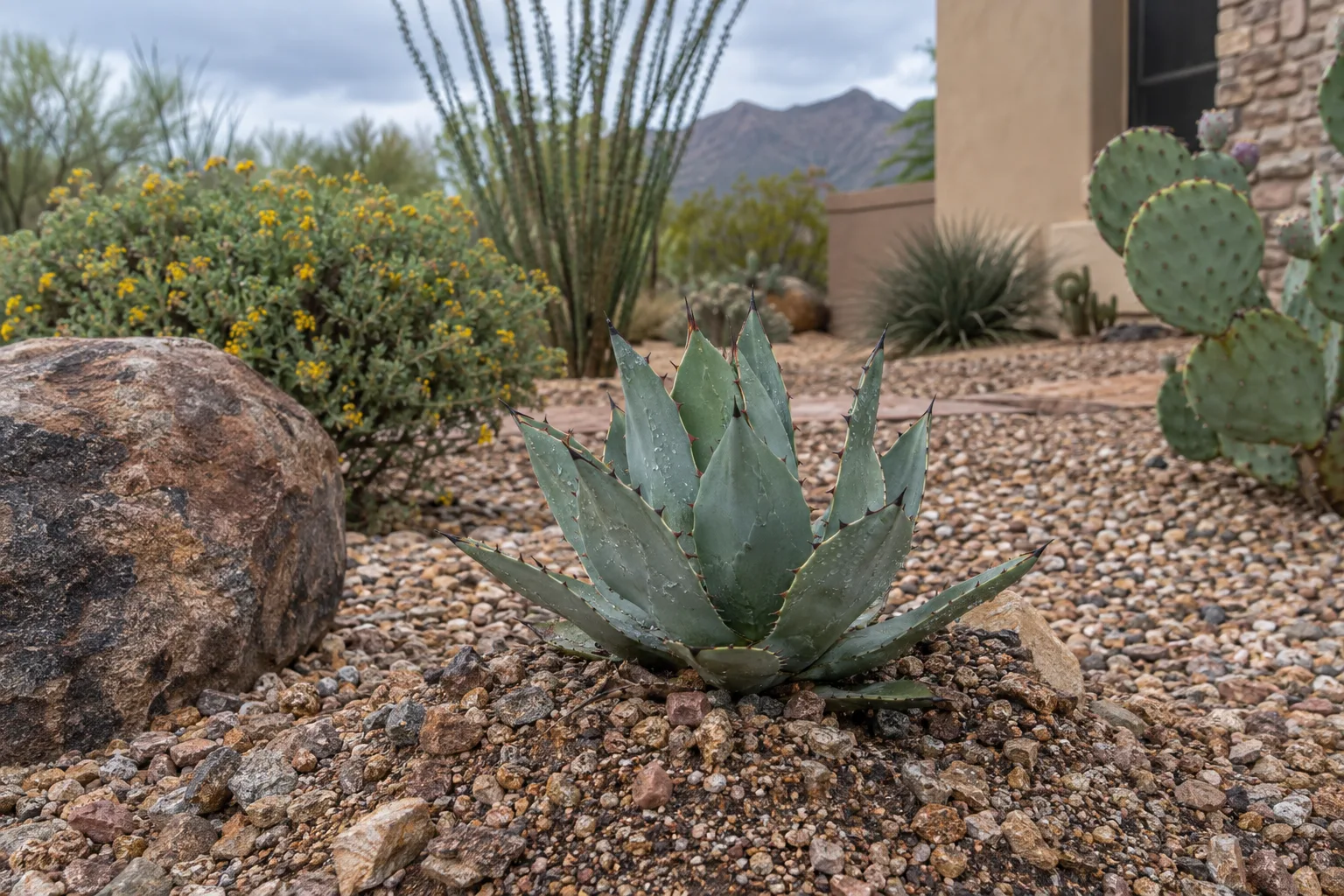
Why do young agaves rot more in winter than in summer?
Winter soil stays wet far longer, and young agave roots are too slow and shallow to cope with it. Heat is not what kills them.
In July, highs above 110°F pull moisture out of the top foot of soil within a few days of a monsoon storm. In December through February, highs sit in the 60s and 70s, nights in Queen Creek can drop to the upper 30s, and the same amount of water can linger for a week or more. Agaves under about two years old have small root systems and little stored energy, so they have less to fall back on than a large established plant.
If you are planning a low-water planting, our plant department is a good place to start looking at options that suit the low desert.
What happens to agave roots in cold, wet soil?
Roots keep working in winter, only slowly, and wet soil gives rot organisms the advantage. Water molds and fungi such as Pythium, Phytophthora and Fusarium are common in garden soils, and a warm, active root defends itself well against them. A cold root does not.
Saturated soil also holds little air, which roots need to function. Slow roots in oxygen-poor soil start to die back, and the dead tissue is an easy entry point for fungi.
The damage often stays hidden. A plant can look fine through January and February, then collapse in March or April when warming soil speeds up the fungi while the root system is already half gone. It seems to die overnight. The rot started weeks earlier.
Why does Queen Creek soil make winter rot worse?
Caliche and heavy pockets of clay hold water around roots, and a rich planting hole can trap it even more. Three soil situations cause most of the trouble.
Shallow caliche
Caliche is a hard, cement-like layer of calcium carbonate that is common across the East Valley, often starting 6 to 18 inches down. Water drains through the soil above it, hits the layer and stops. The planting hole fills like a bowl and stays saturated long after the rain ends.
Clay pockets
Clay drains slowly in any season, and cold weather slows it further. A spot that dries in a couple of days in August can stay soggy for more than a week in January.
Amended planting holes
Adding compost or potting mix to a hole seems generous, but it creates a sponge surrounded by tighter native soil. Water drains into the hole and stays there. Agaves do best in lean, gritty soil, so plant them in native soil mixed with decomposed granite or coarse sand instead.
How can I tell crown rot from root rot?
Crown rot shows at the center of the plant, while root rot shows underground and in the plant’s stability. Telling them apart tells you what went wrong.
Crown rot
The crown is the growing point at the base of the newest leaves. When water pools there in cool weather, bacteria and fungi enter the soft tissue. The center leaves pull out easily, the base is mushy and discolored, and there is often a sour or fermented smell. It moves fast. Plants set too deep or in low spots are the most exposed.
Root rot
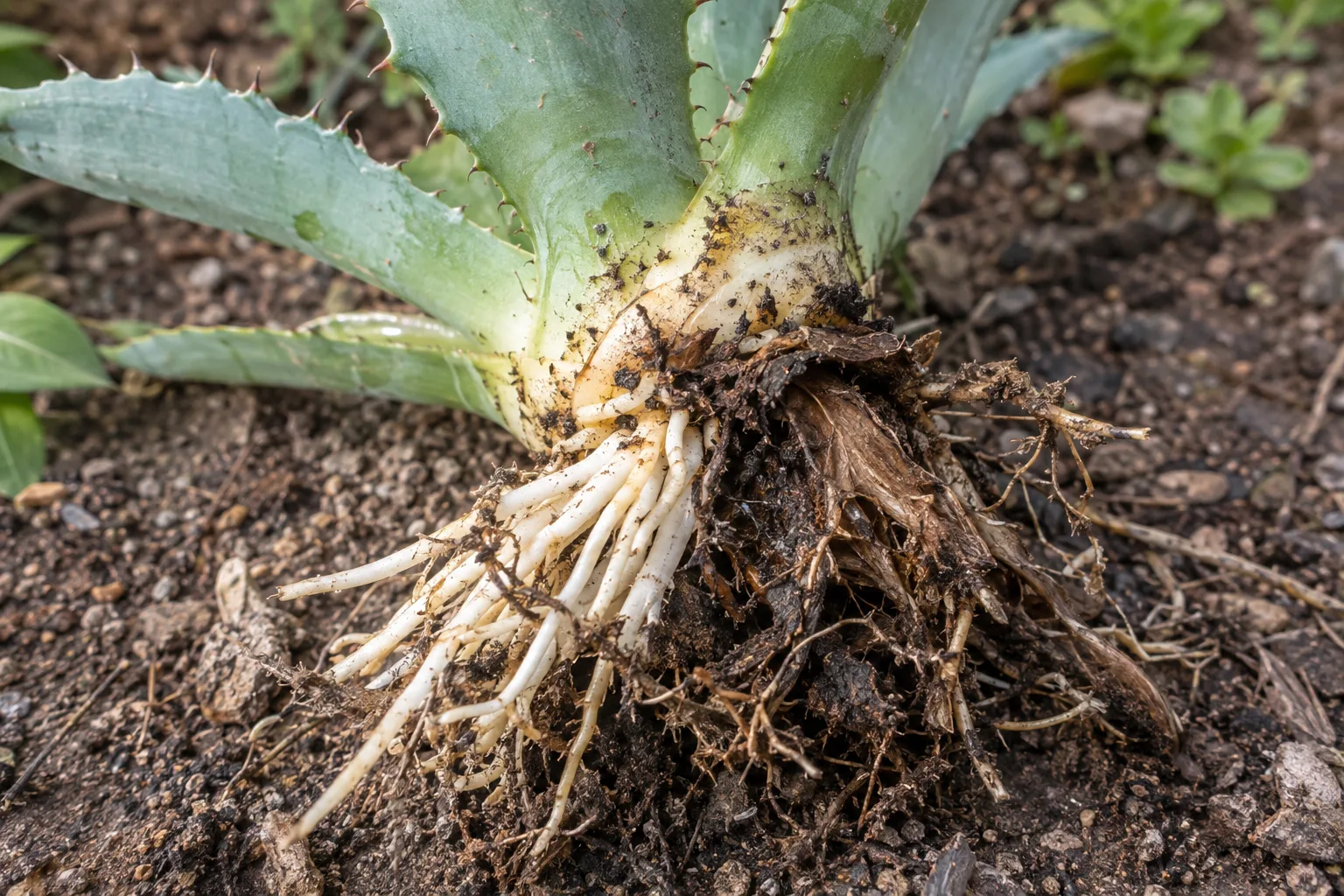
Root rot stays out of sight until it is advanced. Roots turn soft and brown, and the leaves may look normal for weeks. Eventually the plant yellows, softens or wobbles in the soil because too few healthy roots are holding it. If a young agave rocks loosely, lift it and look at the roots. Firm, light-colored roots are healthy, and soft brown or missing roots mean rot has started.
How do I prevent agave rot before winter?
Fix drainage and planting depth first, then adjust watering. Prevention works far better than rescue.
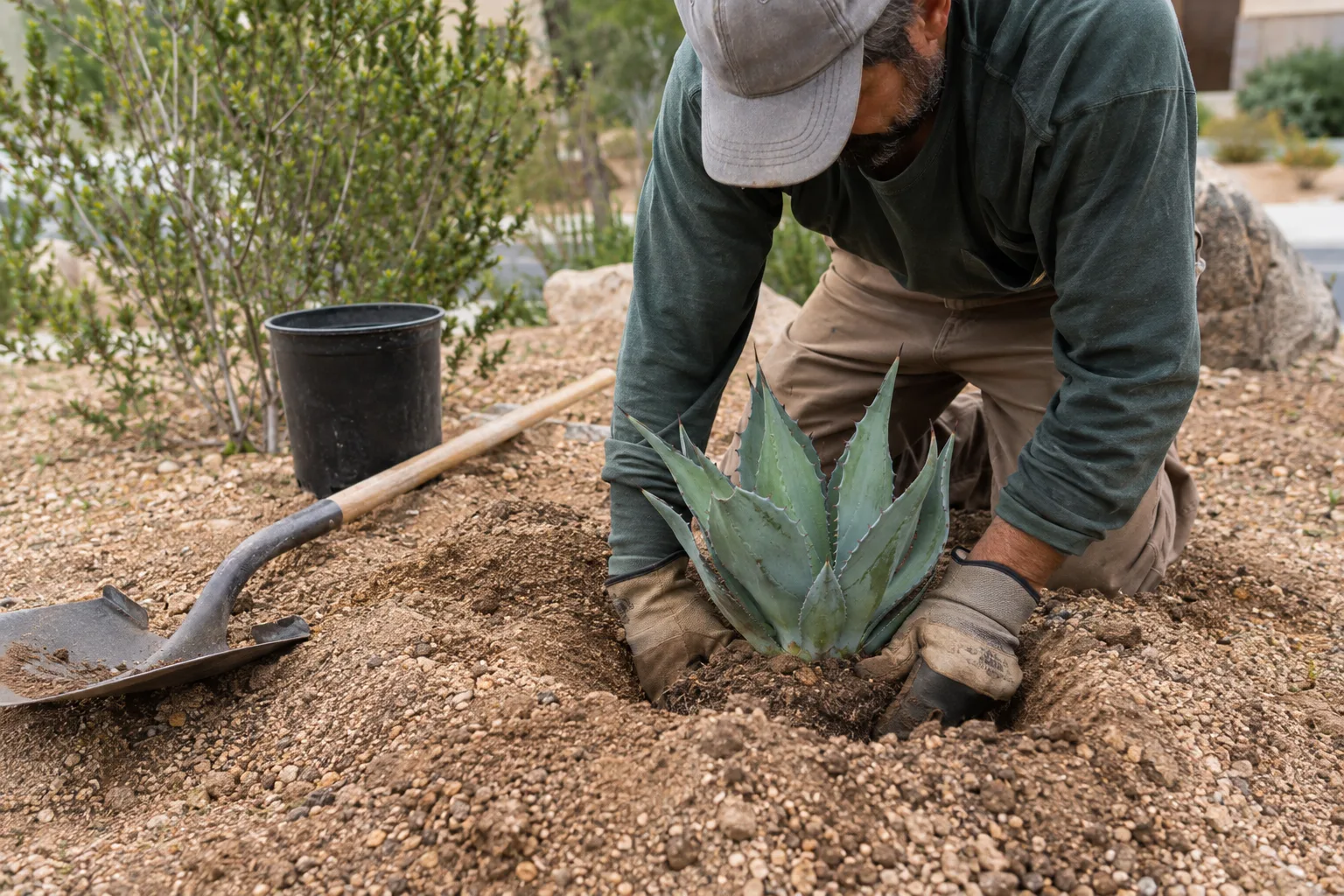
- Test drainage before planting. Fill the hole with water twice. If water is still standing after 24 hours, choose another spot or build a mound.
- Raise the planting area 4 to 6 inches above the surrounding grade where water is slow to move away.
- Backfill with native soil, or a mix of native soil and decomposed granite, instead of compost or potting mix.
- Set the crown at or slightly above the soil line so water cannot collect in the center of the rosette.
- Turn off irrigation to in-ground agaves from November through February. Check the controller, since many run a summer schedule long after the weather cools.
- Walk the yard within a day of a big storm. If water is still pooling around an agave, regrade the spot.
- Hold off on fertilizer until March, because feeding in cold months pushes soft growth that rots and freezes easily.
Young agaves in the ground rarely need supplemental water in winter, and an established plant can go the entire season without any. If fall was very dry, one deep watering in early December is the most a young plant should need.
When should I plant young agaves in Arizona?
March through April and September through October give roots the most warm weather to settle in. Planting during those windows lets roots grow into the surrounding soil before either a 110°F summer or a wet, cold winter.
November through January is the riskiest time. A freshly planted agave has disturbed roots and no reserves in its new spot, and cold wet soil adds stress on top of that. If you must plant in winter, pick the best-draining spot in the yard, keep irrigation off and check the forecast for a dry stretch first. Our gardening calendars lay out the planting seasons month by month.
Can I save an agave that has started to rot?
Sometimes, if the rot is caught early and has not reached the center of the rosette. Once it reaches the growing point, the plant is almost always lost.
For an early case, lift the plant and cut away soft, brown tissue with a clean, sharp knife until only firm, light-colored tissue remains. Let the plant dry in shade with good airflow for several days to a couple of weeks, then replant in dry, gritty soil on a mound. Do not water it until new roots have had time to form.
Fungicides are a secondary tool. If you use one, pick a product whose label lists ornamental succulents or agave, and follow the label exactly. The University of Arizona Cooperative Extension can advise on what is appropriate for your plant. Healthy pups from a failing plant can often be removed and started fresh once the cut ends have dried.
Which agaves handle wet winters best?
Species native to rocky slopes handle wet winters best, and soft-leaved types are the most at risk. Some of these are varieties we commonly carry, but availability changes week to week and season to season.
- Agave parryi (Parry’s agave) is compact, cold-hardy and adapted to thin, rocky soils.
- Agave murpheyi (Murphey’s agave) is a Sonoran Desert native of modest size that suits smaller yards.
- Agave deserti (desert agave) is a small native used to lean, fast-draining ground.
- Agave weberi (Weber’s agave) is large and forgiving of average soil, but still needs drainage.
- Agave americana (century plant) is big and tough once established, though young plants still need a dry winter spot.
Agave attenuata (foxtail agave) is popular for its soft, spineless leaves, but those leaves lack the thick protective surface of hardier species. It rots more easily in cold, wet soil and is damaged by hard frost. Plant it in your best-drained spot and cover it with frost cloth when a freeze is forecast.

Frequently asked questions
Do young agaves need frost protection in Queen Creek?
Cold-hardy species rarely need it, but soft-leaved types such as foxtail agave do. Cover them with frost cloth when a freeze is forecast, especially after rain, because wet tissue freezing is damaged faster than dry tissue. Remove the cloth the next morning so moisture does not stay trapped against the leaves.
How long should I wait before replanting where an agave rotted?
Let the spot dry for at least two to four weeks, longer if winter rain continues. Dig in coarse sand or decomposed granite, or build a mound, before planting again. If a second plant fails in the same hole, the drainage problem remains, so change the grade or choose a different location.
Can agaves in pots rot in winter?
Yes, pots rot too when the soil stays soggy. Use a gritty cactus mix and a container with drainage holes, and raise it off saucers so water escapes. Browse our pottery and planters for options. Move pots under an overhang during long rainy stretches.
Does decomposed granite mulch protect agaves from rot?
A 1 to 2 inch layer of decomposed granite helps shed water from the soil surface, but keep it a few inches back from the crown. Piled against the base, mulch holds moisture against the leaves and invites rot. Mulch cannot fix a planting hole that drains poorly, so check drainage first.
Should I fertilize young agaves in fall or winter?
No, hold off until March at the earliest. Fertilizer pushes soft new growth that cold and rot damage easily, and agaves need little feeding anyway. A light spring application, once nights stay above about 50°F, is plenty. For more on timing, check our classes and events page for gardening workshops.
Are young agaves worth the winter risk?
Yes, if you can give them a mounded, gritty planting spot and keep the irrigation off from November through February. Established agaves handle summers above 110°F with very little care. Skip them, or grow them in pots, if your yard holds water after storms, if the sprinklers cannot be zoned separately, or if you only plant in December. Stop by our nursery in Queen Creek and we will help you match a planting spot to the right agave.
